Quick Answer
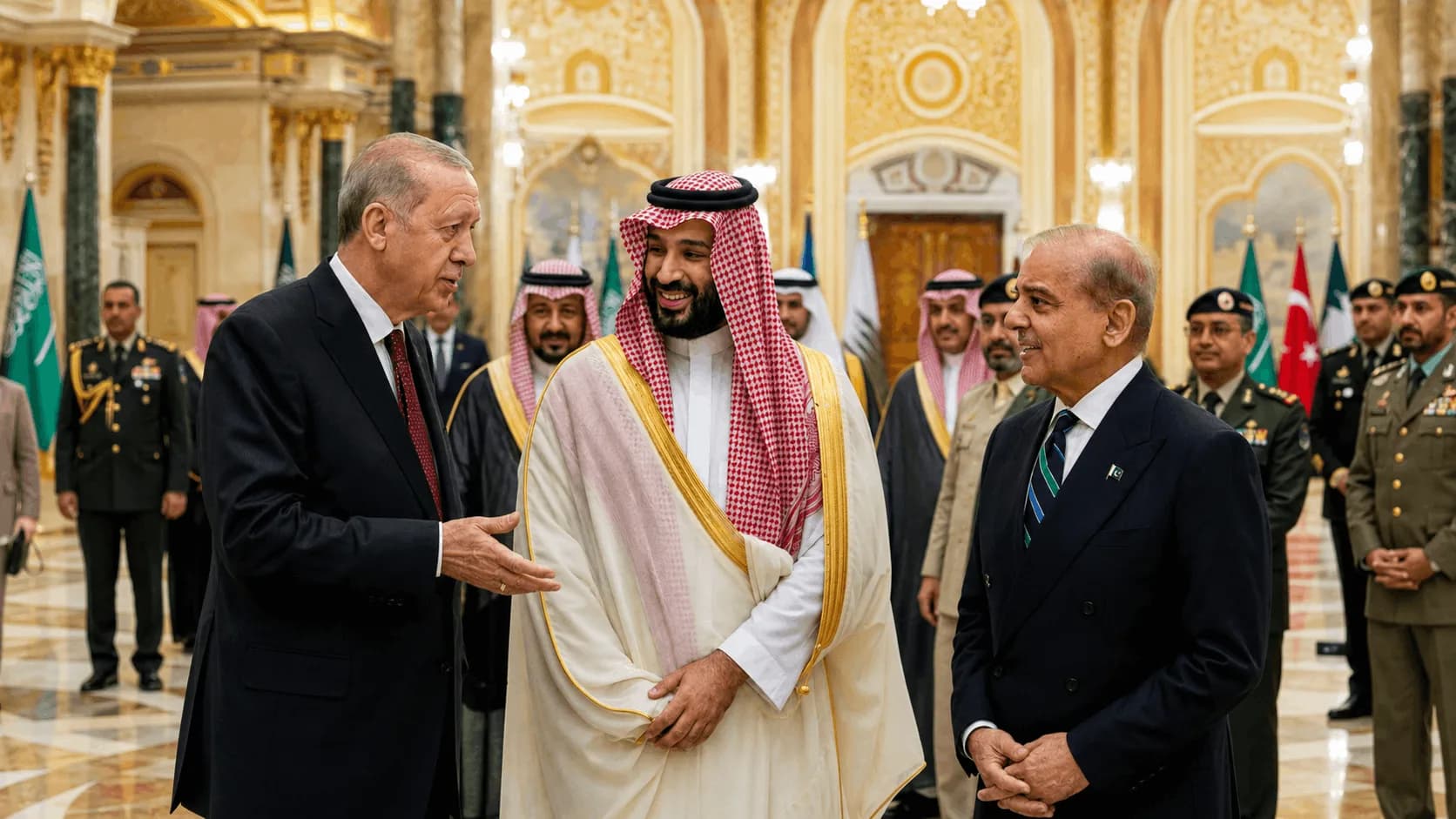
The Mecca Joint Defence Agreement, signed by Pakistan, Saudi Arabia and Turkiye in Makkah on August 7, 2026, says that an armed attack on one of the three countries will be treated as an attack on all. The agreement aims to strengthen collective deterrence and defence cooperation, while officials say it is defensive and not directed against any specific country.
What makes this agreement important is what each country brings to it. Pakistan brings military experience and strategic deterrence, Saudi Arabia brings economic strength and regional influence, while Turkiye adds NATO experience and a growing defence industry.
The pact does not feel like three countries suddenly becoming partners. It looks more like long-standing relationships finally being given a formal structure.
Pakistan Brings Military Experience and Strategic Deterrence
Pakistan’s role in the agreement deserves particular attention.
Pakistan is the only Muslim-majority country known to possess nuclear weapons. The Bulletin of the Atomic Scientists estimated in 2025 that Pakistan had a stockpile of around 170 nuclear warheads.
That does not mean the Makkah pact automatically provides a nuclear security guarantee. Officials have not announced such an arrangement. Still, Pakistan’s strategic capability gives it an important position in any serious regional defence partnership.
Its security relationship with Saudi Arabia is also not new.
Pakistan and Saudi Arabia have maintained defence ties for decades. Brookings notes that their cooperation builds on a major 1982 defence protocol, while Pakistani forces have been deployed in Saudi Arabia since the 1970s, at times numbering more than 10,000 personnel.
Pakistan also sent thousands of troops to Saudi Arabia during the 1990–91 Gulf War, while military training, advisory support and joint cooperation continued in later years.
Another sign of that trust can be seen in the Islamic Military Counter Terrorism Coalition. Former Pakistan Army chief General Raheel Sharif has served as the military commander of the Saudi-based coalition since 2017. The IMCTC currently describes itself as a 43-nation coalition.
Pakistan, therefore, is not entering this agreement as an unfamiliar defence partner. It brings decades of military cooperation and experience.
Saudi Arabia Brings Economic Strength and Regional Influence
Saudi Arabia brings a different kind of strength.
As the home of Makkah and Madinah and custodian of Islam’s two holiest mosques, the kingdom holds deep religious importance across the Muslim world. It also has the financial resources needed to support major defence programmes and long-term investment.
According to the Stockholm International Peace Research Institute, Saudi Arabia spent an estimated $83.2 billion on its military in 2025, making it the largest military spender in the Middle East that year.
But Saudi Arabia is not focused only on buying military equipment from abroad.
Under Vision 2030, the kingdom is working to build its own defence industry. Saudi Arabia’s General Authority for Military Industries says the country aims to localise more than 50% of spending on military equipment and services by 2030.
This gives Saudi Arabia an important role in the partnership. Its economic strength can support investment, defence production and technology cooperation with both Pakistan and Turkiye.
Turkiye Adds Military Scale and Defence Technology
Turkiye adds another major piece to the partnership.
NATO itself describes Turkiye as having the alliance’s second-largest army. The country has also developed a strong domestic defence industry and has expanded its military technology and equipment production in recent years.
SIPRI estimated Turkiye’s military spending at $30 billion in 2025 and said investment in its domestic arms industry was a major reason behind the increase.
President Recep Tayyip Erdogan has said the Makkah agreement is based on collective deterrence and reaffirms the right of defence recognised under Article 51 of the United Nations Charter.
He also said the agreement targets no particular country and remains open to other friendly countries seeking peace and stability in the region.
This gives the pact more than military strength alone. Turkiye brings NATO experience, defence technology and knowledge of building a large domestic military industry.
Why the Makkah Defence Pact Could Matter Beyond Three Countries
The most important part of the agreement is simple: an armed attack on Pakistan, Saudi Arabia or Turkiye would be treated as an attack on all three.
Turkish Foreign Minister Hakan Fidan compared this principle to NATO’s Article 5. However, he also explained that the three countries would consult each other to decide what type and level of support should be provided if a member were attacked.
That distinction matters. The agreement creates a strong political commitment, but some practical military details still need to be developed.
The pact may also grow beyond its current three members.
Turkiye has said other regional countries could eventually join, with Egypt mentioned as one possible future participant. Reuters also reported that a ministerial committee will be formed and a general secretariat will be based in Saudi Arabia. Operational details are expected to be discussed in future meetings.
The agreement also does not replace the countries’ existing alliances or international partnerships.
Stronger Together, but the Real Test Comes Next
This is why I believe the Makkah pact matters.
Pakistan brings strategic deterrence and decades of military experience. Saudi Arabia brings financial strength, religious importance and regional influence. Turkiye brings NATO experience, military scale and a developed defence industry.
But signing an agreement is only the first step.
The real test will be whether the three countries can turn their promises into practical cooperation through joint planning, defence production, technology sharing and effective consultation during a crisis.
The symbolism of signing the agreement in Makkah is powerful, but its long-term value will depend on what happens next.
Each country is already influential on its own. Together, they now have a formal framework that could turn years of cooperation into a stronger and more organised security partnership.
If the agreement remains focused on deterrence, stability and cooperation rather than confrontation, it could become an important new security structure for the wider Muslim world.
FAQs
1. What is the Makkah Defence Pact?
The Makkah Defence Pact is an agreement between Pakistan, Saudi Arabia and Turkiye aimed at strengthening collective defence and security cooperation.
2. What happens if one member country is attacked?
Under the agreement, an armed attack on one of the three countries would be treated as an attack on all three.
3. When was the Makkah Pact signed?
Pakistan, Saudi Arabia and Turkiye signed the defence agreement in Makkah on August 7, 2026.
4. What does Pakistan bring to the defence partnership?
Pakistan brings military experience, long-standing defence cooperation and strategic deterrence as the Muslim world’s only nuclear-armed state.
5. What is Saudi Arabia’s role in the pact?
Saudi Arabia brings economic strength, regional influence, major defence spending and growing investment in its domestic military industry.
6. What does Turkiye contribute to the agreement?
Turkiye contributes NATO experience, a large military and a well-developed defence industry, including growing expertise in military technology.
7. Can other countries join the Makkah Pact?
Officials have indicated that the agreement could remain open to other friendly regional countries, although any future membership would require further discussions.
Topics in this story
Article Details
Category: News
Published:
Author: Rabia
More Stories