
Program details such as subsidy phases, coverage numbers, and eligibility criteria are periodically updated by the Government of Punjab — always cross-check current status on the official PSER portal.
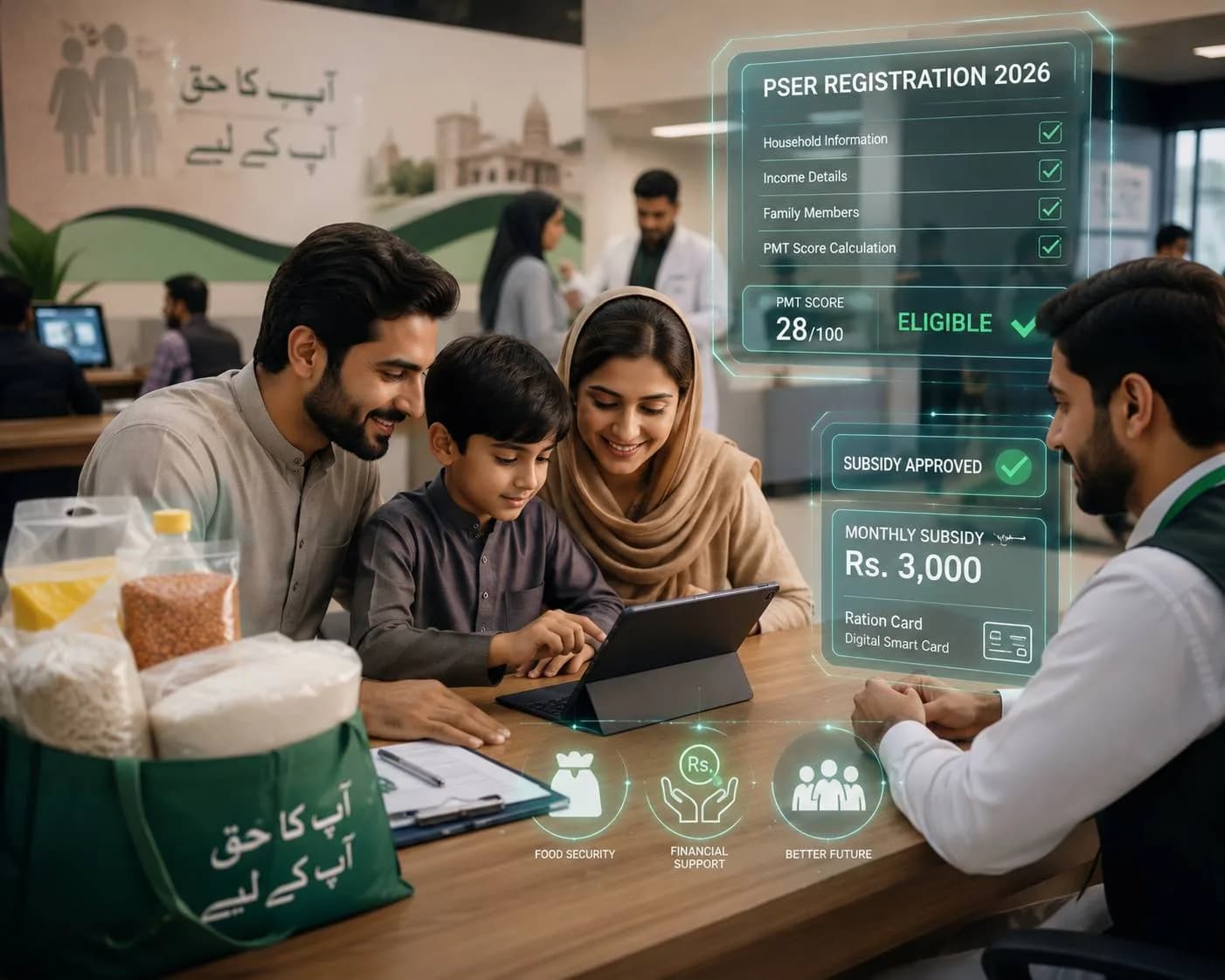
Punjab Ration Card Program PSER registration is the first — and honestly the only — step that decides whether your family gets the Rs. 3,000 monthly ration subsidy or not. A lot of people apply directly for the "Ration Card" thinking it's a separate form, get confused when nothing happens, and give up. That confusion is exactly what this guide clears up: what PSER actually is, who qualifies, how to register the right way, and how to check your status without falling for a fake "checker" website.
Table of Contents
What Is PSER Registration?
PSER vs. CM Punjab Ration Card
Who Qualifies? Eligibility Criteria
Documents You Need
How to Register (Online & Offline)
How to Check Your Status
Monthly Subsidy — Amount & Usage
Why Applications Get Rejected
Safety Notes
FAQs
What Is PSER Registration?
PSER (Punjab Socio-Economic Registry) is a household database run by the Government of Punjab. It records your family's income, household size, employment, and living conditions, then uses that data to calculate something called a PMT (Proxy Means Test) score — basically a poverty score. Your PMT score is what determines whether you're placed into the pool of families eligible for the Ration Card and several other Punjab welfare schemes.
It's worth being clear here: PSER by itself doesn't give you money. It's the entry gate. Think of it like a job application form — filling it out doesn't guarantee the job, but you can't get hired without it.
PSER isn't a one-off form either — it's the single unified database now sitting behind almost every Punjab-specific welfare program. That matters practically, because one accurate registration can open the door to more than just the Ration Card, including health cards, education stipends, and livestock support, without filling out a separate application for each one.
PSER vs. CM Punjab Ration Card
Feature PSER Ration Card What it is Data registry/survey Monthly subsidy program Mandatory? Yes, for any welfare benefit Applied for separately using PSER data What you get A PMT score & household profile Rs. 3,000/month digital card Where used PSER portal or door-to-door survey Utility stores & registered kiryana shops
Who Qualifies? Eligibility Criteria
Based on the criteria the Punjab government has consistently applied, here's the checklist:
Criteria Requirement Residency Permanent resident of Punjab PSER Status Registered and verified CNIC Valid, NADRA-issued Mobile Number Registered on applicant's own CNIC Monthly Income Below Rs. 50,000 PMT Score Below 35 Employment Not a government employee Applicants Only one person per household
Statistic worth knowing: the program's first rollout phase alone covered over 1.25 million households across Punjab, with coverage expanding in later phases — which tells you two things: the scale is genuinely large, and competition for accurate data entry matters, because incomplete records are the easiest way to get skipped.
Documents You Need
Keep these ready before you start — this alone saves most people a second trip:
Original CNIC (not a photocopy)
Mobile number registered on your own name
Proof of residence in Punjab
Passport-size photograph
Proof of household income, if requested
There is no fee at any stage of this process — none. Applicants sometimes assume a "processing charge" is normal because private agents demand one, but nothing in the official process involves payment. If someone asks for money at a registration center, that's a red flag, not standard procedure.
How to Register (Online & Offline)
Online, through the PSER portal:
Go to pser.punjab.gov
Enter your full name, CNIC, and mobile number
Select your district and tehsil
Create a password (save it — you'll need it to check status later)
Fill in household and income details carefully
Review everything before submitting
Save your confirmation message or reference number
Offline, at Union Council or e-Khidmat Markaz:
Visit with your original CNIC and mobile number. A staff member will fill the form for you — just make sure you double-check the details before it's submitted, since you're still responsible for accuracy even when someone else types it in.
Door-to-door survey: In several union councils, government teams are visiting homes directly, working under the supervision of the local Deputy Commissioner's office. This phase exists specifically for households without easy internet access or digital literacy, so nobody is excluded simply because they can't use the online portal. If your area hasn't been visited yet, don't wait indefinitely — visit your nearest registration center yourself instead of assuming a team will eventually knock on your door.
Pro Tip: The single biggest reason applications stall isn't eligibility — it's a mismatched mobile number. Before you register, confirm your SIM is registered under your own CNIC, not a family member's. This one check prevents most delays.
How to Check Your Status
Portal login — log back in with your CNIC and password to view your dashboard
Helpline — call 0800-02345 for status updates or issues
SMS check — different sources list different short codes for this. That inconsistency is exactly why you shouldn't trust the first number you find on Google.
Pro Tip: Never send your CNIC to a status-check number you found on an unfamiliar website. Confirm the active shortcode by calling the official helpline first — this is the single easiest way to avoid a data-harvesting scam.
Monthly Subsidy — Amount & Usage
Eligible households receive Rs. 3,000 per month, credited to a digital smart card. It's meant to be spent on basic groceries — flour, sugar, ghee, pulses, and rice — at government-authorized utility stores and registered kiryana shops that use biometric verification. The subsidy typically doesn't carry over month to month, so it's designed to be used within the cycle it's issued in.
The biometric step matters more than it sounds. It confirms the person collecting the subsidy is the actual registered beneficiary, not someone else using their card or CNIC details — a control that earlier, non-digital ration systems in Pakistan struggled with for years.
Why Applications Get Rejected
Issue Fix Mobile number not on applicant's CNIC Re-register SIM under your own CNIC Incomplete household data Log in and update the missing fields PMT score above 35 Re-check that income/asset details were entered accurately More than one applicant per family Only the head of household should apply Applicant is a government employee Not eligible under current rules
Safety Notes
Registration and status checks are free — full stop. If anyone offers to "guarantee approval" for a fee, that's not a real service. Only use the official portal or the verified helpline number, and be cautious of look-alike websites that copy the government's design but aren't actually connected to it. A simple habit protects you here: before entering your CNIC anywhere, check the web address matches the official government domain, and never share your PSER password with anyone claiming to "help" you check status faster.
Final Takeaway
The Punjab Ration Card only exists on the other side of an accurate PSER registration — not around it. Get your household data right, keep your CNIC and mobile number matched, and confirm your status through the official portal or the 0800-02345 helpline instead of random SMS numbers online.
Ready to check your eligibility? Start your PSER registration today at the official portal, and keep this guide handy for every step after.
Frequently Asked Questions
1. Is PSER registration compulsory for everyone? It's not compulsory for every citizen, but it's mandatory if you want to be considered for the Ration Card or any linked Punjab welfare program.
2. What documents are required for PSER registration? A valid CNIC, a mobile number registered on that same CNIC, proof of residence in Punjab, and a passport-size photo.
3. How is the PMT score calculated? It's based on household income, assets, family size, and general living conditions collected during registration or the door-to-door survey.
4. Can I update my PSER information after submitting? Yes. You can log back into the portal to correct or update household details if your situation changes.
5. What is the difference between the Ration Card and a Relief Package? The Ration Card is an ongoing monthly subsidy (Rs. 3,000/month), while relief packages, like the Ramzan package, are usually one-time or seasonal payments tied to specific events.
6. How many family members can apply from one household? Only one — applications from multiple members of the same household are typically rejected.
7. Is there any fee for PSER or Ration Card registration? No. The entire process is free, from registration to card issuance.
Topics in this story
Article Details
Category: Goverments
Published:
Updated:
Author: Fiza
More Stories