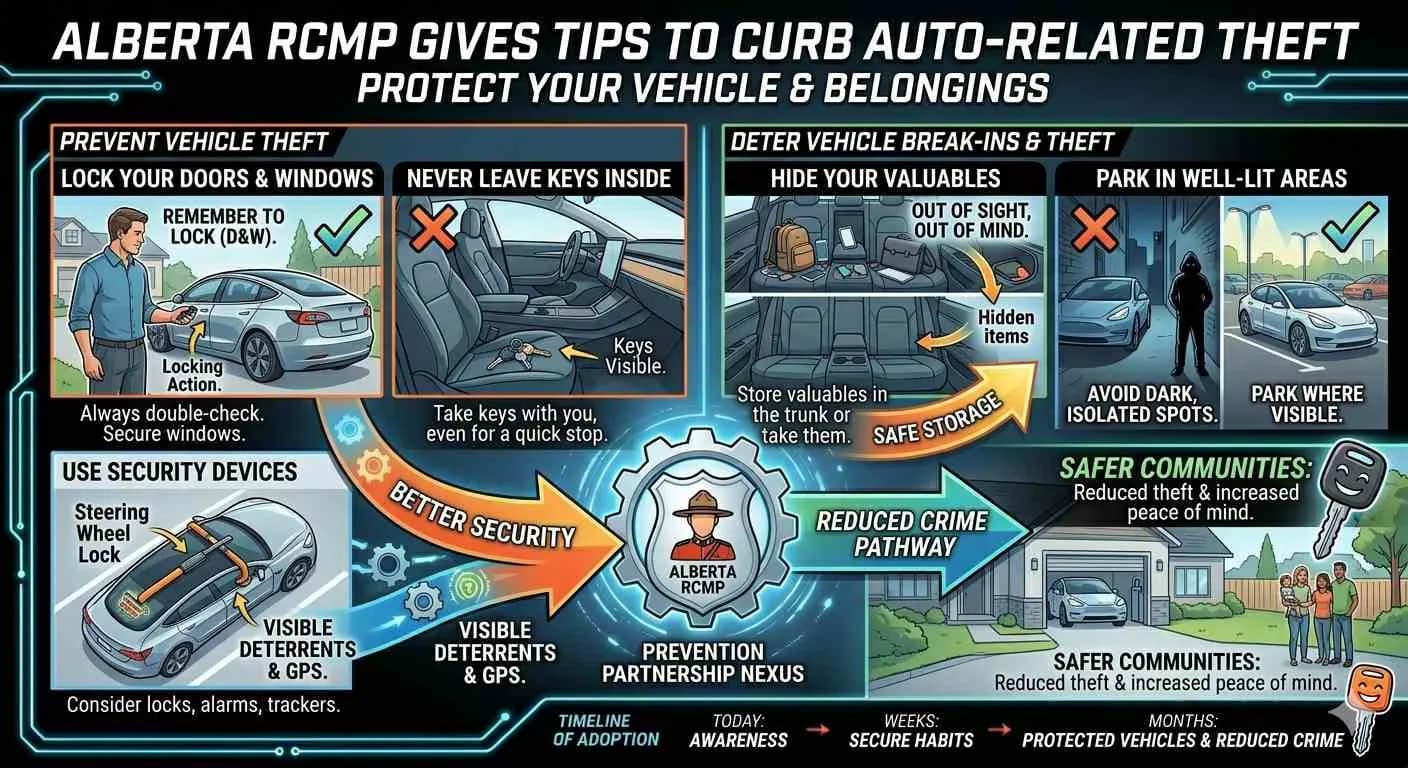
What if a few simple habits could make the difference between keeping your car safe or becoming the next theft statistic? That is the message coming from Alberta RCMP as authorities push updated guidance to curb growing auto-related theft incidents across communities.
Rising Auto Theft Prompts New Public Guidance
Law enforcement in Alberta has highlighted increasing concerns around vehicle theft and related crimes. RCMP officials are now encouraging residents to adopt stronger preventive measures to reduce risk exposure.
In many cases, vehicle theft is not a sophisticated operation. Opportunistic criminals often rely on unlocked doors, visible valuables, or unattended vehicles running briefly in driveways.
The advisory focuses on simple but effective precautions that can significantly lower the chances of becoming a target.
Why Vehicle Theft Remains a Persistent Issue
Auto theft continues to be driven by a mix of opportunistic crime and organized activity. Modern vehicles with keyless entry systems and electronic ignition have created new vulnerabilities that criminals exploit.
From experience, one common mistake people make is assuming newer cars are automatically safer. While they include advanced security features, they can still be compromised through signal relay attacks or neglected physical security habits.
For families, the impact goes beyond financial loss. Losing a vehicle can disrupt daily routines such as school drop-offs, work commutes, and medical appointments. It is similar to losing a primary utility in the household, where everything from mobility to scheduling becomes unstable.
Key Tips Recommended by Alberta RCMP
Authorities are encouraging residents to adopt layered security habits rather than relying on a single preventive measure.
| Prevention Tip | Purpose |
|---|---|
| Lock all doors and windows | Eliminates easy access for opportunistic theft |
| Avoid leaving keys in vehicles | Prevents easy ignition-based theft |
| Park in well-lit areas | Reduces chances of unnoticed tampering |
| Do not leave valuables visible | Removes incentive for break-ins |
Technology and Theft Prevention Challenges
While modern vehicles come with advanced security systems, criminals continue to adapt. Signal interception devices and relay attacks have made keyless entry systems a growing concern.
In many cases, physical security habits remain the most reliable defense. Simple steps such as steering wheel locks or secure parking locations still play an important role in reducing theft risk.
Authorities also encourage residents to consider vehicle tracking systems, which can significantly improve recovery chances in case of theft.
Community Awareness Plays a Key Role
RCMP emphasizes that community awareness is just as important as individual precautions. Reporting suspicious activity and sharing safety practices can help reduce crime rates in residential areas.
Neighborhood vigilance programs and improved lighting infrastructure are also being encouraged in high-risk areas.
Closing Thought
Auto theft prevention is not dependent on a single solution but a combination of awareness, habits, and simple security measures. Alberta RCMP’s guidance highlights how small behavioral changes can significantly reduce risk and help protect both vehicles and daily routines across communities.
Quick Facts Box
- Auto theft remains a growing concern in Alberta
- Most thefts involve opportunistic access to unsecured vehicles
- Modern keyless systems can still be vulnerable to attacks
- Simple preventive habits significantly reduce theft risk
Article Details
Category: Auto
Published:
Author: Muhammad Sheikh
More Stories