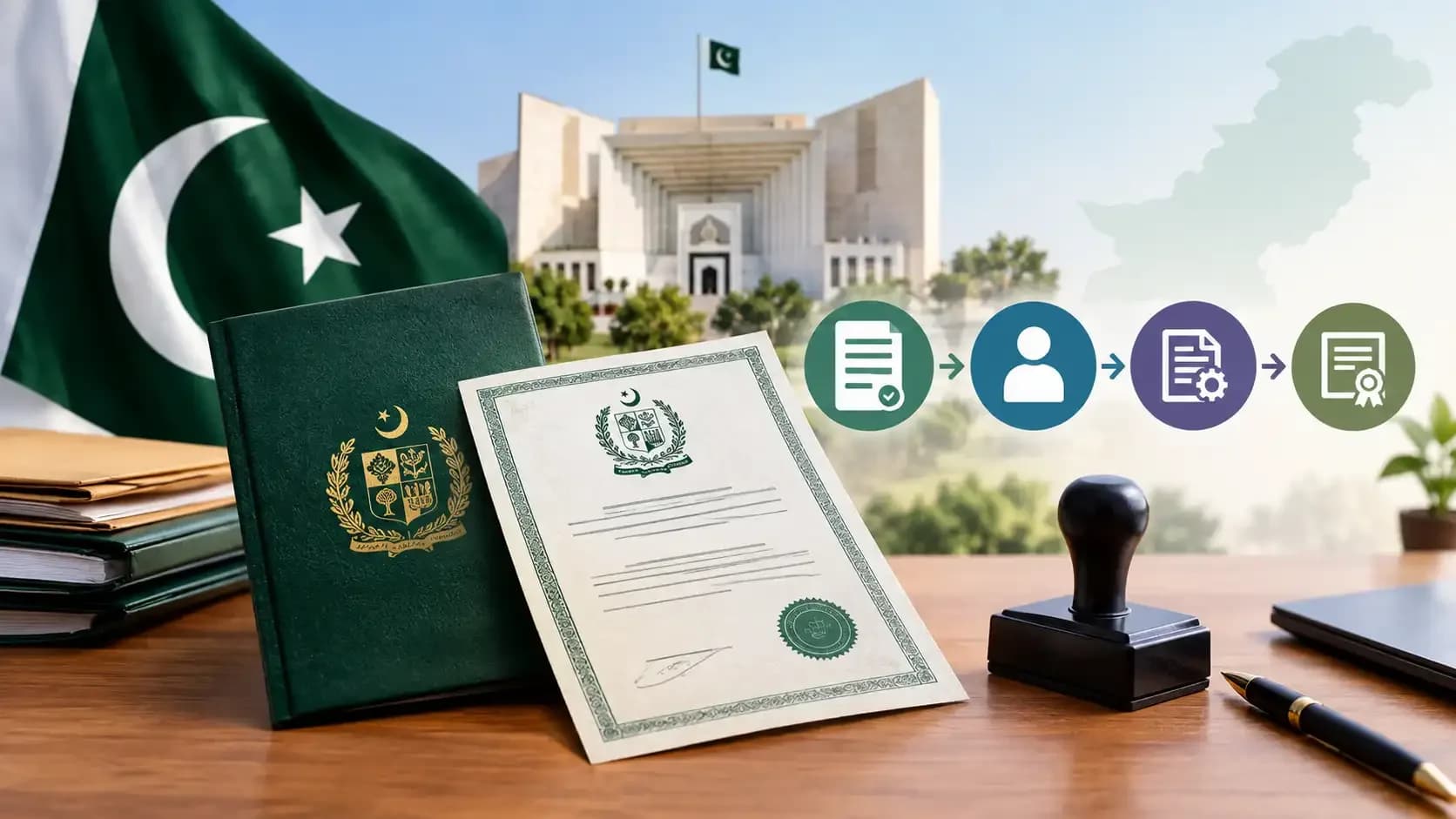
Almost every government job advertisement in Pakistan ends with the same line: "domicile of the relevant province/region is required." Without a domicile certificate, your application is rejected before anyone reads your qualifications, your test score, or your experience.
The same goes for a Permanent Residence Certificate (PRC) if you're applying under the Islamabad quota or for certain federal posts.
To see how domicile fits into the full government hiring process, read the complete guide to government jobs in Pakistan.
This guide explains what a domicile certificate is, why it matters for government recruitment, what documents you need, how much it costs, and the step-by-step process to get one province by province.
What Is a Domicile Certificate?
A domicile certificate is an official document issued by the district administration (Deputy Commissioner / Assistant Commissioner office) that certifies your permanent residence in a specific district and province. It is not the same as your CNIC address your CNIC shows your current address, but your domicile proves your permanent territorial connection to a province or region.
In government recruitment, your domicile determines your provincial quota the share of seats reserved for candidates from each province. Federal posts are distributed roughly by population: Punjab 50%, Sindh (Rural) 11.4%, Sindh (Urban) 7.6%, KP 11.5%, Balochistan 6%, and so on. You compete within your domicile's quota, not against the entire country.
For the full quota breakdown and how relaxation rules work alongside domicile, see age relaxation and quota rules explained.
What Is a PRC (Permanent Residence Certificate)?
A Permanent Residence Certificate (PRC) serves a similar purpose but applies specifically to residents of Islamabad Capital Territory (ICT). Since Islamabad is not a province, it has its own residency document. A PRC is also required for candidates applying under the ICT / Federal Capital quota in FPSC and other federal recruitments.
The PRC is issued by the Deputy Commissioner's office, Islamabad, and the process is broadly similar to a provincial domicile you prove long-term residence through documents, pay a fee, and receive the certificate.
Why Every Government Job Applicant Needs a Domicile
The domicile certificate is not optional it's a hard requirement at multiple stages of government recruitment:
Application stage: most commissions (FPSC, PPSC, SPSC, KPPSC, BPSC) require you to upload or submit your domicile at the time of application. Without it, your form is incomplete.
Not sure which commission applies to your post? See FPSC vs PPSC vs NTS vs PTS - which test for which job.
Quota allocation: your domicile determines which provincial quota you fall under. Applying under the wrong quota or without a domicile gets your application cancelled.
Document verification: even if you clear the written test and interview, your original domicile is verified before final appointment. A missing or mismatched domicile at this stage means disqualification.
Scholarships and admissions: beyond government jobs, many HEC scholarships, public university merit seats, and provincial quota seats in medical and engineering colleges also require a domicile.
For a complete overview of how government hiring and quota allocation works, read the complete guide to government jobs in Pakistan.
Domicile vs PRC vs Other Residency Documents
Applicants often confuse the domicile with other documents. Here's how they differ:
Document | Issued by | Proves | Used for |
Domicile Certificate | DC/AC office (provincial) | Permanent residence in a province/district | Govt jobs, scholarships, admissions quota |
PRC | DC office, Islamabad | Permanent residence in ICT | ICT quota in federal recruitment |
CNIC | NADRA | Identity + current address | Identity verification (not quota) |
Fard | Patwari / Revenue dept | Land/family record in a district | Supporting document for domicile |
Local Certificate | Nazim / Councillor | Residence in a union council | Supporting document, not standalone |
The key distinction: your CNIC address does not determine your quota. A person living in Lahore with a Peshawar domicile applies under the KP quota, not Punjab.
Documents Required for a Domicile Certificate
Requirements vary slightly by province, but the core set is consistent across Pakistan:
CNIC (original + photocopy) of the applicant. For minors, Form-B.
Father's CNIC (original + photocopy).
Two passport-size photographs (recent, white background).
Matric certificate or school-leaving certificate - this is the primary proof of district connection, as it shows the school/board from your area.
Affidavit on stamp paper - a sworn statement declaring your permanent residence in the district. Usually Rs 50–100 stamp paper, notarised.
Two witnesses with CNICs - residents of the same district who can attest your permanent residence.
Property document, utility bill or rent agreement - at least one proof of residential connection to the district.
Fard (family certificate) from Patwari - required in Punjab and parts of KP. Proves your family's record in the revenue register of that district.
Note for women after marriage: in most provinces, a married woman can retain her father's domicile district or apply for a new domicile in her husband's district. The choice depends on which quota she wants to apply under.
How to Get a Domicile Certificate - Province by Province
The issuing authority is the Deputy Commissioner (DC) or Assistant Commissioner (AC) office of your district. The process is similar across provinces, with minor variations:
Punjab
Punjab has moved the domicile process online through the e-Stamping / Punjab PITB portal in several districts, though many still accept walk-in applications.
Visit the AC/DC office of your district or apply online (where available).
Submit the application form with all documents listed above.
Pay the government fee (Rs 100–200 in most districts).
A revenue officer or Patwari may verify your residential claim.
Certificate is issued within 7–15 working days in most districts.
Sindh
Apply at the Mukhtiarkar or AC office of your taluka/district.
Submit documents including a local residential certificate from the area councillor or Nazim.
Fee: Rs 100–250 depending on the district.
Processing time: 10–20 working days.
Sindh domicile applications distinguish between Sindh (Urban) and Sindh (Rural) and your domicile district determines which sub-quota you fall under in federal jobs.
Khyber Pakhtunkhwa
Apply at the DC/AC office of your district.
KP requires a Fard from the Patwari in addition to standard documents.
Fee: Rs 100–150.
Processing time: 7–15 working days.
For merged areas (former FATA), domicile issuance follows a slightly different administrative process through the relevant AC office, and candidates from merged areas receive additional age relaxation and reserved quota in federal posts.
Balochistan
Apply at the DC office of your district.
Standard documents apply; tribal/jirga certificate may be required in some areas.
Fee: Rs 50–150.
Processing time: 10–20 working days.
Islamabad (PRC)
Apply at the DC office, Islamabad.
Proof of long-term residence required utility bills, property documents, or a certificate from the area magistrate.
Fee: Rs 200–500.
Processing time: 15–30 working days.
PRC applicants generally need to demonstrate a longer history of continuous residence in Islamabad compared to provincial domicile requirements.
Domicile Certificate Fee - Summary by Province
Fees are nominal but vary by province and can change with periodic revisions:
Province / Region | Approximate fee (Rs) | Processing time | Issuing office |
Punjab | 100–200 | 7–15 working days | AC/DC office |
Sindh | 100–250 | 10–20 working days | AC/Mukhtiarkar office |
Khyber Pakhtunkhwa | 100–150 | 7–15 working days | AC/DC office |
Balochistan | 50–150 | 10–20 working days | DC office |
Islamabad (PRC) | 200–500 | 15–30 working days | DC office, Islamabad |
AJK | 100–200 | 10–15 working days | DC office |
Gilgit-Baltistan | 100–200 | 10–20 working days | DC office |
Fees are approximate and subject to revision. Confirm the current fee at your district office before applying.
Common Mistakes That Delay or Reject Your Domicile Application
Applying in the wrong district: your domicile district should match your permanent residential connection where your family lives, where you studied, or where your property is. Applying in a random district because the quota is easier gets caught at verification.
Incomplete documents: a missing Fard, an unattested affidavit, or expired witness CNICs are the most common reasons for rejection. Prepare every document before visiting the office.
Confusing domicile with CNIC address: changing your CNIC address does not change your domicile. These are separate documents with separate issuing authorities.
Not getting it early enough: government job deadlines are strict. If your domicile takes 15–20 days to process and you start after seeing the ad, you may miss the deadline. Get your domicile ready before you need it.
Wrong district for married women: decide which quota you want to apply under first, then get the domicile for that district. Switching later costs time.
After Your Domicile - What Else You Need for a Government Job Application
A domicile is one of several documents you'll need. For the complete application package including educational certificates, photographs, experience letters, and the filled application form see government job CV and application form - filled example.
If you're wondering how your domicile affects your take-home salary and posting, the province you're appointed in can influence your house rent allowance check the BPS pay scale chart with allowances and take-home salary for details.
Frequently Asked Questions
Q: Can I have domicile of two provinces?
No. A person can hold only one domicile certificate at a time. If you need to change your domicile district or province, you must surrender the old one and apply fresh in the new district.
Q: Is domicile required for private jobs?
Generally no. Domicile is primarily required for government jobs, public-sector scholarships, and admissions under provincial quota. Private employers do not ask for it.
Q: Can I apply for a government job without a domicile?
For most posts, no. The domicile is a mandatory document at the application stage. Some contract or project-based posts may waive it, but all permanent gazetted posts through FPSC and provincial commissions require it.
Q: My domicile says one district but I live in another - is that a problem?
Not for government job applications. Your domicile district determines your quota, not where you currently live. You can live in Islamabad and hold a Multan domicile you'll apply under the Punjab quota.
Q: Does changing my CNIC address change my domicile?
No. CNIC and domicile are completely separate documents issued by different authorities (NADRA vs DC office). Changing your CNIC address has no effect on your domicile.
Q: How long is a domicile certificate valid?
A domicile certificate does not expire. Once issued, it remains valid unless you apply for a change of domicile to a different district or province.
Q: I'm from FATA / merged areas - do I need a domicile?
Yes. Merged areas now fall under KP's administrative structure, and domicile certificates are issued through the AC offices. Candidates from merged areas receive additional quota and age relaxation in federal posts.
Start Your Government Job Journey the Right Way
Your domicile certificate is the foundation of every government job application without it, nothing else moves. Get it ready now, even before a vacancy is announced, so you're never scrambling against a deadline.
For the complete roadmap from eligibility to appointment, start with the complete guide to government jobs in Pakistan it covers BPS grades, commissions, the selection process, and links to every guide you'll need along the way.
Article Details
Category: Guides
Published:
Updated:
Author: Usama Haider
More Stories