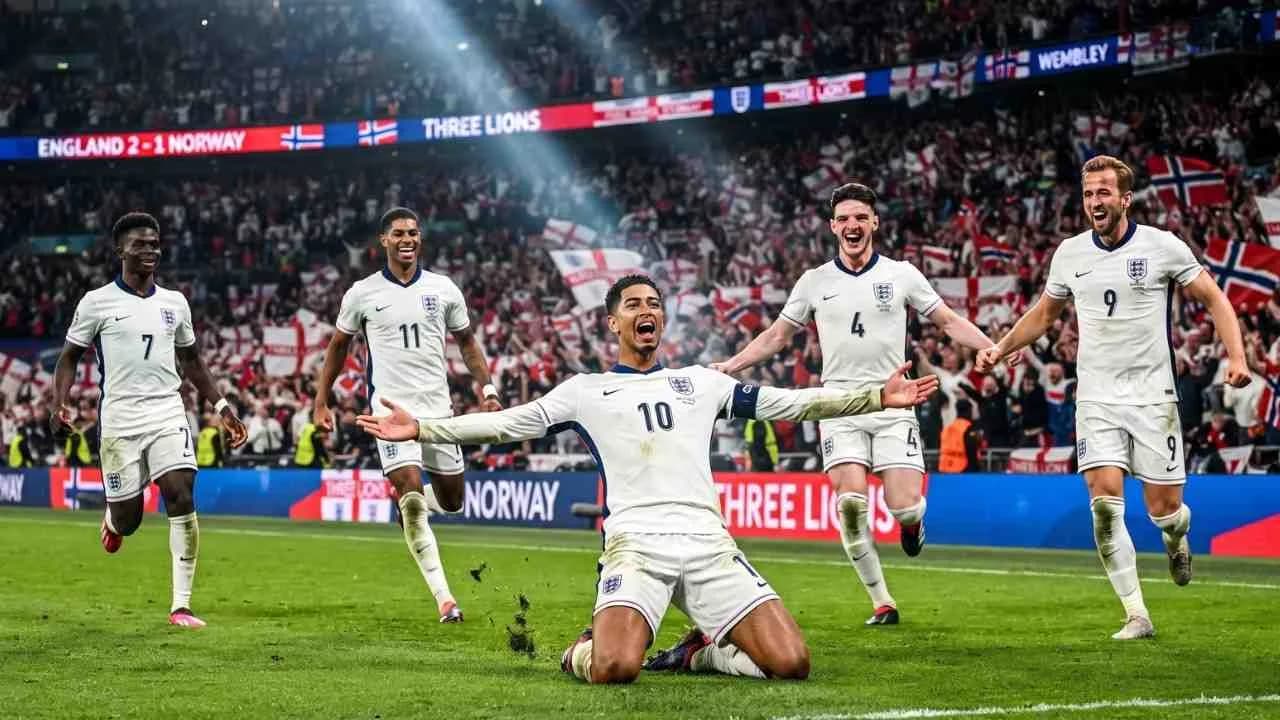
The England vs Norway result ended 2-1 after extra time in the World Cup 2026 quarter-final.
England secured a place in the semi-finals after surviving a difficult and highly competitive match.
Norway took the lead in the first half, but Jude Bellingham brought England back before the break.
He later scored the winning goal in extra time after goalkeeper Ørjan Nyland made a costly mistake.
Bellingham Leads England’s Comeback
Bellingham was the difference between the two teams when England needed a decisive player.
His first goal restored confidence after Norway had gained control of the match.
His second goal showed awareness, quick movement and the instinct to react before Norway’s defenders.
In many cases, knockout matches are decided by one player making the most of a small opportunity.
Bellingham did exactly that and delivered one of England’s most important performances of the tournament.
England Reach Another World Cup Semi-Final
The victory sent England into the World Cup semi-finals for the fourth time in their history.
It was an important achievement, although the overall performance raised several concerns.
England struggled with slow passing, technical mistakes and Norway’s pressure during the second half.
Still, they remained disciplined and found a way to win when the match became physically demanding.
Main Match Highlights
England defeated Norway 2-1 after extra time.
Andreas Schjelderup scored Norway’s opening goal.
Jude Bellingham scored both goals for England.
VAR overturned important decisions for both teams.
England advanced to face Argentina in the semi-final.
The result proved that England can survive difficult moments, but improvement will be needed in the next round.
Norway Take the Lead as England Struggle Early
Norway started the quarter-final with discipline and patience.
England controlled more possession, but their passing was slow and easy to read.
That allowed Norway to stay compact and wait for chances on the counterattack.
Andreas Schjelderup Punishes England
Andreas Schjelderup gave Norway the lead with a dangerous effort from the left side.
The ball travelled across goal and beat Jordan Pickford at the far post.
It was a major moment because England had looked comfortable without creating enough chances.
Norway showed that one sharp attack could be more valuable than long periods of possession.
England Fail to Turn Possession Into Chances
England moved the ball across midfield, but their attacks lacked speed and purpose.
The forwards often received the ball with several Norway defenders already in position.
From experience, this is a common problem when teams dominate the ball but fail to change the tempo.
England needed quicker passes, better movement, and more direct runs behind the defence.
Problems England Faced
Slow passing in midfield
Limited movement around Norway’s box
Poor use of wide areas
Weak protection during counterattacks
Too few clear chances for Harry Kane
Norway Gain Confidence After Scoring
Schjelderup’s goal changed the mood of the match.
Norway became more aggressive and started attacking England’s defensive spaces.
Martin Ødegaard also found more room to influence the game.
England looked nervous and began forcing passes that were not available.
One common mistake teams make is reacting emotionally after conceding.
England briefly lost their shape, which gave Norway a chance to push for another goal.
However, Bellingham’s response before half-time prevented Norway from taking full control.
Jude Bellingham Brings England Level Before Half-Time
England needed a response before the break, and Jude Bellingham delivered it at the perfect moment.
His equaliser changed the mood of the quarter-final and stopped Norway from taking full control.
Bellingham Attacks the Space
Anthony Gordon found room on the left and played the ball into Bellingham’s path.
Bellingham drove into the penalty area, moved beyond the defender, and finished across Ørjan Nyland.
The goal arrived in first-half stoppage time and gave England fresh belief.
It was also England’s first clear attacking moment after a frustrating opening period.
Why the Equaliser Changed the Match
Goals just before half-time can have a major psychological impact.
Norway had defended well, but the late equaliser damaged their confidence before the break.
England entered the dressing room level instead of facing the pressure of chasing the game.
Immediate Impact of Bellingham’s Goal
England regained confidence.
Norway lost some defensive control.
Tuchel gained more tactical options.
Bellingham became more involved.
The match opened up after the break.
Norway Question the Buildup
Norway argued that the ball may have touched an overhead cable before the equaliser.
However, FIFA said the ball sensor showed no evidence of contact.
The goal stood, but the incident became one of the biggest talking points of the match.
From experience, controversial moments often receive more attention than the football itself.
Still, Bellingham’s movement and finish were excellent, and England made the most of a rare opening.
Norway Push England Back During a Difficult Second Half
Norway returned after half-time with more energy and confidence.
England struggled to control midfield and spent long periods defending near their own penalty area.
Norway Create the Better Chances
Martin Ødegaard started finding more space between England’s midfield and defence.
Antonio Nusa and Oscar Bobb also added pace from wide areas.
Norway used crosses, corners and quick passes to keep England under pressure.
Kristoffer Ajer came close to scoring when his header struck the crossbar.
Jordan Pickford also made important saves to stop Norway from taking the lead again.
England’s Main Second-Half Problems
Slow passing from defence
Limited attacking movement
Poor control in midfield
Too many technical mistakes
Weak defending from set pieces
Very few clear scoring chances
Tuchel Changes England’s Shape
Thomas Tuchel introduced Bukayo Saka and Eberechi Eze to add speed and creativity.
Reece James later moved into midfield, allowing Bellingham to play further forward.
The changes gave England more balance, but Norway still looked dangerous.
One common mistake teams make is defending too deeply when pressure increases.
England did that at times and allowed Norway to control the tempo.
England Survive Norway’s Strongest Period
Norway believed they had scored from a corner, but VAR later ruled the goal out.
The decision gave England a major escape during their most difficult spell.
From experience, surviving pressure can be as important as playing well in knockout football.
England stayed organised, avoided conceding again and forced the match into extra time.
VAR Decisions Shape the England vs Norway Quarter-Final
VAR played a major role in the England vs Norway result and changed two important moments during the match.
Both teams had decisions overturned, which increased the pressure as the quarter-final moved toward extra time.
Norway’s Second Goal Is Disallowed
Norway believed they had regained the lead after scoring from a corner in the second half.
However, VAR reviewed the buildup and identified a foul involving Erling Haaland before the ball reached the scorer.
The referee checked the incident and ruled out the goal, giving England a major escape.
Why the Decision Mattered
Norway lost a possible winning goal.
England remained level at 1-1.
The decision changed the match momentum.
Norway’s players became more frustrated.
England gained time to reorganise.
The incident showed how small actions away from the ball can affect a major tournament match.
Haaland’s challenge happened before the finish, but it was still considered important enough to cancel the goal.
England’s Extra-Time Penalty Is Overturned
England were later awarded a penalty after Djed Spence went down inside Norway’s box.
VAR asked the referee to review the incident on the pitch-side monitor.
The decision was reversed after the review suggested Spence had moved across the defender and helped create the contact.
VAR Produces a Fair but Frustrating Outcome
Both teams experienced the disappointment of having a major decision overturned.
From experience, VAR often feels unfair to supporters because it removes the emotion of an immediate celebration.
However, the technology helped the referee examine incidents that were difficult to judge at full speed.
England eventually had to find another way to win, while Norway were left regretting missed chances.
Jude Bellingham Scores the Extra-Time Winner
England finally found the decisive goal in the third minute of extra time.
Morgan Rogers fired a powerful shot from distance, but Ørjan Nyland failed to hold it cleanly.
The ball dropped inside the penalty area, and Bellingham reacted faster than every Norway defender.
Nyland’s Mistake Gives England Their Chance
Nyland had produced several important saves earlier in the match.
However, his error arrived at the worst possible moment for Norway.
Instead of pushing the shot away from danger, he spilled it directly into Bellingham’s path.
Bellingham stayed alert, reached the loose ball first, and finished into the open net.
Why Bellingham’s Reaction Was So Important
He followed the shot instead of watching from distance.
He anticipated a possible goalkeeper mistake.
He moved ahead of Norway’s defenders.
He kept his finish simple under pressure.
He gave England a lead they could protect.
From experience, top midfielders often score because they expect a second chance before it appears.
Bellingham showed that instinct at the most important stage of the match.
England Protect the Lead
After scoring, England became more cautious and defended deeper.
Norway pushed forward, but England blocked crosses and reduced the space around their penalty area.
Bellingham was later substituted after completing an exhausting performance.
The goal proved to be enough, and England held on for a 2-1 victory.
Bellingham Becomes England’s Match Winner
Scoring twice in a World Cup quarter-final placed Bellingham at the centre of England’s success.
His first goal restored hope, while his second secured a place in the semi-finals.
It was not only a strong individual display.
It was the kind of performance that changes how a player is remembered in a major tournament.
Thomas Tuchel Calls England Sloppy and Lucky
Thomas Tuchel praised England’s progress but made it clear that the performance did not meet his expectations.
The head coach said England were sloppy, too slow, and fortunate to survive such a difficult quarter-final.
Tuchel Questions England’s Overall Display
England reached the semi-finals, but Tuchel focused on the problems that could hurt them in the next round.
He was concerned by the technical mistakes, slow passing, and lack of repeated attacking pressure.
Main Issues Raised by Tuchel
Too many simple passing errors
Slow movement in possession
Limited control of the match
Poor decision-making under pressure
Too few sustained attacks
Difficulty handling Norway’s second-half pressure
Tuchel’s reaction showed that he was judging the performance, not only the final England vs Norway result.
From experience, demanding managers often use a major win to raise standards before an even harder match.
Why Tuchel Said England Were Lucky
Norway hit the crossbar, had a goal disallowed, and created several dangerous chances.
England also struggled to produce shots during long periods of the second half.
For that reason, Tuchel believed the match could easily have ended differently.
His criticism was direct, but it was also based on clear warning signs.
A Message Before the Argentina Semi-Final
Tuchel later praised the players for their effort and ability to overcome pressure.
However, he insisted that England would need a faster and more controlled performance against Argentina.
That balance is important.
England deserve credit for reaching the semi-finals, but the team cannot depend on individual moments in every match.
Jude Bellingham Responds to Tuchel’s Criticism
Jude Bellingham did not appear impressed by Thomas Tuchel’s comments after England’s victory over Norway.
When asked about the criticism, he replied briefly and showed clear frustration with the manager’s assessment.
Bellingham Defends England’s Effort
Bellingham argued that Norway were a difficult team to face in demanding conditions.
He highlighted the quality of Erling Haaland, Martin Ødegaard, Antonio Nusa, and Alexander Sørloth.
The midfielder believed England’s players deserved more credit for their effort and mental strength.
Main Points From Bellingham’s Response
Norway had several world-class attacking players.
The playing conditions made the match difficult.
England’s players worked hard for 120 minutes.
Not every knockout match can be won with stylish football.
Results sometimes matter more than performance quality.
England Had to Win the Difficult Way
Bellingham explained that major tournament games are not always controlled through possession and attractive passing.
Sometimes, teams must defend, stay patient, and take advantage of one decisive mistake.
In many cases, World Cup winners survive difficult matches before producing their best football later.
England did not dominate Norway, but they remained competitive and found a way to win.
No Agreement Over the “Lucky” Comment
When Bellingham was asked whether England were lucky, he chose not to give a detailed answer.
His response suggested that he did not fully agree with Tuchel’s description of the performance.
However, the reaction also showed the pressure inside a team competing for a place in the World Cup final.
The disagreement does not necessarily mean there is a serious problem.
It may simply reflect two different views of the same match.
Tuchel Denies Any Disagreement With England’s Players
Thomas Tuchel later clarified that his criticism did not mean there was a serious problem inside the England squad.
He said there was no disconnect between him and the players after the difficult win over Norway.
Tuchel Praises the Players’ Commitment
Tuchel remained unhappy with parts of the performance, but he praised the team’s effort and determination.
England had to recover from a goal down and survive several dangerous Norway attacks.
What Tuchel Appreciated
Strong effort across 120 minutes
Mental strength after conceding
Discipline under pressure
A positive response in extra time
Commitment from every player
Tuchel explained that a coach can support his players while still demanding better football.
From experience, this is common at elite level, where winning does not remove the need for honest analysis.
No Dressing-Room Crisis After the Match
Bellingham’s reaction created speculation about tension between the player and manager.
However, Tuchel insisted that the relationship with his squad remained strong.
He said his criticism focused on passing, speed, and control, not on attitude or commitment.
This distinction matters because performance criticism is different from questioning a player’s effort.
Different Views of the Same Victory
Bellingham focused on how difficult the match was and how hard the players worked.
Tuchel focused on the technical problems that appeared during the England vs Norway result.
Both views can be correct.
England showed character, but they also made mistakes that Argentina could punish in the semi-final.
The key question is whether the disagreement can help England improve rather than create unnecessary pressure.
Harry Kane Supports Tuchel’s Demand for Improvement
Harry Kane understood why Thomas Tuchel remained critical despite England reaching the World Cup semi-finals.
The captain said the team should celebrate the victory, but also accept that a stronger performance will be needed next.
Kane Sees Improvement as a Positive Sign
Kane explained that England had reached the final four without producing their best football.
For him, that creates confidence rather than concern.
If England can improve their passing, movement, and control, they may become even harder to beat.
Kane’s Main Message
England should enjoy reaching the semi-finals.
The team must remain honest about its weaknesses.
Better football will be needed against Argentina.
Reaching another level is still possible.
Tuchel’s high standards can help the squad improve.
Kane’s response was calmer than Bellingham’s reaction and helped reduce talk of a disagreement inside the squad.
Leadership After a Difficult Win
As captain, Kane had to balance celebration with responsibility.
He praised the team’s resilience but accepted that Norway created too many dangerous moments.
From experience, strong captains often protect the dressing room while supporting the manager’s demand for improvement.
Kane did exactly that after the England vs Norway result.
Why Kane’s View Matters
England are now one match away from the World Cup final.
At this stage, confidence is important, but honest analysis is just as necessary.
Kane’s comments showed that the players understand the size of the challenge ahead.
England cannot expect Argentina to waste the same chances that Norway missed.
The team will need sharper finishing, stronger midfield control, and fewer defensive mistakes in the semi-final.
Erling Haaland Struggles and Leaves the Match Injured
Erling Haaland entered the quarter-final as Norway’s biggest attacking threat.
However, England limited his clear chances and prevented him from scoring.
England Keep Haaland Under Pressure
Haaland remained dangerous through his movement, strength, and ability to attack crosses.
Still, England’s defenders stayed close and reduced the space available inside the penalty area.
How England Limited Haaland
Marc Guéhi tracked his runs closely.
John Stones challenged him in the air.
England blocked passing routes into the box.
Pickford reacted well to his headed effort.
Norway struggled to create simple chances for him.
Haaland also became involved in the incident that led to Norway’s second goal being disallowed.
VAR identified a foul before the finish, keeping the score level.
Injury Ends Haaland’s Quarter-Final
Haaland was substituted during the second period of extra time.
Norway coach Ståle Solbakken later said the striker had suffered a dead leg.
The injury affected Haaland’s movement and reduced his ability to press England’s defenders.
Solbakken admitted that the forward had little energy left and could have been removed earlier.
A Rare Scoreless Match for Haaland
Haaland failed to score in a competitive international match for the first time since October 2024.
That statistic shows how unusual the night was for one of football’s leading strikers.
From experience, stopping a player like Haaland requires team discipline, not just one strong defender.
England achieved that, although Norway still created enough chances to make the England vs Norway result uncertain until the final whistle.
England Reach Their Fourth World Cup Semi-Final
England’s 2-1 win over Norway secured another major milestone for the national team.
The victory sent England into the World Cup semi-finals for the fourth time in their history.
England’s Previous Semi-Final Appearances
England have reached this stage in four different World Cup campaigns.
Their previous semi-final appearances came in:
1966
1990
2018
2026
The 1966 tournament remains England’s greatest success, as they went on to win the trophy.
The 1990 and 2018 campaigns ended in semi-final disappointment.
Now, the 2026 squad has another chance to reach the final.
Why This Achievement Matters
Reaching the last four shows that England remain one of the strongest teams in international football.
It also proves the squad can survive pressure, poor spells, and difficult knockout matches.
What England Showed Against Norway
Strong mental resilience
Patience after falling behind
Better concentration in extra time
Individual quality in decisive moments
The ability to protect a narrow lead
From experience, major tournaments are rarely won by playing perfect football in every round.
Successful teams often survive one difficult match before improving later.
Tuchel Reaches the Semi-Final in His First World Cup
Thomas Tuchel has guided England into the final four despite criticism of the team’s performances.
That makes the achievement important for both the manager and the squad.
However, the England vs Norway result also showed that England still have areas to improve.
The team must control possession better, avoid simple mistakes, and defend set pieces with greater confidence.
Reaching the semi-final is a major success, but England’s next challenge will demand an even higher level.
England vs Argentina Semi-Final Preview
England will face Argentina in Atlanta on July 15, 2026.
The match will test England’s defence, midfield control, and ability to stay calm under pressure.
England vs Argentina Comparison
Area | England | Argentina |
|---|---|---|
Key Strength | Physical power and resilience | Creativity and technical control |
Main Threat | Jude Bellingham | Lionel Messi |
Captain | Harry Kane | Lionel Messi |
Midfield Focus | Energy and direct runs | Possession and short passing |
Main Concern | Technical mistakes | Defensive transitions |
Quarter-Final Result | Beat Norway 2-1 | Beat Switzerland 3-1 |
Key Battle in Midfield
England need Bellingham, Declan Rice, and the central midfield to control the space around Argentina’s playmakers.
Argentina may try to slow the game and force England to defend for long periods.
What England Must Do Better
Move the ball faster
Avoid careless passes
Defend set pieces strongly
Stop Argentina’s central attacks
Create more chances for Kane
Stay disciplined after losing possession
Can England Reach the Final?
The England vs Norway result showed that England can win even when they are not at their best.
However, Argentina are likely to punish the mistakes that Norway failed to convert.
From experience, semi-finals are often decided by midfield discipline and one moment of individual quality.
England have Bellingham, Kane, and Saka, while Argentina have Messi, Álvarez, and Mac Allister.
The match may depend on which team handles pressure better.
England must improve, but their ability to survive difficult moments gives them a real chance of reaching the final.
England vs Norway Pros and Cons
The England vs Norway result showed both the strengths and weaknesses of Tuchel’s team.
England advanced, but the performance also exposed problems that must be fixed before the semi-final.
Pros of England’s Performance
Strong Mental Response
England recovered after conceding first and stayed calm during a difficult period.
Bellingham’s equaliser before half-time changed the mood of the match.
Match-Winning Individual Quality
Jude Bellingham produced two decisive goals when England needed leadership.
His movement and awareness separated England from Norway.
Defensive Resilience
England survived Norway’s pressure, set pieces, and late attacks.
The defence stayed focused after taking the lead in extra time.
Effective Substitutions
Tuchel’s changes added pace, width, and fresh energy.
Morgan Rogers also played a role in the move that created the winning goal.
Cons of England’s Performance
Slow and Predictable Passing
England often moved the ball without enough speed or purpose.
That allowed Norway to maintain a compact defensive shape.
Too Many Technical Errors
Simple mistakes gave Norway chances to attack.
Argentina may punish similar errors more effectively.
Limited Attacking Control
England struggled to create regular chances for Harry Kane.
The team depended heavily on Bellingham’s individual quality.
Weakness From Set Pieces
Norway caused repeated problems from corners and crosses.
England must defend aerial situations with greater discipline.
Overall Assessment
Positive Signs | Areas of Concern |
|---|---|
Strong mentality | Slow passing |
Bellingham’s form | Technical mistakes |
Defensive effort | Poor midfield control |
Effective substitutions | Set-piece weakness |
Extra-time composure | Limited clear chances |
England deserved credit for surviving a difficult quarter-final.
However, the team must improve its control and decision-making before facing Argentina.
England Compared With Other World Cup Semi-Finalists
England now join Argentina, France, and Spain in the World Cup 2026 semi-finals.
Each team reached the last four with a different style and set of strengths.
Semi-Finalist Comparison Table
Team | Quarter-Final Result | Main Strength | Main Concern |
|---|---|---|---|
England | Beat Norway 2-1 | Resilience and individual quality | Slow passing and technical errors |
Argentina | Beat Switzerland 3-1 | Experience and attacking control | Space during defensive transitions |
France | Beat Morocco 2-0 | Speed and finishing quality | Can lose midfield control |
Spain | Beat Belgium 2-1 | Possession and technical movement | Vulnerable against direct attacks |
How England Compare With Their Rivals
England may not have played the best football of the four teams.
However, they showed strong mentality after falling behind against Norway.
Argentina offer more control in possession and greater experience in major tournament matches.
France have dangerous pace and can punish mistakes quickly.
Spain rely on movement, passing, and patient attacks around the penalty area.
England’s Competitive Advantages
Jude Bellingham is in strong scoring form.
Harry Kane provides leadership and experience.
England can survive difficult periods.
Tuchel has several strong options from the bench.
The team has already won under pressure.
Where England Still Fall Behind
England’s passing is not as controlled as Spain’s.
Their attacking rhythm is also less consistent than France’s or Argentina’s.
From experience, semi-finals punish teams that lose focus for even a few minutes.
The England vs Norway result proved England are difficult to eliminate.
Still, resilience alone may not be enough against the tournament’s strongest remaining teams.
Supporter Reactions After England Beat Norway
The England vs Norway result created mixed reactions among supporters.
Most fans celebrated the semi-final place, but many were concerned by England’s overall performance.
Fans Praise Bellingham’s Leadership
Bellingham received the strongest praise after scoring both England goals.
Supporters admired his timing, confidence, and ability to deliver under pressure.
Main Positive Reactions
Bellingham carried England during key moments.
The team showed strong mental character.
England recovered well after conceding first.
The substitutes added energy in extra time.
Reaching the semi-final remained the main priority.
Many supporters felt Bellingham’s performance showed why he is one of England’s most valuable players.
His goals gave fans another memorable World Cup moment.
Concerns About England’s Performance
Not every reaction was positive.
Some supporters agreed with Tuchel that England played too slowly and made avoidable mistakes.
Common concerns included:
Poor control in midfield
Limited service for Harry Kane
Weak defending at set pieces
Too much dependence on Bellingham
Difficulty managing Norway’s pressure
A Familiar Tournament Experience
For many England supporters, the match felt familiar.
The team created tension, survived several scares, and eventually found a way to win.
From experience, fans often remember the result more positively once the pressure of the match has passed.
However, the nervous performance will remain part of the discussion before Argentina.
Overall Supporter Mood
The mood was mainly one of relief rather than complete confidence.
England are in the semi-finals, which deserves celebration.
Still, supporters know that a more controlled display will be needed to reach the final.
Final Analysis: England Survive Norway and Reach the Semi-Finals
The England vs Norway result showed why knockout football is rarely simple.
England were not at their best, but they stayed alive during Norway’s strongest moments and found a way to win.
Bellingham Made the Difference
Jude Bellingham produced the two moments that decided the quarter-final.
His first goal restored belief before half-time.
His second came from sharp awareness after Ørjan Nyland failed to control a powerful shot.
Without Bellingham’s movement and finishing, England may not have reached the last four.
England Deserve Credit, but Improvement Is Essential
Thomas Tuchel was right to highlight the technical mistakes, slow passing, and weak control.
At the same time, Bellingham was also right to defend the effort of players who completed a demanding 120-minute match.
Both views can be true.
England showed character and resilience, but Argentina will present a tougher challenge.
England’s Priorities Before the Semi-Final
Pass with greater speed and accuracy
Create more chances for Harry Kane
Reduce careless midfield turnovers
Defend corners and crosses more strongly
Control the game after taking the lead
Avoid depending on one player for goals
From experience, teams often improve after surviving a difficult knockout match.
England now have that opportunity.
Frequently Asked Questions
1. What was the England vs Norway result?
The England vs Norway result was 2-1 after extra time. England advanced to the World Cup 2026 semi-finals.
2. Who scored England’s goals against Norway?
Jude Bellingham scored both goals for England. He equalised before half-time and scored the winner in extra time.
3. Who scored Norway’s goal against England?
Andreas Schjelderup scored Norway’s opening goal during the first half.
4. Why was Norway’s second goal disallowed?
VAR ruled out Norway’s goal because of a foul involving Erling Haaland before the ball reached the scorer.
5. Why was England’s penalty overturned?
England were initially awarded a penalty after Djed Spence went down inside the box.
After reviewing the incident, the referee decided Spence had moved across the defender and helped create the contact.
6. What did Thomas Tuchel say about England’s performance?
Tuchel said England were sloppy, too slow, and fortunate to win.
He praised the team’s commitment but warned that the performance must improve before the semi-final.
7. Who will England face in the World Cup semi-final?
England will face Argentina in Atlanta on July 15, 2026.
The match will decide which team reaches the World Cup final.
[Source: FIFA]
Topics in this story
Article Details
Category: Fifa
Published:
Updated:
Author: Urooj
More Stories