Who Was Involved in the Argentina Spain Brawl
By the time order was restored, six players and one coaching staff member had been pulled into the incident. FIFA's disciplinary and ethics prosecutor is now reviewing footage and referee reports to determine who crossed the line and who was simply defending a teammate.
Here is a quick breakdown of who did what, based on match footage and referee documentation.
Player or Staff | Team | Alleged Role in the Incident |
|---|---|---|
Leandro Paredes | Argentina | Grabbed Eric Garcia by the throat, pushed Gavi to the ground |
Nahuel Molina | Argentina | Made physical contact with Rodri near midfield |
Roberto Ayala | Argentina | Assistant coach, altercation with Dani Olmo |
Nicolas Otamendi | Argentina | Verbal confrontation with former teammate Rodri |
Thiago Almada | Argentina | Involved in the wider scuffle |
Enzo Fernandez | Argentina | Sent off separately, second yellow card in stoppage time |
Why Paredes Is the Central Figure
Out of everyone involved, Paredes is drawing the most attention. A throat grab is not something referees or FIFA tend to overlook, even after the final whistle. What makes it messier is that he was not shown a red card during the match itself, and reports later confirmed no disciplinary action was recorded on the official sheet at the time.
That gap between what the cameras showed and what the referee's report says is likely to be the center of FIFA's review.Why FIFA Removed Paredes Red Card From the Record
This is the part of the story that confused a lot of fans watching at home, and honestly, it confused me too when I first read the match report. Early reports claimed Paredes had actually been sent off on the pitch for the throat grab incident. Then, within hours, that detail quietly disappeared from the official record.
So what actually happened.
Under Article 36 of the FIFA Disciplinary Code, incidents that a referee misses or fails to act on during a match can still be reviewed and punished after the fact, separately from anything shown on the match card. In simple terms, the red card that fans initially heard about was never officially issued during the game. Referee Slavko Vincic did not stop play or show a card for the throat grab in real time, likely because it happened after his final whistle, when his authority over in game sanctions technically ends.
That is exactly why FIFA had to step in through a separate disciplinary process rather than relying on the referee's original report.
What This Means for the Investigation
No red card was shown on the pitch, so this is not a simple appeal against an existing suspension
FIFA is building the case from scratch using video evidence and match observers
This gives FIFA more flexibility in the punishment it can hand down, since it is not bound by a referee's in game decision
If you have ever seen an NFL replay review overturn a call days after a game, it is a similar idea. The action still counts, even if nobody raised a flag in the moment.What Punishment Could Argentina Face
This is the question everyone actually cares about. Video evidence looks bad for Argentina, but FIFA punishments do not always match public expectation. Sometimes they come down harder than fans expect, sometimes surprisingly light.
Based on FIFA's disciplinary code and how similar cases have played out before, here is what is realistically on the table.
Multi match suspensions for Paredes and Molina, since they appear to be the primary instigators
A formal warning or fine for Ayala as a coaching staff member
A financial penalty against the Argentine Football Association itself, separate from individual player bans
A lighter possibility, a suspended suspension that only applies if similar behavior happens again
A Useful Comparison from Recent History
FIFA and other major soccer bodies have dealt with throat grabs before, and the punishments give a rough benchmark for what might come next.
Incident | Body | Punishment |
|---|---|---|
Zlatan Ibrahimovic throat grab, MLS 2021 | MLS Disciplinary Committee | 2 game suspension |
Molina contact with Rodri, 2026 final | FIFA (pending) | Under review, 3 game ban possible under FDC Chapter 2, Section 14 |
Paredes throat grab, 2026 final | FIFA (pending) | Under review |
Worth noting, Spain's players are unlikely to face any real punishment here. Gavi's push toward Paredes looked more defensive than aggressive on replay, and FIFA rarely penalizes a reaction unless it clearly escalated the situation.
If you have followed enough of these cases, you start to notice a pattern. FIFA tends to punish the player who threw the first real move, not the one who reacted to it.stigation Into Argentina Over World Cup Final Altercation
The final whistle at MetLife Stadium was supposed to mark the end of one of the most dramatic World Cup finals in recent memory. Instead, it opened the door to a mess that FIFA is still trying to sort out. The FIFA investigation Argentina now faces has become almost as big a talking point as Spain's 1-0 extra time win itself.
If you watched the broadcast live, you probably saw it unfold in real time. One second it is a championship celebration, the next it is players shoving each other while security scrambles onto the pitch. That contrast is exactly why this story has legs beyond a normal post match scuffle.
What Happened After the Final Whistle
Spain sealed the win through Ferran Torres in the 106th minute, ending Argentina's hopes of a repeat title. Referee Slavko Vincic had already sent off Enzo Fernandez in stoppage time, leaving Argentina to finish the match a man down.
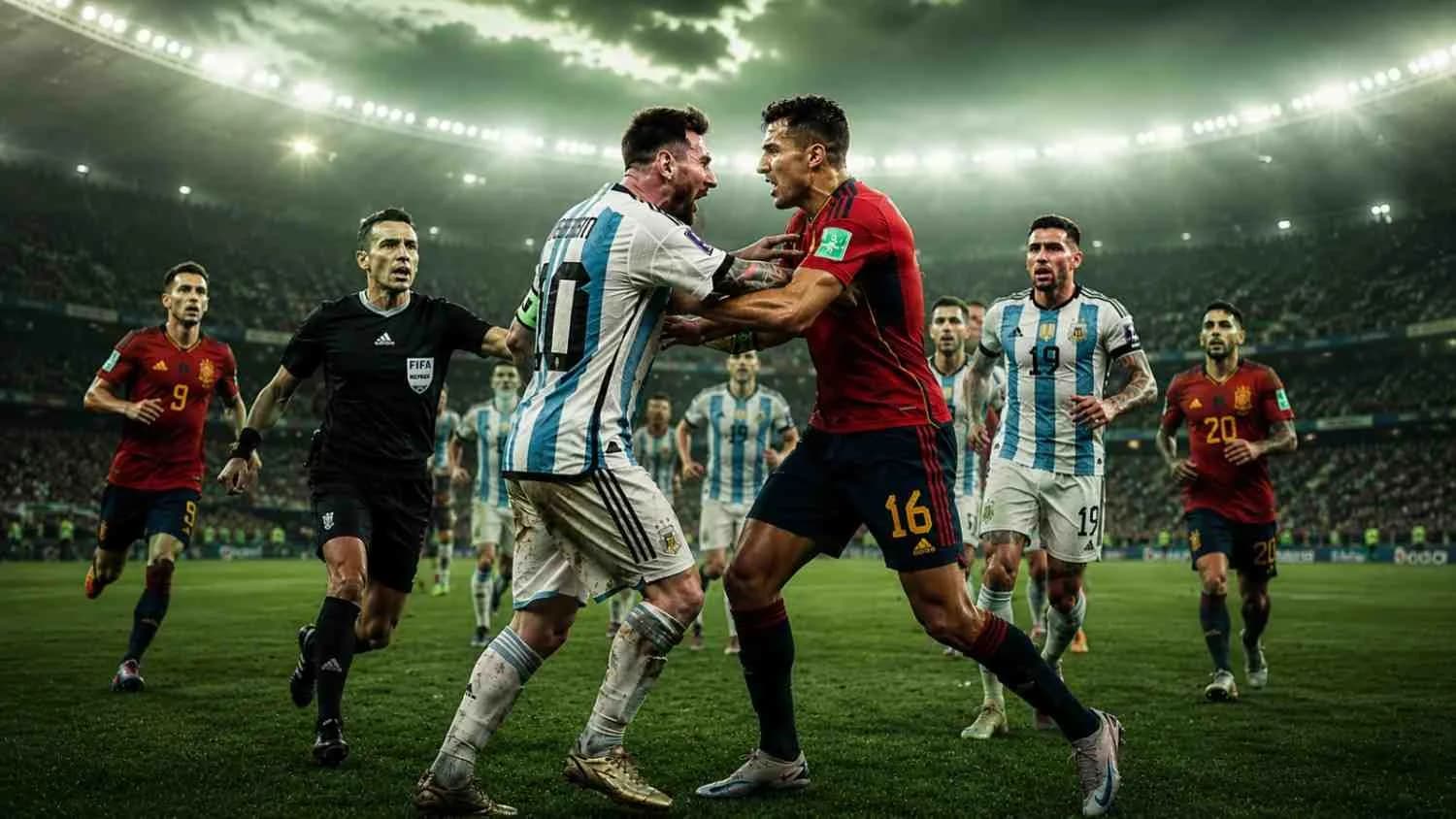
Moments after the final whistle blew, Spain's Rodri, who had been substituted earlier in extra time, ran onto the field to celebrate with his teammates. That is when things turned physical.
Nahuel Molina confronted Rodri and made contact with him
Leandro Paredes appeared to grab Eric Garcia by the throat
Gavi stepped in and was pushed to the ground by Paredes
Assistant coach Roberto Ayala was seen in an altercation with Dani Olmo
It escalated fast, and it took several staff members from both benches to pull players apart.This Is Not Argentina's Only FIFA Investigation Right Now
Here is something a lot of casual fans missed while focusing on the brawl. This is not even the first disciplinary matter Argentina is dealing with from this tournament.
After Argentina's semi final win over England, players displayed a banner referencing the country's claim over the Falkland Islands during their on field celebration. FIFA had already opened a separate review into that incident before the final was even played. Political statements and banners are a sensitive area for FIFA, since the organization has strict rules against using matches as a platform for political messaging.
The Trophy Ceremony Only Made Things Worse
There is also a smaller moment from the final that has not gotten as much attention, but it says a lot about the mood on the Argentina side that night.
Spain's players formed a guard of honor for Argentina as they collected their runner up medals
When it was Spain's turn to lift the trophy, Argentina's players turned their backs toward the podium
They faced their own fans instead of acknowledging the new champions
Small gesture, but in a sport where sportsmanship gets scrutinized heavily, it did not go unnoticed. Combined with the on field brawl and the ongoing Falklands banner review, FIFA now has three separate behavioral issues tied to Argentina from this single tournament run. That pattern alone could influence how strict the final punishment ends up being.What Happens Next in the FIFA Investigation
If you are expecting a quick announcement, do not hold your breath. FIFA has a track record of taking its time with disciplinary cases like this, especially ones involving multiple players and a coaching staff member.
Here is roughly how the process works from here.
The Disciplinary and Ethics Prosecutor reviews match reports, referee documentation, and video footage from multiple angles
Players named in the investigation may be given a chance to respond or explain their side
The committee decides whether individual bans, fines, or a combination of both are warranted
A final ruling gets published, though FIFA has not given any expected date
Why FIFA Has Not Set a Timeline
FIFA rarely rushes these decisions, mainly because appeals are common and a poorly reviewed case can get overturned or challenged by national federations. In past incidents involving physical contact after a match, rulings have taken anywhere from a few days to several weeks.
There is also the Falklands banner review running in parallel, and FIFA may choose to address both matters around the same time rather than issuing separate statements days apart. That would not be unusual. Organizations dealing with more than one open case involving the same federation often prefer a single, combined ruling instead of a drawn out back and forth in the headlines.
For now, the safest expectation is a decision sometime in the coming weeks, not days.Stay Updated on the FIFA Investigation
Stories like this rarely wrap up in a single news cycle. FIFA still has to review footage, question the players involved, and issue a final ruling, and that process could stretch over the coming weeks.
If you want the real story as it develops, rather than recycled headlines, keep checking back here. We are tracking every update on the FIFA investigation Argentina is facing, along with the parallel Falklands banner review, so you are not left piecing information together from scattered sources.
Bookmark this page or follow our sports section for the latest confirmed updates, straight from FIFA statements and verified match reports.
Frequently Asked Questions
Was Leandro Paredes given a red card during the World Cup final?
No. Although early reports suggested Paredes was sent off, FIFA later confirmed no red card was officially recorded during the match. The incident is now being reviewed separately under Article 36 of the FIFA Disciplinary Code.
Why is FIFA investigating Argentina after the match already ended?
FIFA can review incidents that happened after the final whistle, even if the referee did not act on them in real time. Since the brawl occurred after the game officially ended, it falls outside the referee's normal in game authority.
Who are the main players involved in the FIFA investigation?
Leandro Paredes and Nahuel Molina are seen as the central figures, along with assistant coach Roberto Ayala. Nicolas Otamendi and Thiago Almada were also involved in the wider scuffle.
Could Argentina be fined as a football association, not just individual players?
Yes. Separate from any player suspensions, the Argentine Football Association could face a financial penalty if FIFA determines the federation failed to control its players and staff.
Is this connected to the Falklands banner controversy from the semi final?
It is a separate case, but both are open at the same time. Argentina is dealing with the banner review from the semi final against England alongside this new investigation into the final's post match brawl.
When will FIFA announce its final decision?
FIFA has not given a timeline. Based on similar past cases, a ruling could take anywhere from a few days to several weeks, especially since two separate Argentina related cases are running in parallel.
Will any Spain players face punishment as well?
It is unlikely. Gavi's involvement looked defensive rather than aggressive on video review, and FIFA typically does not penalize a reactive move unless it clearly escalated the situation.
Topics in this story
Article Details
Category: Fifa
Published:
Updated:
Author: Rabia
More Stories