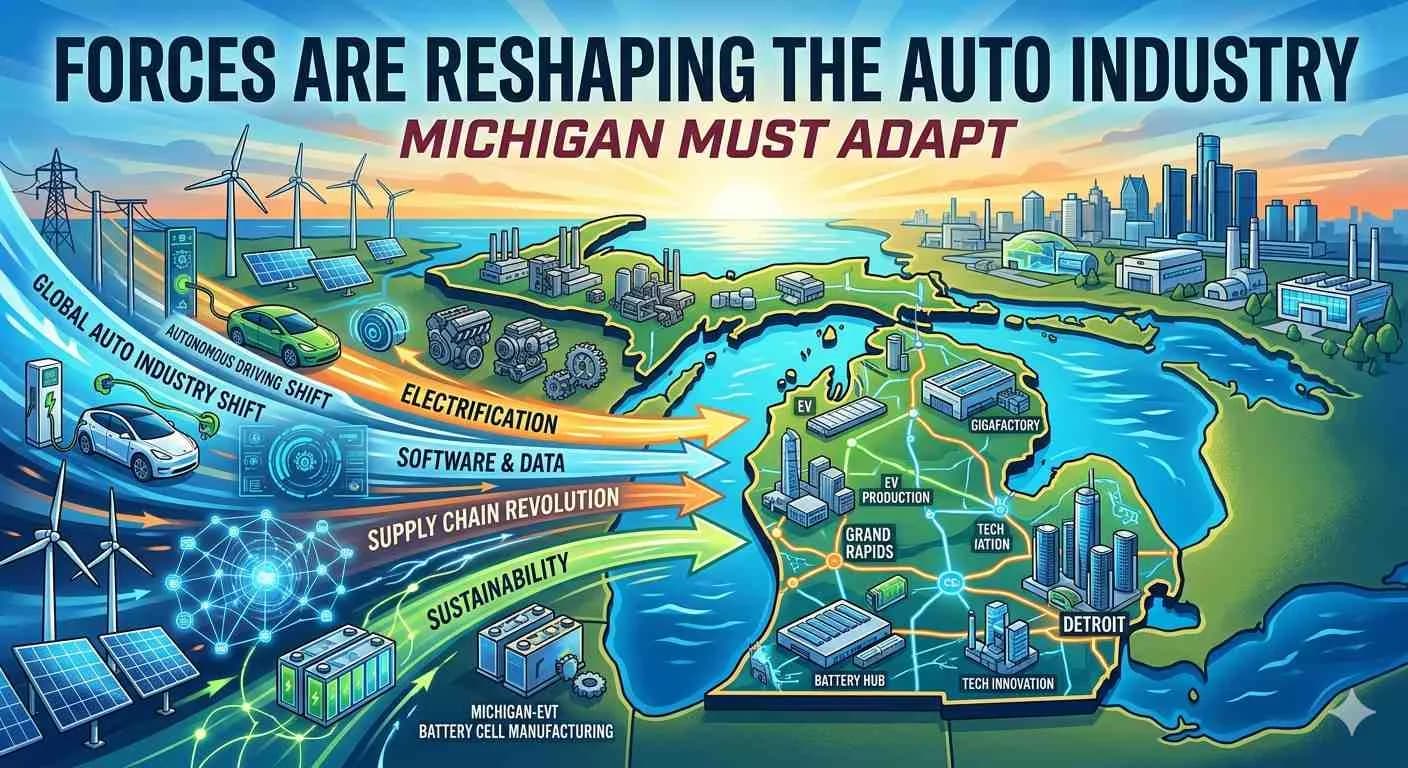
What happens when an industry that once defined an entire region starts to change faster than the factories that built it? That is the challenge Michigan is now facing as powerful global forces reshape the automotive landscape.
Auto Industry Transformation Is Accelerating
The automotive sector is undergoing one of the fastest transitions in its history. Electric vehicles, automation, software integration, and global supply chain realignments are changing how cars are designed and manufactured.
In many cases, these shifts are not gradual. They are structural. Traditional manufacturing hubs like Michigan are now under pressure to adapt to a rapidly evolving ecosystem where software and batteries matter as much as engines and assembly lines.
Why Michigan Sits at the Center of the Shift
Michigan has long been the heart of America’s automotive industry. Its workforce, suppliers, and infrastructure were built around internal combustion engine production.
From experience, one common mistake people make is assuming industrial dominance continues automatically once established. In reality, industries must continuously evolve or risk losing relevance as technology advances.
For local communities, these changes are deeply personal. A shift in manufacturing demand can influence job security, household income, and even local business activity. It is similar to how a major tech company moving out of a city affects everything from rent prices to small retail shops.
Key Forces Reshaping the Auto Industry
Several global trends are driving the transformation of the automotive sector. These forces are interconnected and are redefining production priorities worldwide.
| Driving Force | Impact on Auto Industry |
|---|---|
| Electric Vehicle Adoption | Reduces demand for traditional engine manufacturing |
| Software Integration | Increases need for tech-focused workforce |
| Global Supply Chain Shifts | Changes sourcing and production locations |
| Automation & Robotics | Reduces manual assembly roles |
Economic Pressure on Traditional Manufacturing Regions
As production methods evolve, regions dependent on legacy manufacturing face significant adjustment pressure. This includes workforce retraining, factory modernization, and investment in new technologies.
In many cases, companies are choosing locations based on battery supply chains, renewable energy access, and digital infrastructure rather than traditional manufacturing advantages.
For households, this transition can feel like sudden financial uncertainty. A stable factory job once supported multiple expenses, similar to how a single household income used to cover rent, utilities, and education without additional income streams.
Michigan’s Path Toward Reinvention
Despite the pressure, Michigan is not standing still. The state is actively attracting electric vehicle investments, battery production facilities, and advanced manufacturing projects.
Workforce training programs are also expanding, focusing on software engineering, robotics, and clean energy technologies. These efforts aim to bridge the gap between legacy skills and future industry needs.
Closing Thought
The forces reshaping the auto industry are not temporary disruptions but long-term structural changes. Michigan’s ability to adapt will determine how it remains relevant in the next phase of global automotive evolution. The transition will be complex, but it also opens the door to entirely new industrial opportunities.
Quick Facts Box
- Auto industry is shifting toward electric and software-driven vehicles
- Michigan remains a historic hub for automotive manufacturing
- Workforce retraining is becoming increasingly important
- Supply chain changes are reshaping production decisions globally
Article Details
Category: Auto
Published:
Author: Muhammad Sheikh
More Stories