Ever opened a website hosted abroad and wondered how it reaches your phone in seconds? Much of Pakistan’s global internet traffic travels through undersea fiber optic cables lying quietly beneath oceans.
Why Undersea Cables Matter For Pakistan
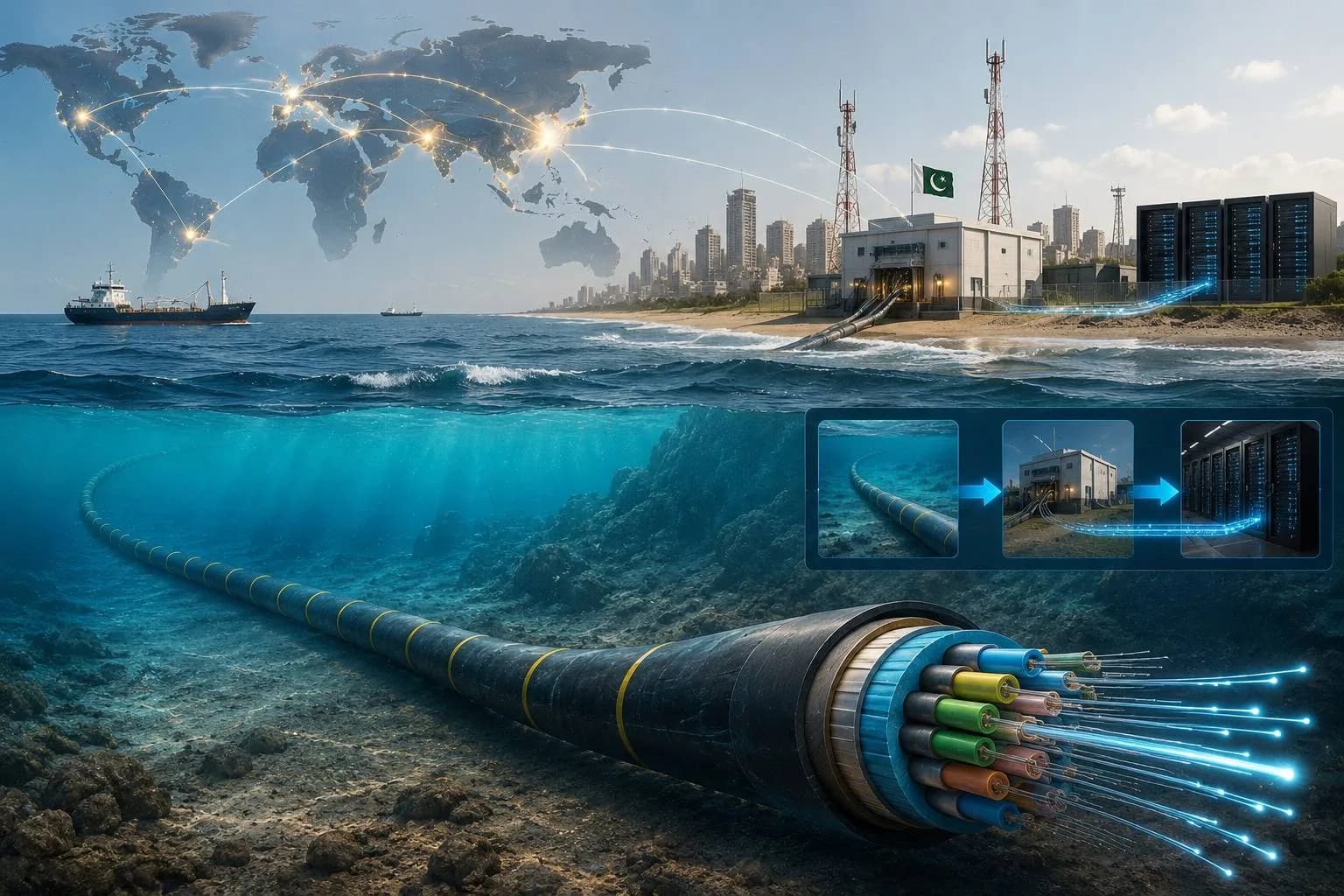
Undersea Internet Cables Pakistan depends on are the hidden routes that connect local users with global servers, cloud platforms, payment systems, video apps, and international businesses.
Submarine Cable Map lists major systems connected to Pakistan, including AAE-1, IMEWE, PEACE, SeaMeWe-4, SeaMeWe-5 and SeaMeWe-6. These cables help move international data between Pakistan, the Middle East, Europe, Africa, and Asia.
Major Roles Of Undersea Cables
| Use | Why It Matters |
|---|---|
| International browsing | Connects Pakistani users to global websites, apps, and platforms. |
| Cloud services | Supports businesses using global storage, software, and remote tools. |
| Digital payments | Helps banks, fintech apps, and payment systems exchange data quickly. |
| IT exports | Allows freelancers and companies to serve foreign clients reliably. |
How The Data Journey Works
When a user in Karachi, Lahore, or Peshawar opens an international website, the request travels through local networks, national fiber links, landing stations, and then into submarine cable systems. From there, it moves toward overseas data centers.
In many cases, this journey happens so quickly that users never notice it. But if a submarine cable develops a fault, internet speed can slow down because traffic must be shifted to alternate routes.
Why Cable Faults Affect Daily Life
PTA has previously reported internet disruption risks when submarine cables face faults or damage. In 2025, public reports also noted service impact after cable cuts near Saudi waters affected SMW4 and IMEWE capacity.
From experience, users usually notice this through slow browsing, failed uploads, laggy video calls, or poor access to international platforms. The internet may not fully stop, but it can feel heavy and unreliable.
The Financial Burden On Families And Workers
Slow international connectivity can increase costs for ordinary users. A freelancer may miss a deadline. A student may fail to upload an assignment. A small seller may lose orders because customer messages and payment confirmations are delayed.
It is like using a main highway where one bridge suddenly closes. Traffic still moves through side roads, but it takes longer, wastes fuel, and creates stress for everyone.
Why New Cables Are Important
Undersea Internet Cables Pakistan uses need constant expansion because data demand keeps rising. Dawn reported that SEA-ME-WE 6 links Pakistan with countries between Singapore and France, offering total capacity of over 100Tbps, with Pakistan allocated 13.2Tbps and 4Tbps activated immediately.
More cables mean better redundancy. If one route faces damage, operators can move traffic to another route. This improves stability for cloud services, streaming, e-commerce, fintech, education, and remote work.
Closing Thought
Undersea cables may be invisible to most users, but they are central to Pakistan’s digital future. Stronger international connectivity can support IT exports, online learning, fintech, data centers, and global business. The next challenge is not only adding more cables, but also ensuring better backup routes, local infrastructure, and faster recovery when faults happen.
Quick Facts Box
- Pakistan is connected to multiple submarine cable systems including AAE-1, IMEWE, PEACE, SeaMeWe-4, SeaMeWe-5 and SeaMeWe-6.
- SEA-ME-WE 6 spans around 19,200 km between Southeast Asia, the Middle East, and Western Europe.
- Pakistan has been allocated 13.2Tbps capacity on SEA-ME-WE 6, with 4Tbps activated immediately.
- Submarine cable faults can slow international browsing, cloud access, uploads, and video calls.
Article Details
Category: Telecom
Published:
Author: Pari Row
More Stories