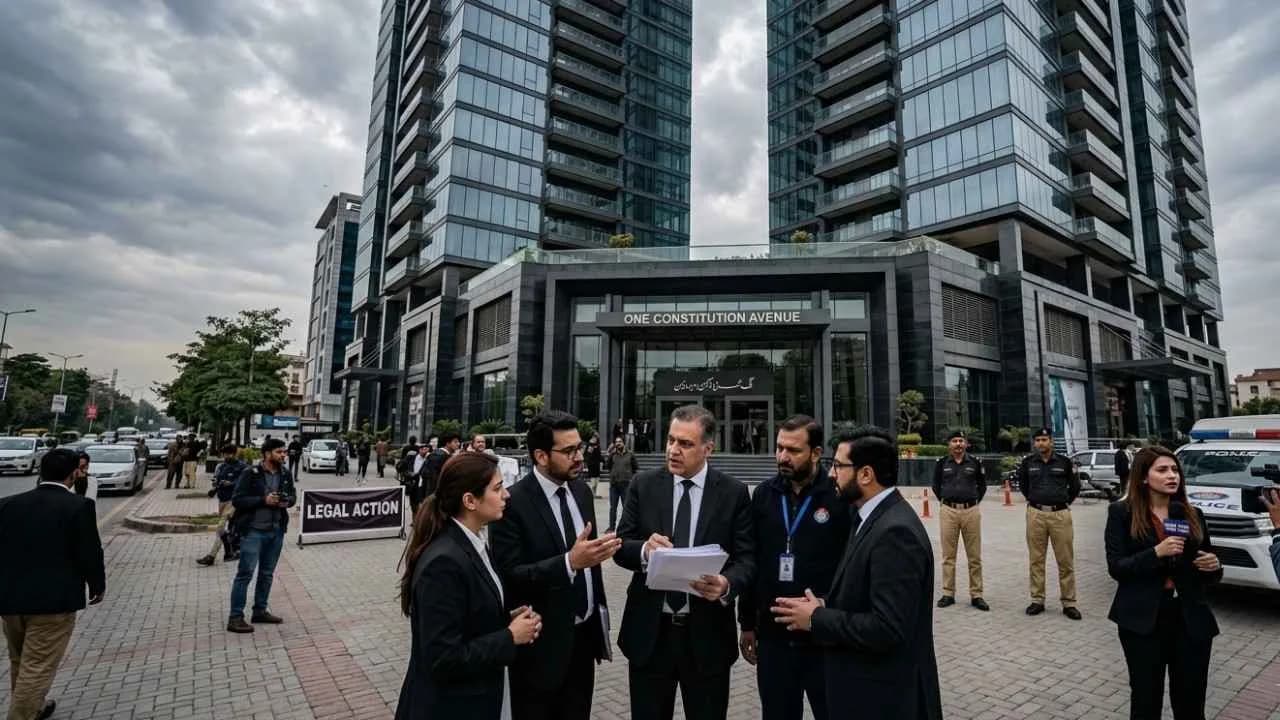
What happens when property ownership collides with unresolved lease legality? The Islamabad High Court’s latest hearing in the One Constitution Avenue dispute has once again highlighted the long-running uncertainty surrounding one of the capital’s most controversial real estate projects.
Legal Battle Over High-Profile Apartments Continues
The Islamabad High Court (IHC) on Wednesday declined to grant immediate relief to around 30 appellants who claim ownership rights as sub-lessees in the One Constitution Avenue apartments case. The matter was heard by a division bench reviewing intra-court appeals challenging earlier judgments linked to the disputed project.
The case involves well-known personalities among the appellants, while arguments from both sides centered on the legality of the original lease and subsequent sub-leases issued to apartment buyers.
Core Dispute Over Lease Validity
At the heart of the case is whether the cancellation of the original lease automatically invalidates all downstream sub-leases. The Capital Development Authority (CDA) maintained that once the foundational lease was cancelled, no legal ownership could be transferred to third-party buyers.
CDA further argued that the original lease agreement was never properly registered and therefore lacked legal standing, making all subsequent transactions questionable under law.
Case Snapshot
The dispute revolves around a luxury apartment project in Islamabad where buyers are challenging the cancellation of the master lease and seeking recognition of their ownership rights.
| Key Aspect | Details | Status |
|---|---|---|
| Project | One Constitution Avenue Apartments | Under Litigation |
| Applicants | ~30 Sub-lessees | Seeking Relief |
| Authority | CDA (Capital Development Authority) | Defending Lease Cancellation |
| Court Action | Immediate Relief Denied | Proceedings Continuing |
Why This Case Matters for Property Buyers
Property disputes like this often expose gaps in due diligence during high-value real estate transactions. In many cases, buyers invest life savings without fully verifying the legal strength of the parent lease or approvals behind a project.
For example, a family purchasing an apartment worth millions may assume ownership is secure, but if the foundational lease is later declared invalid, their investment can remain stuck in legal uncertainty for years, similar to buying a car without confirming its registration history.
Arguments From Both Sides
CDA maintained that the original plot was intended for a hotel project and not for subdivision into residential apartments. It also pointed out that only a small portion of the agreed amount had been paid over decades, weakening the claim of valid ownership transfer.
On the other hand, apartment owners argue that they purchased units in good faith and should not be penalized for administrative or contractual lapses between the developer and authorities.
Closing Perspective
The One Constitution Avenue case reflects the complexity of urban property development in large cities where legal, financial, and regulatory frameworks often overlap. As proceedings continue, the outcome is expected to shape how future high-rise residential projects handle ownership transparency and lease compliance.
Article Details
Category: Property
Published:
Updated:
Author: Fiza
More Stories