Quick Answer
Kuwaiti Foreign Minister Sheikh Jarrah Jaber Al-Ahmad Al-Sabah has congratulated Pakistan’s Deputy Prime Minister and Foreign Minister Ishaq Dar on the Makkah Joint Defence Agreement signed by Pakistan, Saudi Arabia and Türkiye. During their phone call, the two ministers also discussed the regional situation, including Occupied East Jerusalem, Pakistan-Kuwait relations, investment and further cooperation. The defence agreement, signed in Makkah on August 7, 2026, says that an armed attack on one of the three member countries will be treated as an attack on all three.
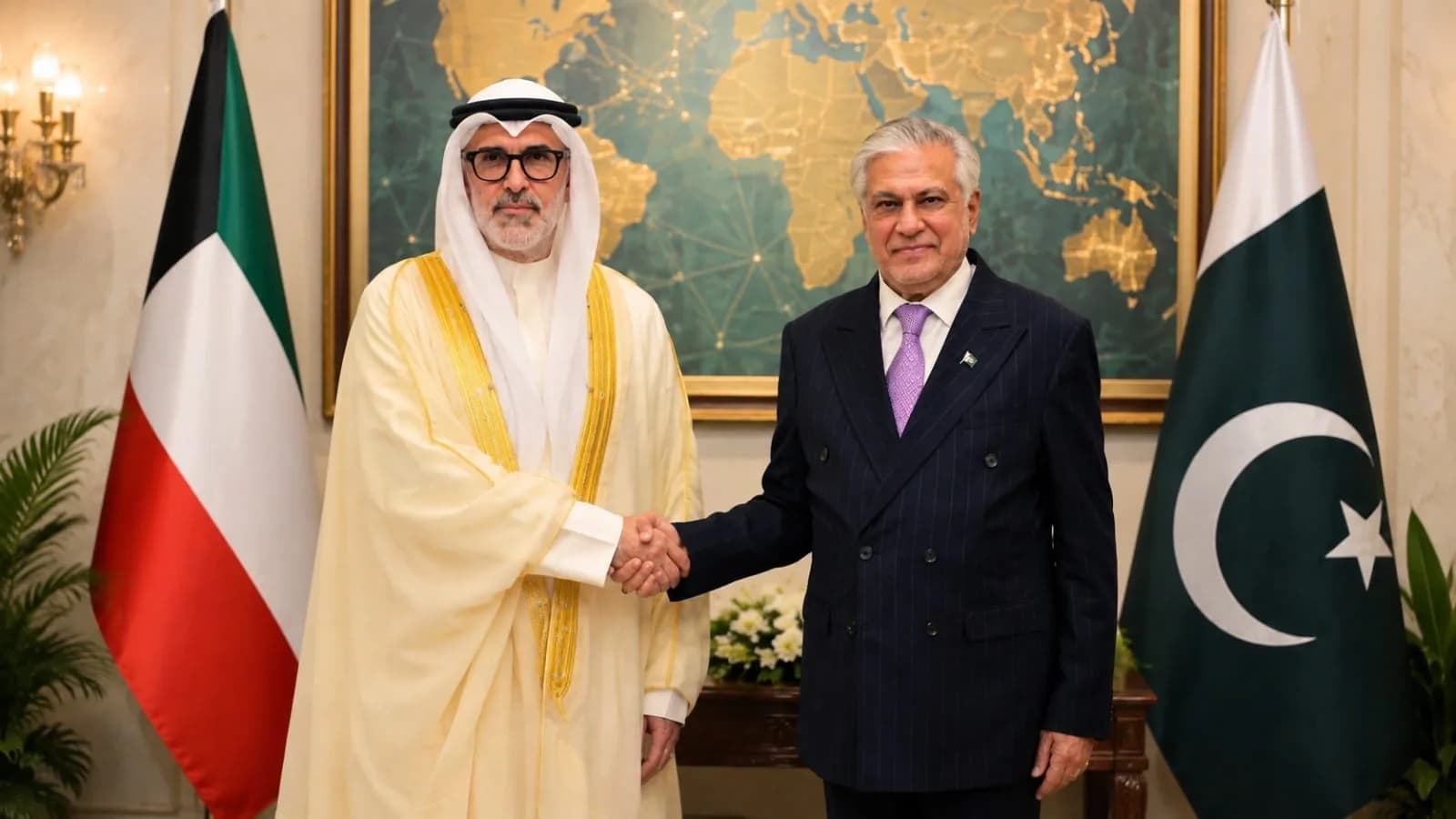
Kuwait has welcomed the new defence agreement between Pakistan, Saudi Arabia and Türkiye, with Foreign Minister Sheikh Jarrah Jaber Al-Ahmad Al-Sabah personally congratulating Ishaq Dar.
According to Pakistan’s Foreign Office, Sheikh Jarrah spoke with Dar late on Sunday night. Apart from the Makkah Joint Defence Agreement, their discussion covered regional developments and ways to improve Pakistan-Kuwait cooperation.
The conversation comes shortly after Sheikh Jarrah’s official visit to Pakistan in late July, when both countries agreed to expand cooperation in trade, investment, energy, information technology, agriculture and other areas.
Kuwaiti Foreign Minister Congratulates Ishaq Dar
The Foreign Office said Sheikh Jarrah felicitated Ishaq Dar on the signing of the Makkah Joint Defence Agreement between Pakistan, Saudi Arabia and Türkiye.
The agreement was signed in Makkah on August 7 and introduced a collective defence arrangement among the three countries.
Under its main defence clause, an armed attack against any one of the three countries would be considered an attack against all of them.
The phone call also showed Kuwait’s interest in the new regional security arrangement at a time when countries across the Middle East are reviewing their defence needs.
Dar and Sheikh Jarrah agreed to stay in close contact as Pakistan and Kuwait work on their own bilateral relationship.
Dar and Kuwaiti FM Discuss Occupied East Jerusalem
The regional situation was another part of the conversation.
Pakistan’s Foreign Office said the two foreign ministers exchanged views on current developments, including the situation in Occupied East Jerusalem.
The issue has remained part of Pakistan’s recent diplomatic contacts with Muslim and regional countries.
Dar had travelled to Amman on August 5 for a ministerial meeting on Jerusalem, where Pakistan repeated its support for the Palestinian people and called for a Palestinian state based on pre-1967 borders, with Al-Quds Al-Sharif as its capital.
The discussion with Kuwait therefore came within a wider series of diplomatic contacts focused on both regional security and Palestine.
Pakistan and Kuwait Seek More Trade and Investment
The phone call was not limited to defence and regional politics.
Dar and Sheikh Jarrah also reviewed Pakistan-Kuwait relations and discussed follow-up work from the Kuwaiti foreign minister’s recent visit to Islamabad.
During that July 29 visit, the two countries agreed to deepen cooperation in trade, investment, energy, agriculture, information technology, education and health. They also agreed to establish joint working groups in several sectors.
These groups are expected to help both governments follow projects more closely and turn political agreements into practical cooperation.
For Pakistan, investment and energy cooperation with Gulf countries remain important parts of its economic diplomacy.
Pakistan-Kuwait Defence Cooperation Already Has a Formal Framework
Kuwait’s response to the Makkah pact also comes as its own defence ties with Pakistan are growing.
Pakistan and Kuwait originally signed a Defence Cooperation Agreement on June 11, 2023. Kuwait completed the ratification process in 2026, making the agreement fully operational.
According to Pakistan’s Foreign Office, the agreement covers areas such as military exercises and training and builds on decades of defence cooperation between the two countries.
However, the Foreign Office has clearly said that the Pakistan-Kuwait Defence Cooperation Agreement is not the same as Pakistan’s mutual defence arrangement with Saudi Arabia.
Pakistan has also held discussions with Kuwait over deeper defence, energy and investment cooperation, although Reuters reported in July that talks on any expanded arrangement were still at an early stage.
What Is the Makkah Joint Defence Agreement?
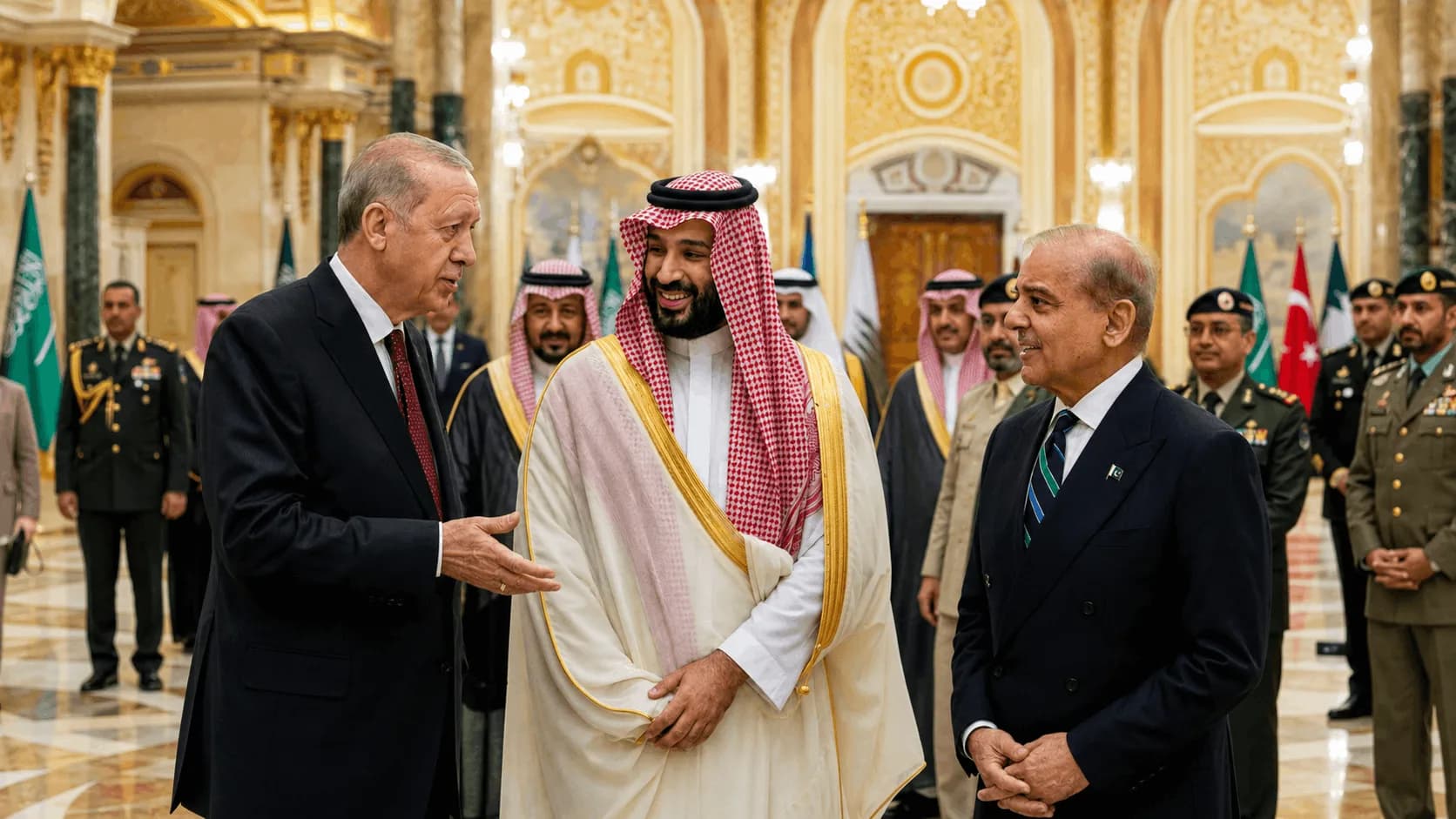
The Makkah Joint Defence Agreement brings Pakistan, Saudi Arabia and Türkiye into a three-country collective defence framework.
Prime Minister Shehbaz Sharif, Saudi Crown Prince and Prime Minister Mohammed bin Salman, and Turkish President Recep Tayyip Erdoğan signed the agreement in Makkah on August 7, 2026.
Its most important provision is the mutual defence commitment.
If one member faces an armed attack, the attack will be treated as an attack against all three members. The countries have also agreed to strengthen defence coordination and deterrence.
The agreement creates a stronger formal structure around defence relations that already existed between the three states.
Pakistan and Saudi Arabia have had close military relations for decades, while Pakistan and Türkiye cooperate in military training, defence production and other security areas.
Ishaq Dar Says Pact Is Purely Defensive
Ishaq Dar has rejected suggestions that the new agreement is aimed at any particular country.
Speaking after the signing, Dar said its purpose was to support peace, stability and prosperity in the region. He also said the agreement does not cancel or replace other bilateral or multilateral agreements held by Pakistan, Saudi Arabia or Türkiye.
Pakistan has described the arrangement as defensive and linked it to the right of self-defence under Article 51 of the United Nations Charter.
Dar has also said the framework could remain open to other countries that agree with its principles and support peaceful regional cooperation.
This clarification is important because the pact was signed during a period of serious tension across the Middle East.
Türkiye Compares Mutual Defence Clause to NATO Article 5
Turkish Foreign Minister Hakan Fidan has compared the main defence clause of the Makkah agreement with NATO’s Article 5.
Article 5 is based on the principle that an attack against one NATO member is treated as an attack against all members.
Fidan said the basic mutual-defence principle of the Pakistan-Saudi Arabia-Türkiye pact works in a similar way.
However, this does not mean the Makkah pact is identical to NATO.
NATO is a large military alliance with decades of established command structures, procedures and institutions. The three-country Makkah arrangement is new, and many of its working rules are still being developed.
Fidan said the type and level of support required during a crisis would be discussed by member countries depending on the situation.
Saudi Arabia to Host Secretariat for Defence Pact
The three countries are also planning a formal structure to manage the agreement.
According to Hakan Fidan, a committee of ministers will be formed under the pact, while a permanent general secretariat will be based in Saudi Arabia.
The committee is expected to discuss how the agreement will work in practice.
This includes rules for cooperation, consultation and the type of support member countries could provide to each other.
Further details are expected to be worked out during future meetings rather than being automatically decided by the signing of the agreement.
Could Other Countries Join the Makkah Defence Pact?
The agreement may not remain limited to Pakistan, Saudi Arabia and Türkiye.
Turkish officials have said other regional countries could join in the future.
Fidan specifically mentioned Egypt as a possible future participant once technical matters are resolved.
Dar has also indicated that the framework is not intended to be a closed group and could welcome countries that accept its peaceful and defensive goals.
Any future expansion, however, would require political agreement and clear rules among the existing members.
For now, Pakistan, Saudi Arabia and Türkiye remain the three members of the Makkah Joint Defence Agreement.
Iran Says It Has No Reason to Fear the Agreement
Iran also responded to the new defence pact on August 10.
Iranian Foreign Ministry spokesperson Esmaeil Baghaei said Tehran saw no reason to be concerned about the agreement between Pakistan, Saudi Arabia and Türkiye.
He said greater regional reliance on local security arrangements could be positive if such cooperation remains inclusive and responds to the real security needs of the region.
Iran’s response is important because the agreement was signed during continuing tensions involving Tehran and other regional and international powers.
Both Pakistani and Turkish officials have said the Makkah pact is not aimed specifically at Iran or any other country.
Makkah Agreement Builds on Pakistan-Saudi Defence Pact
The latest agreement also builds on an earlier defence pact between Pakistan and Saudi Arabia.
Pakistan and Saudi Arabia signed the Strategic Mutual Defence Agreement in September 2025.
That pact stated that aggression against either Pakistan or Saudi Arabia would be considered aggression against both countries.
The Makkah Joint Defence Agreement has now taken the same basic idea to a trilateral level by bringing Türkiye into a new framework alongside Pakistan and Saudi Arabia.
The new pact does not replace the earlier Pakistan-Saudi agreement. Dar has said existing agreements will continue separately.
Exact Military Response Will Depend on the Situation
The phrase “attack on one is an attack on all” gives the pact a strong collective defence commitment, but it does not mean the same military response will automatically follow every incident.
The exact form of assistance has not been publicly fixed in detail.
Turkish Foreign Minister Hakan Fidan said countries could decide what type of support is needed through consultation.
That support could depend on the nature of the threat and the needs of the member involved.
This distinction helps explain why officials compare the agreement’s basic principle with NATO Article 5 without describing the new group as a full copy of NATO.
Ishaq Dar Briefs African Leaders on Defence Agreement
Dar has also been explaining the agreement to leaders outside the Middle East.
According to the Foreign Office, he spoke with Democratic Republic of the Congo President Félix-Antoine Tshisekedi Tshilombo and former Guinea-Bissau president Umaro Sissoco Embaló.
Dar briefed them on the main points of the agreement and explained Pakistan’s view that it could support strategic cooperation and regional peace, stability and security.
Dar and President Tshisekedi also discussed Pakistan-DRC relations and agreed on the need for stronger bilateral contacts, including high-level exchanges.
The calls show that Pakistan is trying to explain the purpose of the new pact to international partners rather than allowing its goals to be shaped only by outside speculation.
Why the Makkah Joint Defence Agreement Matters
The agreement links three countries with long-standing but different defence strengths.
Pakistan has a large military and long defence relations with Saudi Arabia. Türkiye is a NATO member with a developed defence industry, while Saudi Arabia has major economic resources and an important position in the Gulf and the wider Muslim world.
The pact also comes during a period of conflict and security pressure across the Middle East.
For the three members, the agreement offers a formal way to improve coordination, strengthen deterrence and reduce the risk of facing major threats alone.
At the same time, its long-term importance will depend on how the planned ministerial committee and secretariat work, how members respond to future security crises, and whether more countries eventually join.
What Happens Next?
The signing of the Makkah Joint Defence Agreement is only the first stage.
Pakistan, Saudi Arabia and Türkiye will now have to work on the practical rules needed to run the arrangement.
Attention will be on the first ministerial meetings, the establishment of the Saudi-based secretariat and decisions on how members will coordinate during a security crisis.
Possible expansion will also remain an important question, especially after Türkiye mentioned Egypt as a potential future member.
For Pakistan, the agreement also comes alongside closer defence and economic contacts with Kuwait and other Gulf states.
Kuwait’s congratulations to Ishaq Dar therefore carry more weight than a routine diplomatic message. They come at a time when Pakistan, Saudi Arabia, Türkiye and Gulf partners are building closer security, investment and diplomatic ties while trying to manage a highly tense regional situation.
Frequently Asked Questions
1. What is the Makkah Joint Defence Agreement?
The Makkah Joint Defence Agreement is a defence pact signed by Pakistan, Saudi Arabia and Türkiye. It says that an armed attack on one member will be treated as an attack on all three.
2. Why did the Kuwaiti Foreign Minister congratulate Ishaq Dar?
Kuwaiti Foreign Minister Sheikh Jarrah Jaber Al-Ahmad Al-Sabah congratulated Ishaq Dar on the signing of the Makkah Joint Defence Agreement and also discussed regional and bilateral issues with him.
3. When was the Makkah Joint Defence Agreement signed?
The agreement was signed in Makkah on August 7, 2026, by Pakistan, Saudi Arabia and Türkiye.
4. Is the Makkah defence pact aimed at any specific country?
Pakistan has said the agreement is defensive in nature and is not directed against any specific country. Its stated purpose is to support regional peace, stability and security.
5. Is the Makkah defence pact similar to NATO Article 5?
The mutual-defence principle is similar because both treat an attack on one member as an attack on all. However, the Makkah pact is not the same as NATO and has a different structure.
6. Can other countries join the Makkah Joint Defence Agreement?
Officials have indicated that the framework could be opened to other countries in the future if they agree with its principles and the existing members approve.
7. What did Pakistan and Kuwait discuss besides the defence pact?
Ishaq Dar and the Kuwaiti Foreign Minister also discussed regional developments, Occupied East Jerusalem, investment, bilateral relations and ways to strengthen cooperation between Pakistan and Kuwait.
Topics in this story
Article Details
Category: News
Published:
Updated:
Author: Rabia
More Stories