 Posted by
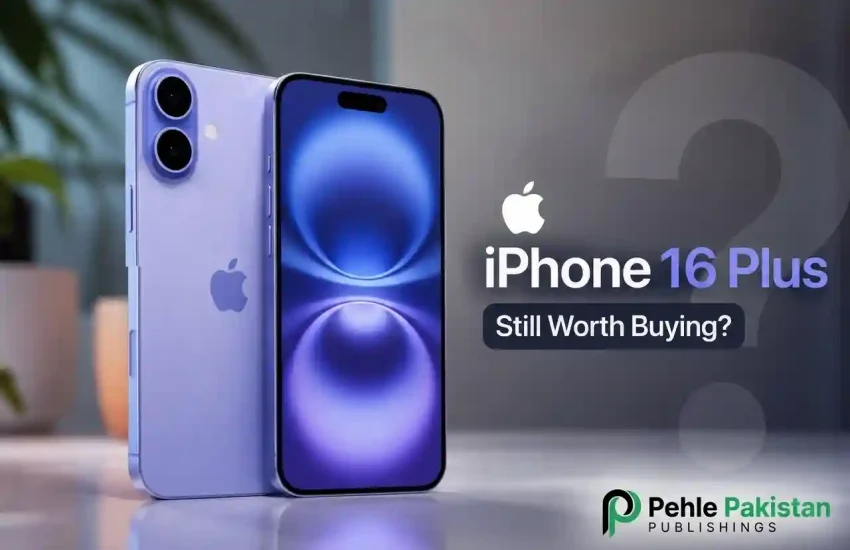
 The Apple iPhone 16 Plus is no longer the newest large-screen non-Pro iPhone, but it still has a clear reason to exist in 2026. It gives you a 6.7-inch OLED display, strong battery life, the A18 chip, Apple Intelligence support and two useful rear cameras without moving to a Pro Max.
Its main weakness is just as clear: the display is still 60Hz, while newer iPhones have moved to 120Hz ProMotion. So the iPhone 16 Plus makes the most sense for buyers who care more about a large screen and battery life than the smoothest display or the newest camera hardware.
For current Pakistan pricing and the complete hardware list, see the Apple iPhone 16 Plus price and full specifications.
Before choosing a model, compare the latest iPhone prices in Pakistan across the current lineup.
Why the iPhone 16 Plus Still Makes Sense in 2026
Big Screen and Strong Battery
The biggest reason to choose the iPhone 16 Plus is still its 6.7-inch OLED display. It gives you more room for video, reading, gaming and photo editing than the regular iPhone 16, while staying lighter than a Pro Max.
Battery life is another real strength. Apple rates the phone for up to 27 hours of video playback, and independent testing has also shown the 16 Plus can last very well in mixed use. That makes it a sensible option for people who want a large iPhone without charging anxiety being the main concern.
A18 Performance and Apple Intelligence
The A18 chip is still fast enough for everyday apps, gaming, camera processing and current iOS features. More importantly in 2026, the iPhone 16 Plus supports Apple Intelligence, while the regular iPhone 15 and iPhone 15 Plus do not.
That gives the 16 Plus a stronger long-term software position than the previous Plus model. Apple Intelligence features still depend on supported languages, regions and the latest iOS version, so buyers should treat compatibility and feature availability as two separate things.
Camera: Useful, but Not Pro-Level
| Camera feature | What it means |
| 48MP Fusion main | Good main camera with 24MP/48MP capture and a useful 2x crop option. |
| 12MP Ultra Wide with autofocus | Adds wide-angle shooting and macro photography. |
| Camera Control | Quick camera launch and direct access to zoom, exposure and other controls. |
| No dedicated telephoto lens | Long-range zoom is the main camera limitation compared with Pro models. |
For normal photos, family shots, travel, video and social content, the iPhone 16 Plus camera system is still versatile. The Ultra Wide camera can focus for macro photography, and the main camera also provides a 2x optical-quality crop.
But this is not a Pro camera system. There is no dedicated telephoto lens, so buyers who regularly shoot distant subjects or want stronger zoom should look at a Pro model instead.
The 60Hz Display Is the Main Compromise
The screen itself is large, bright and sharp, but its 60Hz refresh rate is the biggest reason the iPhone 16 Plus can feel older in 2026. Newer iPhones such as the iPhone 17 and iPhone Air use 120Hz ProMotion, which makes scrolling and supported animations look smoother.
If you are coming from another 60Hz iPhone, this may not bother you. If you already use a 120Hz phone, the difference is much easier to notice. For some buyers, this one limitation will matter more than the A18 chip or Camera Control.
How Does It Compare with Newer iPhones?
The iPhone 16 Plus now sits between newer models rather than having a direct iPhone 17 Plus replacement. The iPhone 17 is smaller but more modern, while the iPhone Air is lighter and thinner but gives up the Ultra Wide camera.
If you’re comparing other options, our guide to the best camera and battery phones can help.
| What matters | iPhone 16 Plus | iPhone 17 | iPhone Air |
| Screen | 6.7-inch OLED | 6.3-inch OLED | 6.5-inch OLED |
| Refresh rate | 60Hz | Up to 120Hz | Up to 120Hz |
| Rear cameras | 48MP main + 12MP Ultra Wide | 48MP main + 48MP Ultra Wide | Single 48MP main |
| Apple video playback claim | Up to 27 hours | Up to 30 hours | Up to 27 hours |
| Weight | 199g | 177g | 165g |
Choose the iPhone 17 if the smoother 120Hz display, newer cameras and newer chip matter more than having the biggest non-Pro screen. Choose the iPhone Air if thinness and low weight are the priority and you can live without an Ultra Wide rear camera.
The iPhone 16 Plus still has the clearest case for buyers who want a 6.7-inch screen, two rear cameras and strong battery life in a non-Pro iPhone. That combination is what keeps it relevant even after the Plus name disappeared from the newer lineup.
If the thinner design is more important to you than the larger screen and second rear camera, see the iPhone Air before deciding.
Should iPhone 15 Plus Owners Upgrade?
For most iPhone 15 Plus owners, the upgrade is useful but not essential. The two phones share the same 6.7-inch screen size and a similar overall design, so the change is more about new features than a completely different daily experience.
| What changed | iPhone 16 Plus | iPhone 15 Plus |
| Chip | A18 | A16 Bionic |
| Apple Intelligence | Supported | Not supported |
| Controls | Action button + Camera Control | Ring/Silent switch |
| Ultra Wide | Autofocus + macro | Fixed-focus Ultra Wide |
| MagSafe | Up to 25W | Up to 15W |
| Apple video playback claim | Up to 27 hours | Up to 26 hours |
The strongest reasons to upgrade are Apple Intelligence, the A18 chip, macro photography, Camera Control, the Action button and faster MagSafe charging. Those are real improvements, but they do not change the fact that both phones use a large 60Hz OLED display and a similar basic camera layout.
If your iPhone 15 Plus is already fast enough and you do not care about Apple Intelligence or the new controls, keeping it is the more sensible choice. The iPhone 16 Plus becomes more attractive for users coming from an iPhone 14 Plus or an older model.
Who Should Buy the iPhone 16 Plus?
- Buy it if you want a large 6.7-inch iPhone but do not need Pro Max cameras or Pro features.
- Buy it if battery life and media viewing matter more to you than a 120Hz display.
- Buy it if you want a large iPhone with strong battery life and newer features without moving to a Pro Max model.
- Consider something else if you want 120Hz ProMotion, a dedicated telephoto camera, lighter weight or faster wired charging.
- If you already own an iPhone 15 Plus, upgrade only if the A18, Apple Intelligence, macro camera or new controls solve a real need for you.
What Pakistan Buyers Should Check
- PTA and IMEI status: confirm the exact phone’s PTA status and match the IMEI with the device and box before paying.
- SIM variant: iPhone 16 Plus models are eSIM-only, while models purchased outside the U.S. can include a physical nano-SIM tray. Confirm the exact variant before buying.
- Storage choice: the phone starts at 128GB, but iOS, apps, photos, video and Apple Intelligence models all use storage. Buyers who keep phones for years should choose capacity around their real usage.
- Warranty and condition: confirm local warranty coverage and inspect imported, open-box or used units carefully, including battery health, display condition and repair history.
- Charging accessories: the phone supports faster MagSafe charging than the iPhone 15 Plus, but the required adapter and MagSafe charger are sold separately.
Frequently Asked Questions
Does the iPhone 16 Plus support fast charging?
Yes. The iPhone 16 Plus supports fast charging with a USB-C power adapter of 20W or higher. Apple says it can reach up to 50% charge in around 30 minutes when using a compatible adapter and USB-C charging cable. The charger is sold separately, so buyers should check their accessories before purchase.
Does the iPhone 16 Plus support Apple Intelligence?
Yes. Apple lists all iPhone 16 models as compatible with Apple Intelligence. Feature availability still depends on the iOS version, supported language and region.
Does the iPhone 16 Plus have a 120Hz display?
No. The iPhone 16 Plus uses a 60Hz display. If smooth scrolling and high-refresh gaming are priorities, newer 120Hz iPhones are a better fit.
Does the iPhone 16 Plus have a physical SIM slot?
It depends on where the phone was originally sold. U.S. models are eSIM-only, while models purchased outside the U.S. can have a physical nano-SIM tray. This is an important check for Pakistan buyers.
Does the iPhone 16 Plus have a telephoto camera?
It does not have a dedicated telephoto lens. The 48MP main camera provides a 2x optical-quality crop, but longer-range zoom is better handled by Pro models with a real telephoto camera.
Can the iPhone 16 Plus charge at 25W with MagSafe?
Yes. Apple lists MagSafe and Qi2 wireless charging up to 25W with the required compatible charger and power adapter.
Is 128GB enough for the iPhone 16 Plus in 2026?
It can be enough for light users who rely on cloud storage, but photos, 4K video, apps and Apple Intelligence models can use space quickly. Buyers planning to keep the phone for years should choose storage based on their actual media and app use.
Is the iPhone 16 Plus water resistant?
Yes. It carries an IP68 rating under controlled laboratory conditions, but water resistance is not permanent and can decrease with normal wear. Liquid damage is not treated as normal waterproof use.
Final Verdict
The Apple iPhone 16 Plus is still worth considering in 2026 if your priorities are a large screen, strong battery life, reliable performance and Apple Intelligence support. It makes the most sense for buyers who want a big-screen iPhone experience without needing Pro Max features.
Its biggest weakness is the 60Hz display, and newer models now offer smoother screens, newer cameras and lighter designs. So the iPhone 16 Plus is not the best choice for everyone – but for a buyer who values screen size and battery more than the newest display technology, it still has a clear place.