Quick Answer
Norwegian Foreign Minister Espen Barth Eide has praised Pakistan’s efforts to reduce tensions between Iran and the United States. During an official visit to Islamabad on August 13, 2026, he described the mediation as a “massive task” and said the contributions of Prime Minister Shehbaz Sharif, Deputy Prime Minister Ishaq Dar and Field Marshal Syed Asim Munir were a “service to the world.”
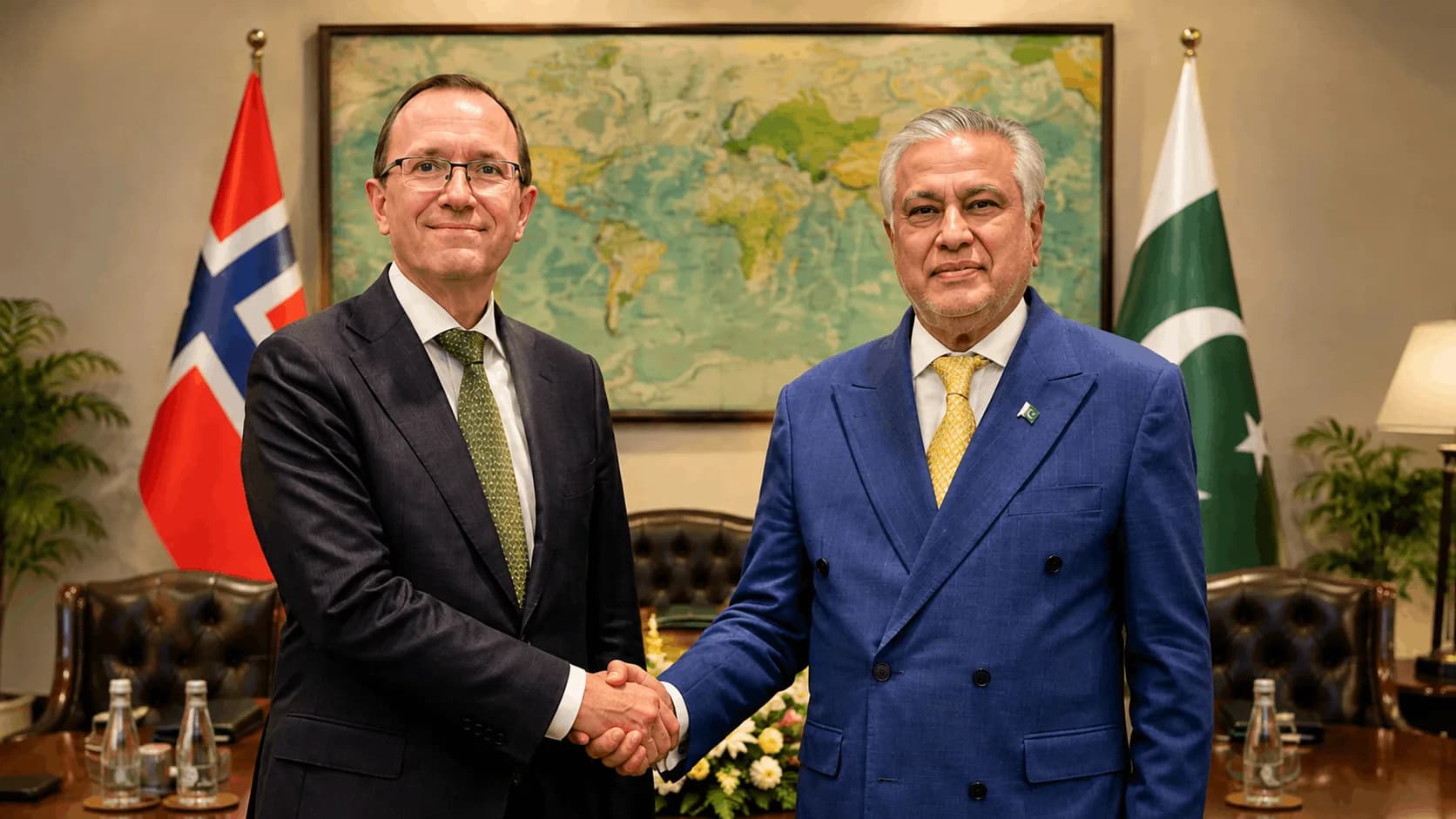
Norway has praised Pakistan for playing an important and constructive role in diplomatic efforts between Iran and the United States. The appreciation came during Norwegian Foreign Minister Espen Barth Eide’s official visit to Islamabad, the first visit by a Norwegian foreign minister to Pakistan in a decade.
Eide made the remarks at a joint press conference after holding delegation-level talks with Deputy Prime Minister and Foreign Minister Ishaq Dar at the Ministry of Foreign Affairs.
His statement placed international attention on Pakistan’s attempt to prevent further escalation and promote dialogue during a dangerous period for the Middle East.
Norway Recognises Pakistan’s Mediation Efforts
Speaking about the Iran-US conflict, Eide said Pakistan had taken on a difficult diplomatic responsibility. He acknowledged that bringing the opposing sides closer was not an easy task, especially when trust remained limited and the risk of renewed fighting was still present.
“I really want to commend Pakistan for the very important role it has taken,” the Norwegian foreign minister said while discussing the conflict and its wider consequences.
Eide described the peace mediation and facilitation process as a “massive task” that Pakistan had offered to undertake during talks in Islamabad.
Norway had previously supported Pakistan-led efforts to create space for dialogue. In an official statement issued in April 2026, the Norwegian government said Pakistan’s work, supported by Türkiye and Egypt, had been important in facilitating communication between the parties.
That statement welcomed diplomatic progress but also warned that a ceasefire should not be treated as a permanent peace agreement. The parties, it said, still needed to exercise restraint and work toward a lasting political solution.
Pakistani Leadership Praised for Peace Efforts
Eide specifically recognised the roles of Prime Minister Shehbaz Sharif, Deputy Prime Minister and Foreign Minister Ishaq Dar, and Chief of Defence Forces and Chief of Army Staff Field Marshal Syed Asim Munir.
“I think Prime Minister Shehbaz Sharif, Field Marshal Asim Munir and Ishaq Dar are really doing a service to the world,” he said.
The remarks indicate that Norway views Pakistan’s mediation as more than a regional initiative. A confrontation involving Iran and the United States could affect security, trade and energy supplies far beyond the Middle East.
Pakistan has maintained diplomatic contact with Iran while also engaging the United States and other international partners. These relationships give Islamabad an opportunity to pass messages, support negotiations and encourage restraint. However, the success of any mediation still depends on the willingness of the main parties to reach and honour an agreement.
Why Pakistan’s Role Matters for Regional Stability
Further escalation between Iran and the United States could create serious consequences for neighbouring countries. It could also increase pressure on global energy markets, commercial shipping and international supply chains.
Pakistan shares a border with Iran and has a direct interest in preventing instability from spreading across the region. A prolonged conflict could create security challenges, disturb border trade and place additional economic pressure on nearby states.
Diplomatic mediation offers a way to keep communication open even when formal relations between the opposing sides are under severe strain. A mediator cannot impose peace, but it can help deliver proposals, reduce misunderstandings and create opportunities for direct or indirect talks.
International support from countries such as Norway may also strengthen the diplomatic process. Such backing shows that preventing escalation is not only a concern for the countries directly involved but a wider international priority.
Norway Calls for Open International Sea Routes
Freedom of navigation was another major issue raised by Eide during his Islamabad visit. As an important maritime and shipping nation, Norway has a strong interest in keeping international sea routes open and secure.
Eide said countries share an interest in open sea lanes, safe trade and respect for the United Nations Convention on the Law of the Sea.
He stressed that access through international waterways should not be viewed only as an issue for the parties involved in the conflict. Any disruption to a major shipping route can affect fuel supplies, transport costs, food prices and international commerce.
The Strait of Hormuz is particularly important because it connects the Gulf with global markets and carries a significant share of the world’s energy shipments. Tensions in or around the strait can quickly increase shipping risks and insurance costs, even before a complete closure occurs.
Norway’s position is that free passage through international waters must be protected in accordance with international law.
Norway’s Position on International Law
Eide said Norway was among the Western countries that had clearly raised concerns about the legality of the war. He also stated that Iran, like other sovereign countries, had a right to protection as a state.
This position reflects Norway’s wider emphasis on the UN Charter, territorial integrity and the peaceful settlement of disputes.
During their talks, Pakistan and Norway reaffirmed their commitment to multilateralism, respect for sovereignty and international law. These principles are important because diplomatic agreements are more likely to last when they are supported by recognised legal frameworks and credible international commitments.
Pakistan and Norway Discuss Stronger Relations
The Islamabad talks were not limited to the Iran-US conflict. Ishaq Dar and Espen Barth Eide also reviewed Pakistan-Norway relations and discussed cooperation in trade, investment, education, climate change and maritime affairs.
Both sides agreed that bilateral trade remained below its potential. Dar highlighted investment opportunities for Norwegian companies and pointed to growing technology links between the two countries.
Labour mobility and legal opportunities for skilled Pakistani workers were also discussed. Pakistan and Norway agreed to continue working on stronger people-to-people contacts.
The Pakistani community in Norway, estimated at around 60,000 people, provides an important connection between the two countries. Its contribution can support business, education and cultural relations alongside official diplomatic engagement.
What Could Happen Next?
Pakistan is expected to continue supporting communication between Iran and the United States, but major disagreements remain. Reports that no progress has been made on reviving an interim peace arrangement show how difficult the negotiations are.
A lasting settlement would require restraint from both parties and clear agreements on security, sanctions, Iran’s nuclear programme and freedom of navigation. International support can help the process, but it cannot replace decisions by Tehran and Washington.
Norway’s praise gives Pakistan valuable diplomatic recognition at a time when regional tensions remain high. The outcome of the mediation, however, will be judged by whether it produces a durable agreement, protects international trade and prevents another cycle of conflict.
Frequently Asked Questions
1. What did Norway say about Pakistan’s mediation efforts?
Norwegian Foreign Minister Espen Barth Eide praised Pakistan’s Iran-US mediation and described its peace efforts as a “service to the world.”
2. Who did the Norwegian foreign minister praise?
He praised Prime Minister Shehbaz Sharif, Ishaq Dar and Field Marshal Syed Asim Munir for supporting peace efforts.
3. Why is Pakistan mediating between Iran and the US?
Pakistan wants to reduce regional tensions, prevent further conflict and support a peaceful agreement between Iran and the United States.
4. Why is the Strait of Hormuz important?
The Strait of Hormuz is a major international shipping route. Any disruption can affect global energy supplies, trade and fuel prices.
5. What did Pakistan and Norway discuss in Islamabad?
They discussed regional peace, trade, investment, education, climate change, maritime cooperation and stronger bilateral relations.
Topics in this story
Article Details
Category: News
Published:
Updated:
Author: Rabia
More Stories