PTA Approved vs Non-PTA Mobile: 2026 Buyer's Guide
PTA Approved vs Non-PTA Mobile: 2026 Buyer's Guide
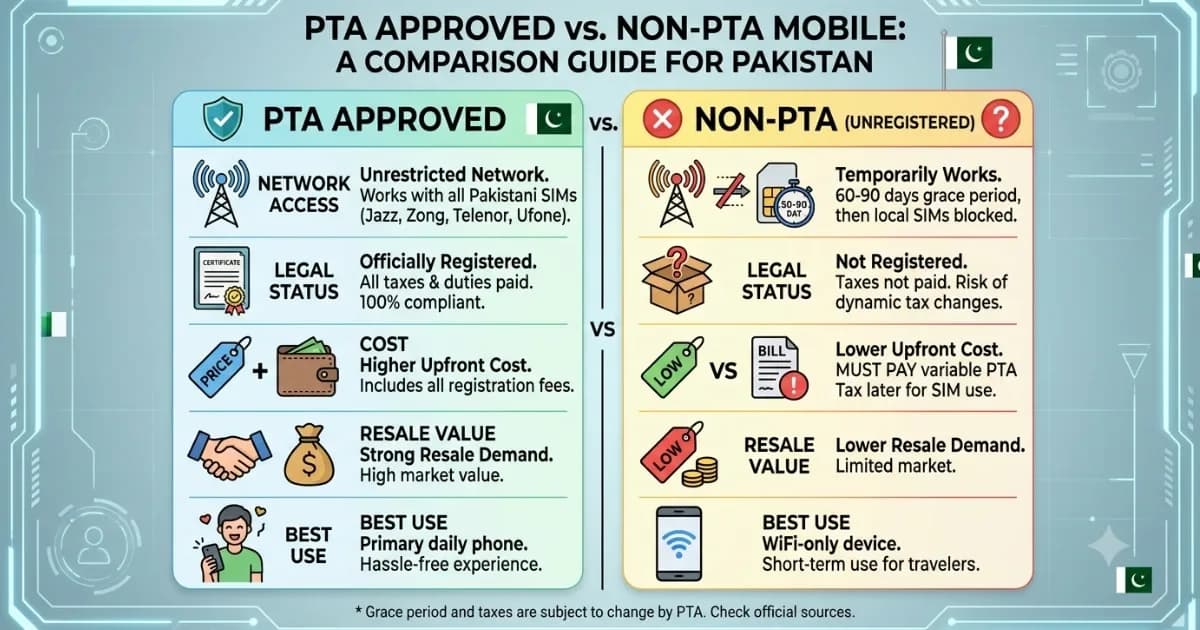
Every phone sold or brought into Pakistan falls into one of two categories: PTA approved or non-PTA. The label sounds like a technicality, but it decides something practical — whether your SIM keeps working after a set number of days. This guide breaks down what each status means, what it costs, and which one fits your situation.
What "PTA Approved" Actually Means
A PTA-approved phone has its IMEI (International Mobile Equipment Identity) registered in the Device Identification, Registration and Blocking System (DIRBS), run by the Pakistan Telecommunication Authority. Once registered, the device is authorized to operate on local Pakistani networks indefinitely.
A non-PTA phone hasn't been through this registration. It isn't illegal to own, and it isn't "banned" — but PTA policy allows unregistered devices to run on a local SIM only for a limited window (commonly cited as 60 days) before mobile network services are restricted.
What Stops Working on a Non-PTA Phone
This is the part buyers underestimate. Once a non-PTA device is blocked:
Calls and SMS on the local SIM stop working
Mobile data stops working
Wi-Fi-based apps continue normally — WhatsApp, streaming, browsing, and games all function as long as you're connected to Wi-Fi
In practice, this means the phone becomes a Wi-Fi-only device. That's a reasonable trade-off for some buyers and a dealbreaker for others, depending on how the phone is actually used day to day.
How DIRBS Registration Works
DIRBS checks a phone's IMEI the moment a Pakistani SIM is inserted. If the IMEI is already registered or the device is within its grace period, service continues. If not, the system flags it for registration and payment before granting long-term access.
A few rules matter here:
Roaming exemption: Phones using an international roaming SIM are not subject to DIRBS blocking while roaming. The check only applies once a local Pakistani SIM is inserted.
Dual-SIM devices have two IMEIs. Registering or verifying only one does not cover the second slot — both need to be checked independently.
Personal allowance: Individuals can register a limited number of devices per year (currently up to five) under the personal-use category without commercial import documentation.
PTA Tax: Why the Amount Isn't Fixed
PTA tax isn't a flat fee — it's a combination of customs duty and sales tax calculated through DIRBS, based on the phone's assessed customs value and the registration route used (CNIC or passport).
A simplified view of how duty tiers work:
Customs Value (USD) | Duty Structure |
|---|---|
Up to $30 | Fixed low-tier amount |
$31–$100 | Fixed tier |
$101–$200 | Fixed tier |
Above $200 | Fixed tier + 17% ad valorem sales tax |
Under the 2026-27 budget, relief measures were reported specifically for phones in the $101–$200 import value bracket, effective from July 1, 2026. Buyers should still confirm the exact payable amount through DIRBS directly, since assessed value and exchange rate can shift the final figure — headline "tax reduced" news doesn't replace checking your specific device.
Official references: DIRBS device registration and FBR mobile device regularization portal.
How to Check PTA Status Before You Buy
Four ways to verify status, from fastest to most detailed:
Dial *#06# to display the phone's IMEI (dual-SIM phones show IMEI1 and IMEI2).
SMS the IMEI to 8484 for an instant status reply.
Dial *8484# (USSD) for status and tax-related guidance without needing internet access.
Check the DIRBS portal for the full compliance record and to generate a PSID for payment.
For used-phone purchases, verify both IMEIs on dual-SIM devices before paying, and treat verbal claims of "PTA approved" as unverified until confirmed through one of these channels.
Who Should Buy Which
Choose PTA-approved if:
It's your only phone and you rely on it for calls, SMS, or banking OTPs
You need consistent mobile data outside Wi-Fi coverage
You may want to resell the device in Pakistan later (PTA-approved phones typically hold resale value better)
Non-PTA can work if:
It's a secondary device used mainly on Wi-Fi (gaming, content consumption, hotspot-tethered)
You're an overseas traveler using an international roaming SIM
You plan to register it later and are comfortable with the interim limitations
Converting a Non-PTA Phone to PTA Approved
Confirm both IMEIs using *#06# and check status via SMS to 8484.
Register through the DIRBS portal, USSD (*8484#), or a mobile operator facilitation center.
Generate a PSID and pay applicable duties through an authorized banking channel.
Recheck status via 8484 and test both SIM slots after payment clears.
Bottom Line
The PTA-approved vs non-PTA decision comes down to how you use the phone, not the phone itself. A daily-driver phone needs registered network access; a secondary Wi-Fi device doesn't. Before paying for either, verify the IMEI status directly through DIRBS or the 8484 service — not through a seller's assurance.
FAQPage Content
Q: What's the difference between PTA and non-PTA phones? A PTA-approved phone's IMEI is registered on DIRBS and can use local SIM services indefinitely. A non-PTA phone's IMEI isn't registered, so local SIM access is restricted after a limited period.
Q: What happens if a phone isn't PTA approved? Calls, SMS, and mobile data on the local SIM can be blocked. Wi-Fi-based apps continue to work normally.
Q: Can I use WhatsApp on a non-PTA phone? Yes, over Wi-Fi. SMS-based OTP verification is the main function affected if the local SIM is blocked.
Q: How do I check if a phone is PTA approved? Dial *#06# for the IMEI, then send it via SMS to 8484, or check directly on the DIRBS portal.
Q: Is PTA tax the same for every phone? No. It depends on the phone's assessed customs value and registration route (CNIC or passport), calculated through DIRBS.
Article Details
Category: Telecom
Published: 20 July 2026
Time: 2:17 pm
Updated: 20 July 2026 at 5:48 pm
Author: Taimoor Ansari
More Stories