
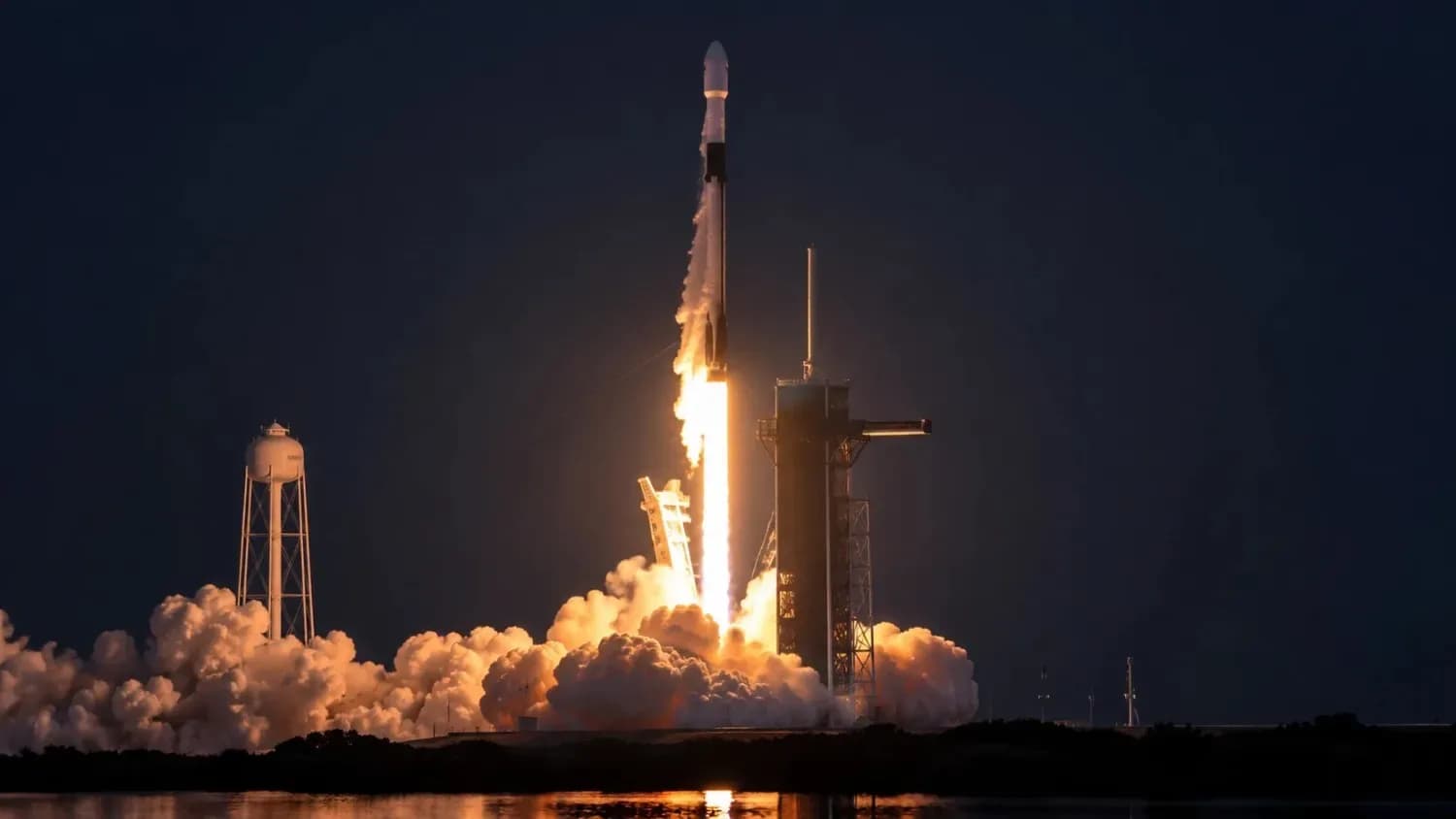
SpaceX launched 21 data transport satellites for the US military from California on July 16, expanding a low Earth orbit network designed to deliver secure, low-latency communications and support the tracking of advanced missile threats.
The Falcon 9 rocket lifted off from Space Launch Complex 4 East at Vandenberg Space Force Base at 1:32 p.m. Pacific Time, or 4:32 p.m. Eastern Time. The spacecraft were launched for the US Space Development Agency, commonly known as the SDA.
According to an official Space Development Agency statement, the mission was the third successful launch of Tranche 1 satellites for the agency’s Proliferated Warfighter Space Architecture.
Key Facts
Rocket: SpaceX Falcon 9
Payload: 21 data transport satellites
Launch site: Vandenberg Space Force Base, California
Launch time: 1:32 p.m. PT, 4:32 p.m. ET
Mission: Third Tranche 1 data transport mission
Satellite manufacturer: York Space Systems
Orbit: Low Earth orbit
Purpose: Secure military communication and missile-threat tracking
Falcon 9 Carries 21 SDA Satellites Into Low Earth Orbit
The Falcon 9 successfully carried the 21 spacecraft into an initial low Earth orbit following its launch from California.
SpaceX identified the flight as the SDA’s third Tranche 1 mission on its official mission page. It is one of nine planned Falcon 9 missions supporting the delivery of Tranche 1 satellites for the Space Development Agency.
The satellites were built by York Space Systems, a US aerospace company involved in several national security space programs.
York previously confirmed that it had delivered groups of 21 spacecraft for the SDA’s Transport Layer. The company is one of several manufacturers contributing satellites and technology to the wider military network.
The launch video showed the Falcon 9 rising above the California coast before heading south over the Pacific Ocean. SpaceX’s official mission page also provides access to the launch coverage and mission visuals.
What the Tranche 1 Transport Layer Does
The newly launched satellites are part of the Tranche 1 Transport Layer, which forms a major section of the Proliferated Warfighter Space Architecture.
The architecture is being developed as a connected network of many smaller satellites in low Earth orbit. Instead of depending on a few large and expensive spacecraft, the system spreads communication and tracking capabilities across a larger number of satellites.
This design is intended to make the network more resilient. Information can continue moving through other satellites even when one part of the system is unavailable or outside the required coverage area.
According to the SDA, the satellites will provide secure, low-latency and beyond-line-of-sight tactical communication links. They will also connect with other spacecraft through optical, or laser-based, communication links.
Low latency means data can move through the network with very little delay. This is important during military operations where commanders and personnel may need information within seconds.
How the Satellites Will Support US Military Operations
The satellites are designed to help military units share information across long distances without depending only on traditional ground-based communication systems.
The Transport Layer is expected to support several military functions, including:
Secure communication between military units
Tactical data delivery to forces in different locations
Beyond-line-of-sight targeting support
Warning and tracking of advanced missile threats
Communication with aircraft, ships and ground forces
Faster delivery of time-sensitive battlefield information
The satellites do not directly detect every missile threat themselves. Instead, the Transport Layer helps move data collected by tracking satellites and other military systems to the personnel who need it.
The SDA said the newly launched spacecraft will strengthen missile-threat tracking by providing a resilient and optically connected communication network. The purpose is to deliver important information to military users at what the agency describes as “mission-relevant speed.”
This connected approach allows information to travel between satellites before being sent to military users on Earth, at sea or in the air.
Falcon 9 Booster Completes Its Fourth Flight
The Falcon 9 first-stage booster supporting the mission was flying for the fourth time, according to SpaceX’s launch information.
After separating from the rocket’s upper stage, the reusable booster returned toward Earth and landed on SpaceX’s Of Course I Still Love You drone ship in the Pacific Ocean.
Recovering the first stage allows SpaceX to inspect, prepare and use the booster for future missions. The company’s reusable-rocket system reduces the need to manufacture an entirely new first stage for every launch.
While the booster returned to the drone ship, the second stage continued toward orbit with the 21 satellites.
Tranche 1 Satellite Total Reaches 63
The latest launch increased the number of Tranche 1 spacecraft in orbit to 63, according to the Space Development Agency.
The three dedicated Tranche 1 launches have each delivered 21 data transport satellites into orbit. The latest group will join spacecraft already undergoing testing and integration.
The complete Tranche 1 constellation is planned to include 154 operational spacecraft:
126 Transport Layer satellites
28 Tracking Layer satellites
Four additional spacecraft will be used for missile-defense demonstrations.
The network’s ground infrastructure will include two Space Operations Centers in Alabama and North Dakota, supported by ground entry points located in different parts of the world.
The SDA is working with several satellite manufacturers and technology providers instead of depending on a single company. The agency says this multi-vendor approach is intended to encourage competition and improve the resilience of the complete system.
What Happens After the Launch?
The 21 satellites are now in an initial insertion orbit, where engineers will test their systems, communication equipment and onboard payloads.
Once the testing and checkout process is complete, the spacecraft will use their propulsion systems to raise their orbits. The SDA says they are expected to reach an operational altitude of approximately 1,000 kilometres, or about 621 miles, above Earth.
Tranche 1 is expected to begin providing its first operational military capabilities in 2027.
These capabilities are planned to include persistent regional tactical data links, improved missile warning and tracking, beyond-line-of-sight targeting and demonstrations of additional military satellite communication systems.
Further launches will be required before the full Tranche 1 network is operating in orbit. The Space Development Agency said its launch campaign will continue until the remaining Transport Layer, Tracking Layer and demonstration spacecraft have been delivered.
Official sources: SpaceX Mission Page | Space Development Agency | York Space Systems
Article Details
Category: Telecom
Published:
Updated:
Author: Usama Haider
More Stories