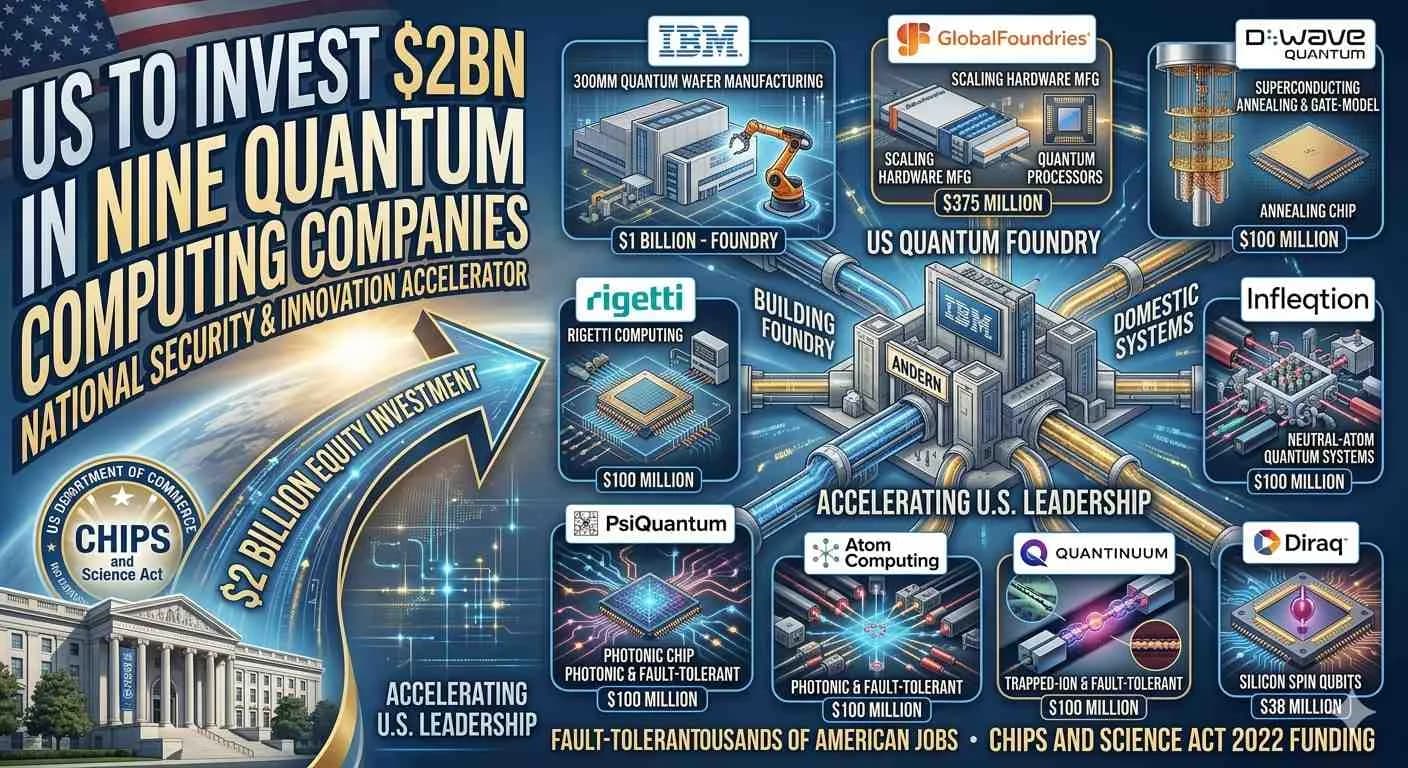
US Commits $2 Billion to Quantum Computing Push Across Nine Firms
Is the next global tech race already underway, and is quantum computing the new battleground? The United States is doubling down on that question with a massive $2 billion investment spread across nine quantum computing companies, signaling a sharper push to secure dominance in next-generation computing power.
A Strategic Bet on the Future of Computing
The funding move reflects Washington’s growing urgency to stay ahead in technologies that could redefine cybersecurity, pharmaceuticals, logistics, and artificial intelligence. Quantum computing, still in its early commercial phase, promises to solve problems far beyond the reach of classical computers.
In many cases, governments treat emerging technologies like long-term infrastructure investments. From experience, when a nation starts funding multiple private firms in parallel, it is less about immediate returns and more about controlling the ecosystem that emerges over the next decade.
Why Quantum Computing Matters Now
Unlike traditional computing that uses binary bits, quantum systems use qubits, which can process multiple states at once. This unlocks computational possibilities that could accelerate drug discovery, optimize energy grids, and break current encryption models.
One common mistake people make is assuming quantum computing is still science fiction. In reality, early-stage commercial systems are already being tested in enterprise environments, though scalability remains a major hurdle.
Industry Impact and Competitive Pressure
The investment is also a signal to global competitors, particularly China and the European Union, both of which are heavily funding quantum research. The US strategy appears focused on diversification, spreading capital across multiple startups rather than betting on a single winner.
Think of it like planting nine different orchards instead of relying on one tree. Only a few may bear fruit early, but the long-term payoff could reshape entire industries, from cybersecurity to financial modeling.
Key Areas Expected to Benefit
| Sector | Expected Impact |
|---|---|
| Cybersecurity | New encryption standards and quantum-safe protocols |
| Healthcare | Faster drug discovery and molecular simulation |
| Finance | Advanced risk modeling and portfolio optimization |
| Logistics | Real-time global supply chain optimization |
A High-Stakes Technology Race
While the promise is enormous, the risks are equally significant. Quantum computing could eventually break widely used encryption systems, forcing governments and corporations to rebuild digital security from the ground up.
From experience, technologies that begin as research tools often evolve into geopolitical leverage points. This investment signals that quantum capability is now part of national security planning, not just academic research.
Closing Perspective
The $2 billion commitment underscores a clear direction: quantum computing is no longer a distant experiment. It is becoming a structured industry backed by state-level funding and strategic intent. As competition intensifies, the next decade may decide which countries define the rules of the quantum era.
Quick Facts Box
- US investment: $2 billion
- Number of companies funded: 9
- Focus: quantum computing commercialization
- Key sectors impacted: cybersecurity, healthcare, finance
Article Details
Category: Investment
Published:
Updated:
Author: Muhammad Sheikh
More Stories