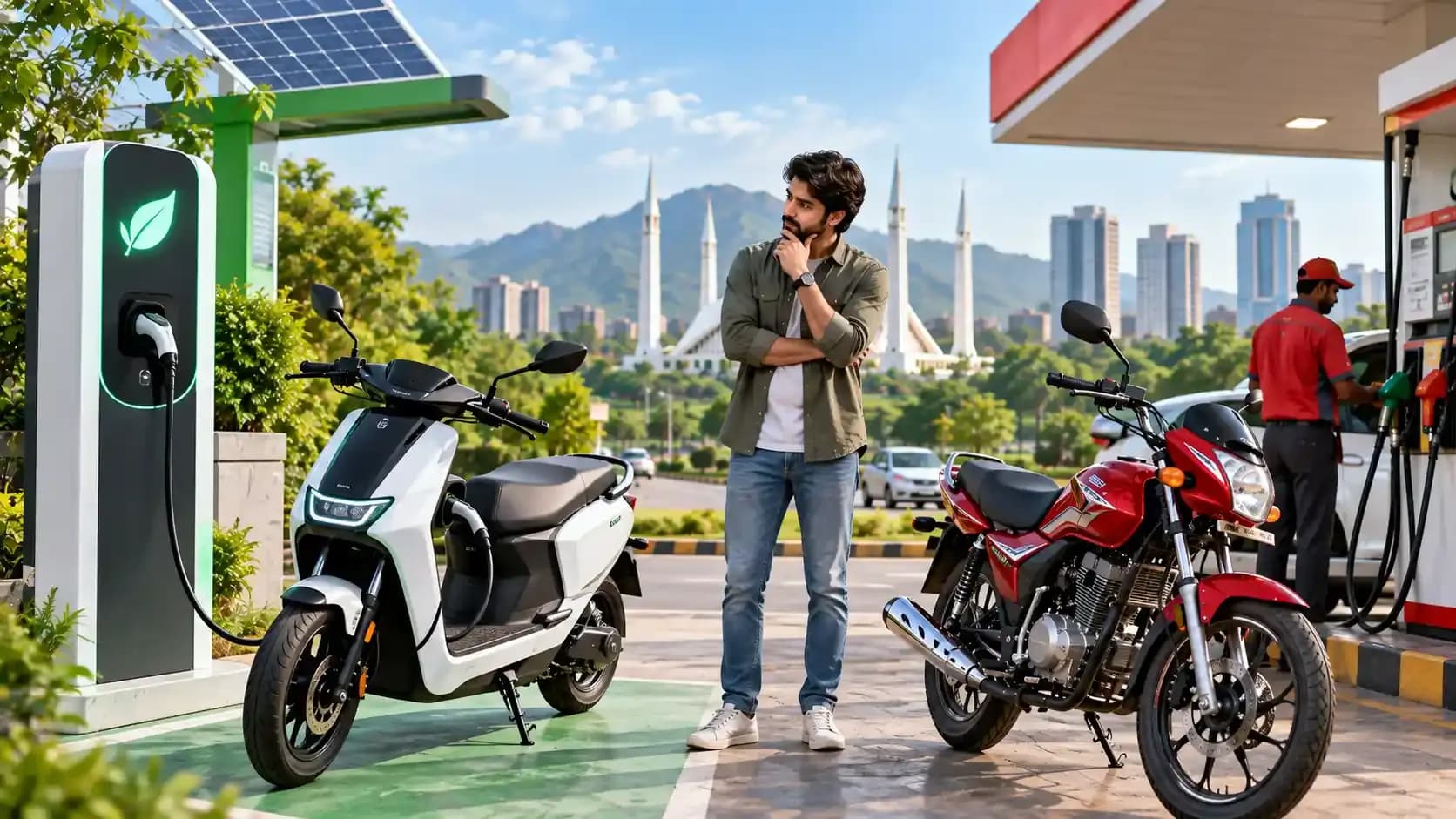
You see electric bikes everywhere now-in showrooms, on roads, in ads. They promise almost-free riding: just plug in, pay pennies for electricity, and goodbye fuel pumps. But is it actually cheaper? How much does it really cost to ride 100km on an electric bike versus a petrol bike? When do you break even on the higher upfront cost?
The answer isn't obvious. Electric bikes cost Rs 300,000-1,200,000 upfront versus Rs 120,000-500,000 for petrol bikes. But monthly charging costs just Rs 50-150 versus Rs 1,600-2,500 for petrol. The math works long-term, but only if you ride enough kilometers and buy the right model.
This guide breaks down electric bike costs in Pakistan. You'll see real cost per kilometer, monthly expenses, payback periods, available models, and whether an e-bike makes financial sense for your riding pattern.
Before comparing the models below, check the latest EV launches and prices in Pakistan.
Cost Per Km - Electric vs Petrol
The most direct comparison: how much does it actually cost to ride one kilometer?
Bike Type | Cost Per Km | Monthly | Annual | Notes |
Electric bike | Rs 0.15-0.25 | Rs 60-100 | Rs 720-1,200 | Charging only |
50-70cc petrol | Rs 0.45-0.60 | Rs 1,300-1,700 | Rs 6,750-7,300 | Fuel + maintenance |
100-125cc petrol | Rs 0.60-0.75 | Rs 1,600-1,900 | Rs 8,100-8,700 | Most popular bikes |
150cc petrol | Rs 0.85-1.00 | Rs 1,900-2,500 | Rs 9,300-10,000 | Performance trade-off |
250cc petrol | Rs 1.00-1.30 | Rs 2,500-3,300 | Rs 10,800-11,600 | Luxury class |
Electric bikes win decisively on running cost. A 100km daily commute costs Rs 15-25 on an electric bike versus Rs 60-75 on a 125cc petrol bike. That's Rs 900-1,500 monthly savings-enough for a family meal every week.
For a complete overview of motorcycle prices, registration, token tax, and running costs, see the complete motorcycle buying guide.
Monthly and Annual Operating Costs
Electric Bike Monthly Costs
Assuming 1,000 km monthly riding:
Expense | Monthly (Rs) | Notes |
Charging (1,000 km) | Rs 50-75 | At Rs 25-30/kWh rate |
Maintenance | Rs 20-30 | Occasional tire/brake only |
Insurance (optional) | Rs 100-200 | Usually bundled |
Total Monthly | Rs 170-305 | Much lower than petrol |
Petrol 125cc Monthly Costs
Assuming same 1,000 km monthly riding:
Expense | Monthly (Rs) | Notes |
Fuel (1,000 km @ 40 km/l) | Rs 1,600-1,900 | At current petrol price |
Oil changes, filters | Rs 100-150 | Every 2-3 months |
Maintenance | Rs 150-250 | Chain, brakes, adjustments |
Insurance | Rs 200-400 | Third-party mandatory |
Total Monthly | Rs 2,050-2,700 | 3-5x higher than electric |
The monthly gap is stark. Electric bikes cost one-fifth to one-tenth what petrol bikes cost to operate. Over five years, that difference totals Rs 120,000-300,000 in fuel and maintenance alone.
Upfront Cost Comparison
Bike Type | Typical Price | Warranty | Best For |
Electric 50-100km | Rs 300K-500K | 2-3 years | City commuting |
Electric 100-150km | Rs 600K-900K | 3-4 years | Longer commutes |
Electric 200+ km | Rs 1M-1.2M | 5 years | High mileage |
Petrol 50-70cc | Rs 120K-180K | N/A | Cheapest option |
Petrol 100-125cc | Rs 200K-350K | N/A | Most popular |
Electric bikes cost 2-4x more upfront. But that premium recovers through lower operating costs if you ride enough kilometers annually.
To compare current motorcycle prices and find models within your budget before deciding on electric, see motorcycle prices Pakistan
Break-Even Analysis - When Do E-Bikes Pay for Themselves?
Comparing a Rs 600,000 electric bike (100km range) vs a Rs 250,000 petrol 125cc bike:
Annual km | E-Bike Cost | Petrol Cost | Savings/Year | Payback |
5,000 km | Rs 850-1,200 | Rs 3,250-3,500 | Rs 2,000-2,650 | 226 years |
10,000 km | Rs 1,700-2,400 | Rs 6,500-7,000 | Rs 4,100-5,300 | 113 years |
15,000 km | Rs 2,550-3,600 | Rs 9,750-10,500 | Rs 6,150-7,950 | 75 years |
20,000 km | Rs 3,400-4,800 | Rs 13,000-14,000 | Rs 8,200-10,600 | 57 years |
25,000 km | Rs 4,250-6,000 | Rs 16,250-17,500 | Rs 10,250-13,250 | 26-34 years |
30,000 km | Rs 5,100-7,200 | Rs 19,500-21,000 | Rs 12,300-15,900 | 22-28 years |
Break-even takes 3-5 years for high-mileage riders (20,000+ km/year). For casual riders (under 10,000 km/year), the financial case is weak. E-bikes make sense if you ride daily for work, delivery, or long commutes.
Popular Electric Bikes Available in Pakistan
Model | Price | Range | Charge | Speed | Best For |
Super Soco TC Max | Rs 420K-480K | 100-120km | 5-6 hrs | 60km/h | City commuting |
OKA EV Classic | Rs 550K-650K | 120-150km | 6-7 hrs | 70km/h | Regular commuting |
Soul EV Apex | Rs 680K-780K | 140-170km | 6-8 hrs | 80km/h | Suburban |
Dabangg Electric | Rs 380K-450K | 80-100km | 4-5 hrs | 55km/h | Budget option |
Liberty One EV | Rs 750K-850K | 160-200km | 7-9 hrs | 90km/h | Performance |
Zongshen Z-One | Rs 320K-380K | 70-90km | 4-5 hrs | 50km/h | Entry-level |
Prices and models change frequently as new manufacturers enter Pakistan. Availability varies by city (more in Lahore/Karachi, limited in smaller cities). Most models offer 2-3 year warranties. Battery replacement (Rs 100,000-300,000) is the biggest long-term cost concern.
Advantages of Electric Bikes
Lowest running cost: Rs 50-150/month charging vs Rs 1,600-2,500 for petrol.
No petrol station visits: Charge at home overnight, always start with full battery.
Silent operation: No engine noise, smooth acceleration, peaceful riding.
Lower maintenance: No oil changes, fewer moving parts, minimal upkeep.
Eco-friendly: Zero emissions, helps reduce urban air pollution.
Tax benefits: Some provinces offer reduced token tax for electric vehicles.
Disadvantages of Electric Bikes
High upfront cost: Rs 300,000-1,200,000 vs Rs 120,000-500,000 for petrol.
Limited range: 50-200km per charge. Long trips need planning.
Slow charging: 4-9 hours for full charge. No quick-charging infrastructure yet.
Battery degradation: Capacity drops 15-20% over 3-4 years.
Limited service network: Fewer repair shops than petrol bikes.
Weather dependency: Cold and rain reduce range significantly.
Who Should Buy an Electric Bike?
Electric bikes make financial sense for daily city commuters riding 15-30km within city limits, delivery workers running fixed short routes daily, high-mileage riders (20,000+ km annually), and anyone with access to home or office charging. Electric bikes do NOT make sense for casual riders (under 10,000 km/year), long-distance travelers, or anyone without home charging access.
Still Want Fuel-Efficient Petrol?
If electric isn't practical for you, fuel-efficient petrol bikes offer a middle ground. These models deliver better mileage and lower monthly fuel costs than performance bikes, though not as cheap as electric.
To compare real-world mileage across 50cc–250cc petrol bikes, see best fuel-average bikes and mileage.
Electric Bikes and Token Tax
Many provinces offer reduced or waived token tax for electric vehicles. Some provide 30-50% discounts or complete exemption. Check your province's transport authority for exact rates. Some regions also provide registration fee waivers or purchase subsidies, though these change with annual budgets.
For complete token tax rates by province and engine capacity for both petrol and electric bikes, see token tax rates for bikes and cars.
Making Your Buying Decision
Calculate your annual riding distance. Multiply by cost per km (Rs 0.15-0.25 electric vs Rs 0.60-1.30 petrol). If savings exceed Rs 50,000 annually, e-bike pays for itself in 6-8 years. Factor in your province's token tax benefits and whether you have home charging access.
Financing Your Electric Bike Purchase
Electric bikes cost significantly more upfront. If budget is tight, explore financing options available through dealers and banks. Monthly instalments make e-bikes more accessible even if total cost is higher.
For detailed information on bike financing options, EMI calculations, and total costs with instalments, see bike instalment options and total costs.
Frequently Asked Questions
Q: What's the real cost per km for electric bikes?
Rs 0.15-0.25 per km for charging. Petrol bikes cost Rs 0.60-1.30 per km depending on engine size and mileage.
Q: How long does a battery last?
Typically 3-4 years under normal use. Battery capacity degrades 15-20% per year. Full replacement costs Rs 100,000-300,000 depending on model.
Q: Can I charge my electric bike anywhere?
Ideally at home or office where you have a regular power outlet. Charging takes 4-9 hours. Public charging infrastructure is still developing in Pakistan.
Q: What range per charge?
50-200km depending on model and conditions. City riding achieves better range than highway speeds or uphill riding.
Q: Are e-bikes cheaper than petrol long-term?
Yes, for high-mileage riders (20,000+ km/year). Break-even is 3-5 years. For casual riders (under 10,000 km/year), petrol bikes remain cheaper.
Q: Do e-bikes get reduced token tax?
Many provinces offer 30-50% token tax discounts or complete waivers for electric vehicles. Check your transport authority for exact details.
Decide: Electric or Petrol?
Calculate annual riding: daily km × 250 working days.
Multiply by cost per km. If savings exceed Rs 50,000/year, electric pays off faster.
Check if you have home/office charging access. If not, petrol is more practical.
Compare petrol alternatives by fuel efficiency with the best fuel average bikes in Pakistan.
Factor in token tax by province using the latest token tax rates in Pakistan.
For the complete bike buying process, including registration and transfer when buying used, see the complete motorcycle buying guide.
If you need financing, see bike on instalments in Pakistan.
Article Details
Category: EVs
Published:
Updated:
Author: Kaif
More Stories