Gandhi on Imam Hussain RA: What the Father of Non-Violence Really Said About the Sacrifice of Karbala
Gandhi on Imam Hussain RA: What the Father of Non-Violence Really Said About the Sacrifice of Karbala
What makes a man who follows a completely different religion look at a 1,400-year-old tragedy and say, "I learned from him how to achieve victory while being oppressed"? Mahatma Gandhi said exactly that about Imam Hussain RA. And he was not simply being polite. For Gandhi, the events of Karbala were not just an Islamic moment in history. They were a universal lesson in how truth, when held firmly enough, becomes more powerful than any army.
Quick Facts
- Imam Hussain RA was the grandson of the Prophet Muhammad (PBUH) and was martyred at Karbala in 680 AD.
- Gandhi's verified writings on Imam Hussain RA are documented in "The Collected Works of Mahatma Gandhi," a 100-volume Government of India publication.
- Gandhi drew a direct connection between Imam Hussain's stand at Karbala and the spirit of his own non-violent resistance movement in India.
- Several widely circulated Gandhi quotes on Hussain RA have disputed authenticity, but multiple statements are sourced directly from verified volumes of his collected works.
Who Was Imam Hussain RA, and Why Did Karbala Matter Beyond Islam
Imam Hussain ibn Ali RA was the son of Hazrat Ali RA and Bibi Fatimah RA, and the beloved grandson of the Prophet Muhammad (PBUH). In 680 AD, on the plains of Karbala in present-day Iraq, he refused to pledge allegiance to Yazid, the ruler of the time, whom he considered unjust and unfit to lead the Muslim world. The refusal was not political ambition. It was a principled stand.
Imam Hussain RA, along with a small group of 72 companions and family members, faced an army of thousands. He knew what the outcome would be. He chose truth over survival. That choice, and the events of Ashura on the 10th of Muharram, left a mark on human history that stretched far beyond the borders of Islamic thought. It reached Gandhi in colonial India, more than twelve centuries later.
What Gandhi Actually Said: Verified and Authentic Statements
One common mistake people make is repeating Gandhi's quotes on Imam Hussain RA without checking whether they are genuine. The internet is full of attributed statements that have no verified source. So it is worth separating what is confirmed from what is debated.
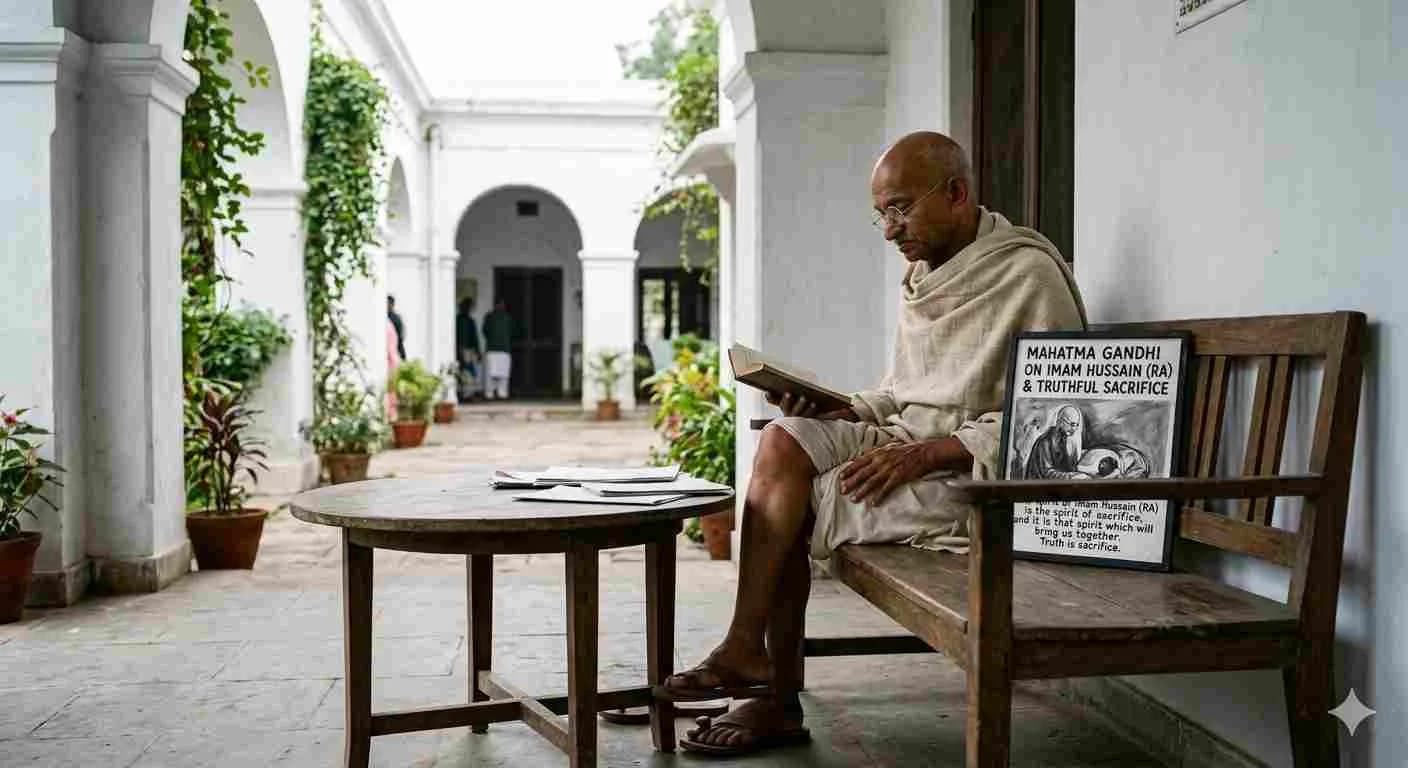
Researchers who went through the Gandhi Heritage Portal and the 100-volume "Collected Works of Mahatma Gandhi," published by the Government of India in 1956, found several authenticated references. In one verified passage from Volume 13, Letter 395, Gandhi wrote about Imam Hassan and Imam Hussain RA. He described how they were called upon to surrender and refused, knowing it would cost them their lives. He wrote that they chose death over disgrace and betrayal of their religion.
Gandhi drew a striking conclusion from this. He stated that Islam did not reach its greatness through the power of the sword, but through the self-immolation of its saints. From experience reading how different freedom movements have drawn inspiration across history, it is remarkable how consistently Karbala surfaces as a reference point for those who fight against oppression without weapons.
In another verified reference from Volume 44, Gandhi mentioned Imam Hasan and Imam Hussain RA alongside other figures he considered examples of truthful, principled living. He encouraged people to meditate on their lives as models of courage and integrity.
Gandhi's Verified vs. Widely Cited but Disputed Statements on Imam Hussain RA
| Statement | Source Status | Reference |
|---|---|---|
| Gandhi writing about Hussain and Hassan RA refusing to surrender and choosing death over disgrace | Verified | Collected Works, Vol 13, Letter 395, Pg 518 |
| Gandhi mentioning Imam Hasan and Hussain RA as examples of truthful, meditative living | Verified | Collected Works, Vol 44, Pg 41 |
| "If I had an army like the 72 soldiers of Hussain, I would have won freedom for India in 24 hours" | Widely Cited / Unverified Source | No confirmed volume or page in Collected Works |
| "I learned from Hussain how to achieve victory while being oppressed" | Attributed / Source Disputed | Cited widely but primary source unclear |
The Connection Between Karbala and Gandhi's Non-Violence
This is the part that many people miss. Gandhi's connection to Imam Hussain RA was not just sentimental. It was philosophical. Gandhi's entire movement, what he called Satyagraha, was built on the idea that truth has a power that brute force cannot defeat. He believed that willingly accepting suffering for a just cause could shift the moral weight of a conflict, even against an overwhelming enemy.
Karbala, at its core, is exactly that story. Imam Hussain RA did not have the numbers. He did not have the weapons. What he had was a refusal to legitimise falsehood. He stood firm even when standing firm meant death. And history did not record Yazid as the winner of Karbala. It recorded Hussain RA.
Think of it this way. A small candle does not fight darkness. It simply refuses to be extinguished. Imam Hussain RA was that candle on the plains of Karbala. Gandhi saw the same principle in his own struggle against the British Empire and acknowledged, in his own writings, that such examples from Islamic history shaped his thinking.
Gandhi's Study of Islam and Its Saints
Gandhi was known to have studied Islamic history seriously. He read about the early Muslims, the life of the Prophet (PBUH), and the events that followed. He was of the view that Islam spread not through conquest alone but through the sacrifice and character of its greatest figures. Imam Hussain RA represented, for Gandhi, the clearest example of that kind of moral courage.
Indian poet and Nobel laureate Rabindranath Tagore also viewed Hussain's sacrifice as a symbol of spiritual liberation, showing that Gandhi was not an outlier among Indian thinkers in drawing meaning from Karbala. The tragedy transcended religion in the minds of those who studied it honestly.
Why the Authenticity Question Actually Matters
It would be easy to simply repeat every quote attributed to Gandhi about Imam Hussain RA and leave it at that. But that approach does a disservice to both figures. Imam Hussain RA stood for truth above all else. It would be somewhat ironic to honour him through unverified attributions.
In many cases, the most famous quotes circulating online about Gandhi and Hussain RA, including the "72 soldiers" statement, have no confirmed page or volume in the Collected Works. That does not mean Gandhi did not hold these views. His verified writings clearly show deep admiration and understanding of Imam Hussain RA's sacrifice. But scholars and researchers have noted the gap between what is documented and what is widely shared.
Sharing accurate information is itself an act of respect. The verified statements Gandhi made are powerful enough on their own. They do not need embellishment.
A Legacy That Belongs to All of Humanity
Imam Hussain RA did not die for a moment. He died for a principle that has no expiry date: that truth must be protected even at the highest personal cost. The fact that Gandhi, a Hindu leader fighting a colonial empire in a different century and a different land, found lessons in Karbala that shaped his own movement tells us something important. The sacrifice of Hussain RA was not only an Islamic event. It was a human one.
As long as people face the choice between convenient silence and costly truth, the story of Karbala will remain relevant. And as long as that story is told, figures like Gandhi who recognised its depth will serve as a reminder that wisdom does not stop at the borders of any one faith. The lesson of Imam Hussain RA is simple, and it is eternal: truth does not need an army. It only needs someone willing to stand for it.
Article Details
Category: News
Published:
Updated:
Author: Muhammad Umer
More Stories