Government Plans Major Export Scheme Overhaul
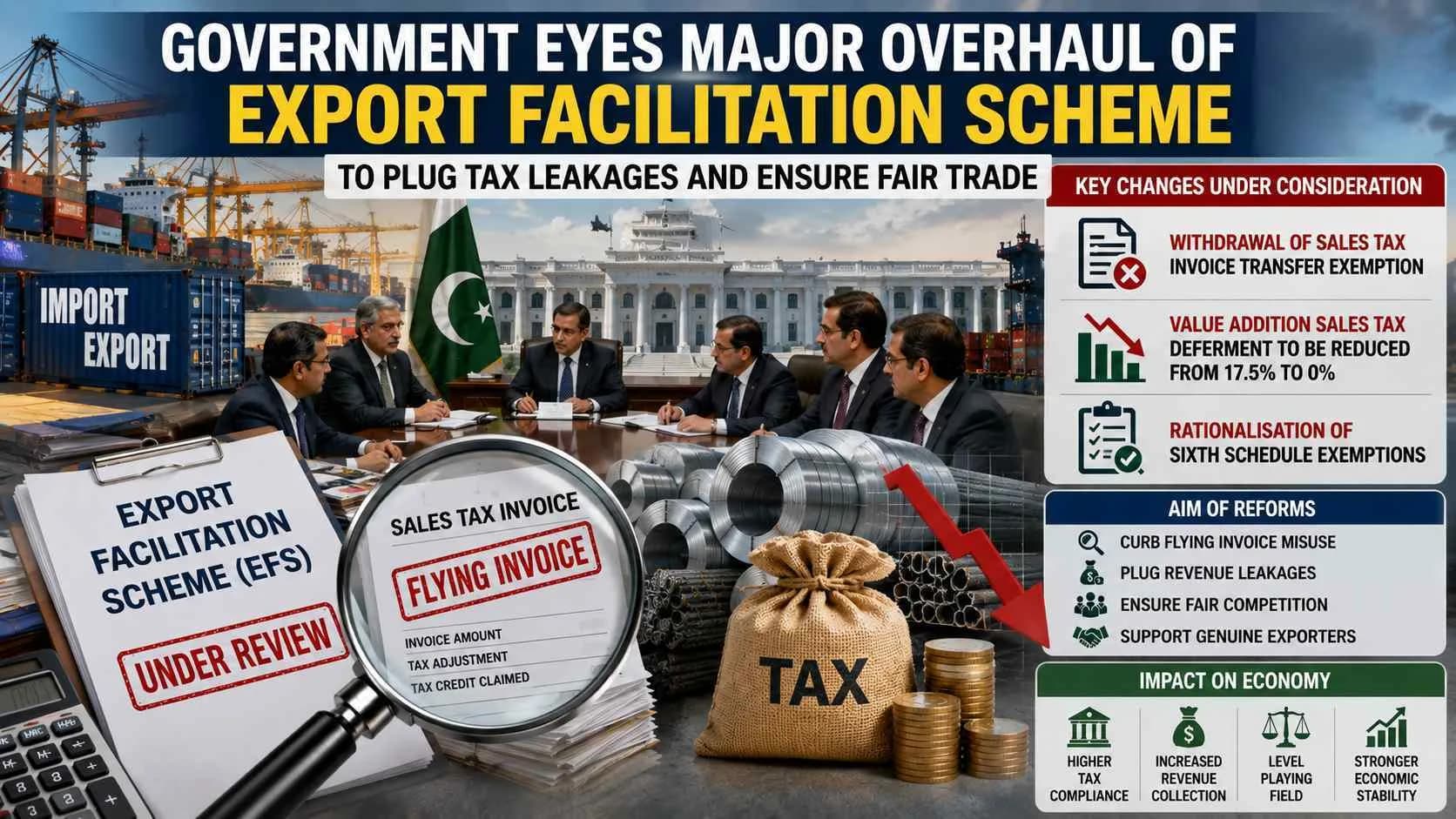
Government Plans Major Export Scheme Overhaul
What happens when a system designed to support exporters starts being used for tax avoidance instead? That is the question now driving fresh policy discussions in Islamabad as authorities review significant changes to the Export Facilitation Scheme (EFS) ahead of the FY2026-27 budget.
Export Facilitation Scheme Under Fresh Scrutiny
The federal government is actively evaluating proposals to restructure the Export Facilitation Scheme, a key trade support mechanism designed to ease import of raw materials for export-oriented industries. Over time, however, concerns have grown that certain commercial importers are exploiting gaps in the system, particularly through misuse of sales tax invoice transfers and related exemptions.
At the centre of the debate is the alleged misuse of so-called flying invoices, a practice that allows some market players to adjust or transfer tax invoices in ways that reduce actual tax liabilities. Authorities believe this has created an uneven playing field between documented manufacturers and informal or semi-documented traders.
Key Policy Changes Under Consideration
Among the major proposals under review is the withdrawal of exemptions that currently allow commercial importers operating under EFS to transfer sales tax invoices in the domestic market. This move is aimed at tightening compliance and improving transparency in tax adjustments.
Another significant proposal is the rationalisation of exemptions under the Sixth Schedule of the Sales Tax Act. Policy makers are also evaluating whether to reduce the Value Addition Sales Tax deferment rate from 17.5 percent to zero under the scheme, a step that could reshape import cost structures across multiple sectors.
Pressure From Documented Industries
Industries such as steel, textiles, and engineering have consistently argued that the current framework disadvantages compliant taxpayers. They claim that businesses contributing fully to the national exchequer face higher operational costs compared to those benefiting from loopholes within facilitation schemes.
From experience, manufacturers often highlight how small distortions in tax structures can ripple through pricing chains. For example, a steel importer benefiting from deferred taxes may offer lower market prices, forcing compliant producers to absorb losses or reduce margins just to remain competitive.
Concerns Over Revenue Leakage
Officials linked to the Federal Board of Revenue (FBR) believe that existing exemptions have contributed to significant revenue losses. These concerns have intensified as import volumes grow and complex invoice structures make tracking actual tax payments more difficult.
Stakeholders argue that such distortions not only affect revenue collection but also disrupt pricing stability in key commodity markets, particularly steel scrap and raw materials used in manufacturing.
Quick Facts Box
- Export Facilitation Scheme under review ahead of FY2026-27 budget
- Proposed removal of sales tax invoice transfer exemption
- Value Addition Sales Tax deferment may drop from 17.5% to 0%
- Reforms aim to curb flying invoice misuse and revenue leakages
Policy Impact Breakdown
| Area | Current Structure | Proposed Change | Expected Outcome |
|---|---|---|---|
| Invoice Transfers | Allowed under exemption | Likely withdrawal | Reduced tax misuse |
| VAT Deferment | 17.5% deferment | May be reduced to 0% | Higher upfront tax compliance |
| Input Tax Adjustments | Broad exemptions | Rationalisation proposed | Stronger audit control |
Real-World Pressure on Consumers and Industry
Tax policy shifts rarely stay limited to boardrooms. In many cases, distortions in import pricing eventually reach everyday consumers. A simple example is household construction. If steel prices fluctuate due to uneven tax treatment, the cost of building a small home increases, forcing families to either delay projects or compromise on materials.
This is why documented sectors are pressing for reforms. They argue that consistent taxation is not just about revenue collection but also about long-term economic stability and fair pricing across markets.
Outlook for FY2026-27 Budget
The proposed amendments to the Export Facilitation Scheme are part of broader fiscal discussions ahead of the upcoming federal budget. Authorities are expected to balance trade facilitation with tighter controls on misuse, a task that often requires careful calibration between industry support and revenue protection.
Going forward, the direction of these reforms will likely depend on stakeholder consultations and the government’s ability to implement stronger monitoring systems without slowing down export activity.
What remains clear is that the Export Facilitation Scheme is entering a new phase of scrutiny, one that could redefine how Pakistan manages trade incentives in a tightening fiscal environment.
Article Details
Category: Scheme
Published: 23 May 2026
Time: 1:45 pm
Updated: 23 May 2026 at 5:02 pm
Author: Fiza
More Stories