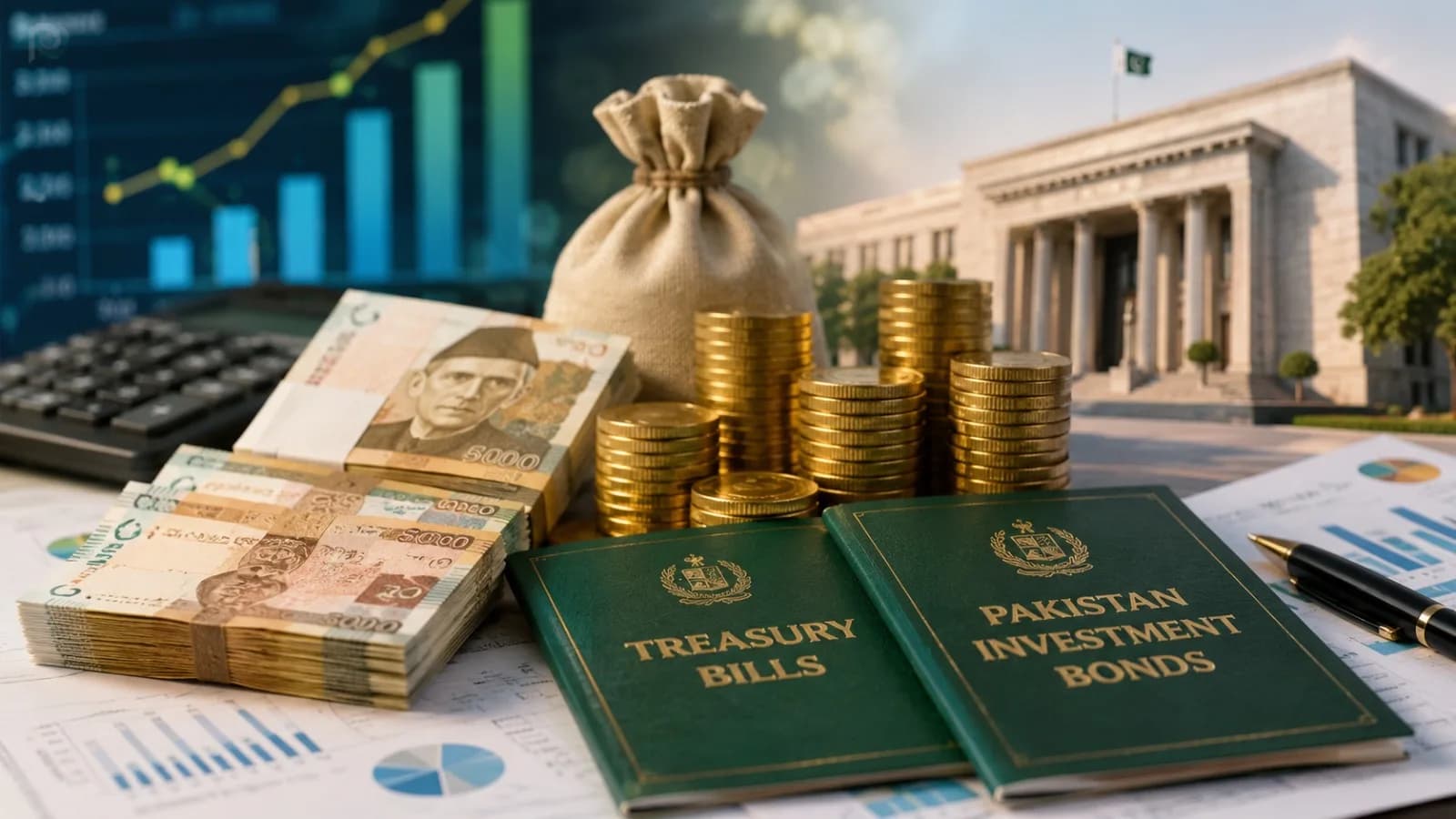
Govt Targets ₨6.8 Trillion Borrowing via T-Bills and PIBs
The borrowing strategy highlights how the government continues to rely heavily on domestic debt markets to manage fiscal requirements, refinance maturing obligations, and support budgetary spending amid evolving economic conditions.
From an investment perspective, the latest borrowing plan is important for banks, mutual funds, fixed-income investors, and financial institutions closely monitoring interest rate expectations in Pakistan.
Analysts believe the aggressive borrowing target may also influence liquidity conditions, government securities yields, and broader money market activity over the coming months.
Investment Overview
The government plans to raise funds through two key debt instruments:
- Market Treasury Bills (MTBs or T-bills)
- Pakistan Investment Bonds (PIBs)
T-bills are short-term government securities typically issued with maturities of 3 months, 6 months, and 12 months. PIBs are longer-duration fixed-income instruments used for medium-term and long-term borrowing.
In practical terms, the borrowing target reflects Pakistan’s continued dependence on domestic banks and institutional investors for financing requirements while external financing conditions remain uncertain.
Quick Facts Box
Market Background
Pakistan’s domestic debt market has expanded significantly over the past several years as the government increasingly shifted toward local borrowing to manage fiscal deficits and external repayment pressure.
T-bills and PIBs remain among the most widely used instruments for government financing. Commercial banks are traditionally the largest investors in these securities because they are considered relatively secure compared to private-sector lending.
In many cases, institutional investors prefer government securities during periods of economic uncertainty due to predictable returns and sovereign backing.
However, heavy domestic borrowing can also create pressure on liquidity and private-sector credit availability over time.
Current Market Situation
- Interest rates in Pakistan remain closely linked to inflation trends.
- Market participants are monitoring future monetary policy decisions.
- Government securities continue attracting strong institutional demand.
- Banks maintain large exposure to sovereign debt instruments.
- Inflation and fiscal deficit concerns continue influencing bond yields.
Investment Type
T-bills are short-duration debt instruments sold through auctions conducted by the State Bank of Pakistan. They are generally considered low-risk investments because they are backed by the federal government.
PIBs, meanwhile, offer longer investment tenures and are typically preferred by investors seeking stable medium-term income exposure.
From an investment perspective, government securities are often used for capital preservation and income generation rather than aggressive growth.
Price / Value Details
| Metric | Details |
|---|---|
| Total Borrowing Target | ₨6.8 trillion |
| T-bill Auction Yield | Determined through competitive bidding |
| PIB Coupon Structure | Depends on auction results |
| Market Capitalization | Not officially mentioned yet. |
Historical Performance
Government securities in Pakistan have historically delivered relatively stable returns compared to equities and high-risk investments.
During periods of elevated policy rates, T-bills and PIBs often become attractive for institutional investors due to higher yields.
| Historical Factor | Market Impact |
|---|---|
| Rising Inflation | Increased bond yields |
| Monetary Tightening | Higher investor participation |
| Fiscal Pressures | Larger government borrowing needs |
Potential Returns and Risk Factors
| Potential Benefit | Associated Risk |
|---|---|
| Stable fixed-income returns | Inflation risk |
| Government-backed investment | Interest rate volatility |
| High liquidity in banking market | Fiscal sustainability concerns |
Short-Term vs Long-Term Outlook
| Investment Horizon | Outlook |
|---|---|
| Short-Term | Investors may benefit from elevated yields if interest rates remain high. |
| Long-Term | Long-term outlook depends on fiscal discipline, inflation trends, and monetary stability. |
Tax and Regulatory Details
| Category | Details |
|---|---|
| Regulatory Authority | State Bank of Pakistan |
| Tax Treatment | Subject to applicable tax regulations |
| Legal Status | Government-issued sovereign debt |
How to Invest
- Open an account with a licensed bank or brokerage.
- Verify participation eligibility in government securities.
- Review T-bill and PIB auction schedules.
- Understand maturity and yield structure.
- Monitor SBP announcements regularly.
Investment Platforms Table
| Platform Type | Purpose |
|---|---|
| Commercial Banks | Government securities investment |
| Brokerage Firms | Fixed-income access |
| SBP Auction Mechanism | Primary issuance auctions |
Beginner Investor Checklist
| Checklist Item | Importance |
|---|---|
| Understand fixed-income investments | Essential |
| Compare maturity periods | Important |
| Monitor inflation trends | Highly Recommended |
Risk Management Tips
- Diversify across multiple investment categories.
- Monitor interest rate announcements regularly.
- Review inflation expectations before investing.
- Avoid overexposure to long-duration instruments.
- Consult licensed financial professionals when needed.
Common Mistakes Investors Make
One common mistake investors make is focusing only on headline yields while ignoring inflation-adjusted returns.
Many beginner investors overlook how future interest rate changes can affect the market value of fixed-income securities.
In many cases, investors also underestimate liquidity needs and lock funds into long-term instruments without proper planning.
Comparison With Other Investments
| Investment Type | Risk Level | Liquidity | Volatility |
|---|---|---|---|
| T-bills | Low to Medium | High | Low |
| PIBs | Medium | Moderate | Moderate |
| Equities | High | High | High |
Pros and Cons
| Pros | Cons |
|---|---|
| Government-backed investment | Inflation may reduce real returns |
| Predictable income potential | Interest rate sensitivity |
| Strong institutional participation | Fiscal deficit concerns |
Expert Analysis
From an investment perspective, the ₨6.8 trillion borrowing target reflects the scale of Pakistan’s financing needs and the growing importance of domestic debt markets.
Investors are expected to closely monitor upcoming auctions for signals regarding future interest rate direction and banking sector liquidity conditions.
For long-term investors, the broader macroeconomic picture remains equally important. Inflation trends, fiscal reforms, IMF-related developments, and monetary policy decisions will continue shaping fixed-income returns across Pakistan’s debt market.
Final Thoughts
Pakistan’s latest domestic borrowing plan highlights the central role of T-bills and PIBs in managing government financing requirements. While these instruments continue offering relatively stable fixed-income opportunities, investors should remain cautious about inflation, interest rate shifts, and broader economic conditions.
In practical terms, government securities remain a core component of Pakistan’s financial system. However, balancing fiscal sustainability with long-term economic growth will remain critical for market confidence going forward.
Frequently Asked Questions
1. What are T-bills?
T-bills are short-term government securities issued through auctions conducted by the State Bank of Pakistan.
2. What are PIBs?
Pakistan Investment Bonds are medium-term and long-term government debt instruments.
3. Is this investment safe?
Government securities are generally considered lower-risk compared to equities, but they still carry inflation and interest rate risks.
4. What is the minimum investment amount?
Not officially mentioned yet.
5. What are the main risks?
Inflation, changing interest rates, and fiscal uncertainty are among the key risks.
6. Is it suitable for beginners?
Yes, but investors should understand fixed-income mechanics before investing.
7. Are there taxes on returns?
Yes, applicable tax laws may apply depending on investor category.
8. How can investors buy government securities?
Through banks, brokerage firms, and approved investment channels.
9. Is this regulated in Pakistan?
Yes. Government securities are regulated by the State Bank of Pakistan.
10. What documents are required?
Investors may require CNIC documentation, banking details, and account verification.
Article Details
Category: Investment
Published:
Updated:
Author: Irfan Ali
More Stories