
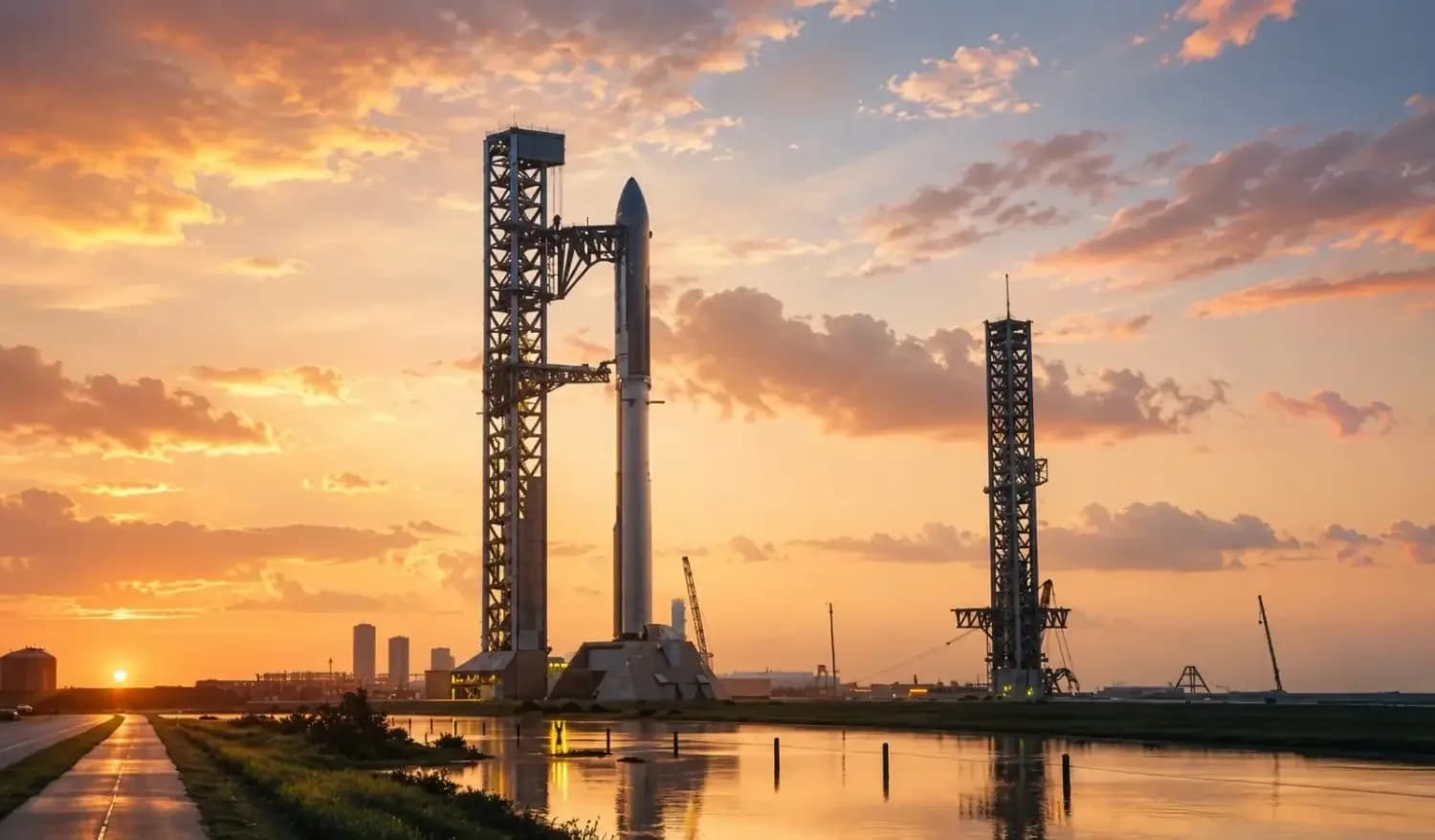
SpaceX is preparing to launch Starship’s thirteenth flight test as early as Thursday, July 23, 2026, from Starbase in South Texas. The 90-minute launch window is scheduled to open at 5:45 p.m. Central Time, while the official live coverage is expected to begin around 30 minutes before liftoff.
For viewers in Pakistan, the launch window will run from 3:45 a.m. to 5:15 a.m. on Friday, July 24, 2026. The flight can be watched through the official SpaceX Flight 13 mission page and the company’s official account on X.
The mission will test updated versions of the Starship spacecraft and Super Heavy booster. Its main goals include deploying 20 next-generation Starlink V3 satellites, testing a Raptor engine restart in space, examining heat-shield performance and attempting controlled ocean landings.
SpaceX has warned that the schedule may change because Starship remains a developmental launch system. Weather conditions, technical checks and vehicle readiness could affect the final liftoff time. Reuters also reported that SpaceX had moved its next Flight 13 launch attempt to July 23.
Starship Flight 13 launch time and viewing details
The launch is planned from SpaceX’s Starbase facility in Texas. The webcast will provide live countdown updates, mission commentary and flight information as Starship completes each planned stage.
Mission detail | Confirmed information |
|---|---|
Mission name | Starship’s Thirteenth Flight Test |
Target date in Texas | Thursday, July 23, 2026 |
Texas launch window | 5:45 p.m. to 7:15 p.m. CT |
Pakistan date | Friday, July 24, 2026 |
Pakistan launch window | 3:45 a.m. to 5:15 a.m. PKT |
Launch location | Starbase, South Texas |
Launch vehicle | Starship and Super Heavy V3 |
Webcast start | Around 30 minutes before liftoff |
Planned flight time | Approximately 65 minutes |
The launch time should be treated as a target rather than a fixed appointment. Developmental rocket tests can be delayed shortly before liftoff if engineers identify an issue or weather conditions move outside approved limits.
Main goals of Starship’s thirteenth flight test
Flight 13 will focus on vehicle performance, engine reliability, satellite deployment, heat-shield testing and controlled descent operations.
The mission will attempt several objectives that were also targeted during the previous flight. However, SpaceX has introduced hardware and software changes after reviewing the results from Flight 12.
Super Heavy booster objectives
The Super Heavy booster is expected to:
Complete a successful launch and ascent
Separate from Starship through hot-staging
Perform its planned directional flip
Restart engines for the boostback burn
Begin a controlled landing burn
Target an offshore landing point in the Gulf
The booster will not return to the launch tower during this test. Instead, SpaceX plans to guide it toward an offshore landing area while collecting information about its engines, movement and descent performance.
Starship upper-stage objectives
After separating from the booster, Starship will attempt to:
Reach its planned suborbital trajectory
Deploy 20 Starlink V3 satellites
Restart one Raptor engine while in space
Test different heat-shield tile designs
Complete a controlled atmospheric re-entry
Descend toward a planned splashdown in the Indian Ocean
The engine restart test is important because Starship will need to reliably restart its engines in space during future missions. The upcoming flight will give engineers another opportunity to test that capability in real flight conditions.
What SpaceX changed after Flight 12
SpaceX has made several changes after studying the performance of the twelfth Starship flight test.
During Flight 12, slight differences in the Starship engine startup sequence affected the direction of the Super Heavy booster’s flip after stage separation. The booster turned around 90 degrees away from its intended direction.
SpaceX has now adjusted the startup sequence to make the maneuver more reliable when small timing differences occur between engines.
The booster also experienced problems when restarting its engines for the boostback burn. Five of its 33 engines faced relight issues, causing the burn to end earlier than planned.
For Flight 13, SpaceX has introduced hardware changes intended to improve engine relight reliability. It has also updated engine warnings and automatic abort settings to better match the conditions created when several engines operate together.
The Starship upper stage also lost one of its three vacuum-optimized Raptor engines around 40 seconds after separation during Flight 12. Despite the engine loss, the spacecraft continued flying and reached its planned suborbital path.
SpaceX says propulsion hardware and operating procedures have been modified to address the connected causes of that engine problem. More reliability improvements are also planned for future versions of the Raptor engine.
Starship will deploy 20 Starlink V3 satellites
A major part of Flight 13 will be the first planned deployment of 20 next-generation Starlink V3 satellites from Starship.
The new satellites are being developed to increase the capacity of the Starlink network and support faster user connections. However, the satellites carried during this test will not remain in orbit.
After deployment, they are expected to:
Extend their solar arrays and antennas
Attempt communication with the wider Starlink network
Test high-capacity laser connections
Send information back to ground operators
The satellites will travel along approximately the same suborbital path as Starship. They are expected to re-enter Earth’s atmosphere and burn up around 20 minutes after deployment.
Reuters confirmed that Flight 13 will carry 20 Starlink satellites to test Starship’s satellite deployment system and the network’s laser communication links.
Satellite cameras will examine Starship’s heat shield
Six of the Starlink V3 satellites will carry cameras designed to capture images of Starship’s heat shield after deployment.
The cameras will scan the spacecraft and transmit pictures to SpaceX engineers. This test will help determine whether satellites could be used to inspect Starship’s heat shield before the vehicle returns to its launch site during future missions.
Several heat-shield tiles have been painted white to represent missing tiles and create visible targets for the cameras. Engineers will study whether the cameras can clearly identify damaged or absent sections of the heat shield.
SpaceX will also test:
Tiles attached to the metallic side of the rear flaps
Modified tiles around the spacecraft’s rear section
Different tile attachment systems
Tiles containing sensors that measure pressure and force
Starship is expected to experience greater aerodynamic pressure during ascent than on earlier tests. This will place additional stress on the tile attachments and provide data about how the heat shield performs under heavier flight loads.
The results will support SpaceX’s wider effort to develop a vehicle that can return safely and be prepared for another launch with limited repair work.
Starship Flight 13 expected timeline
All times in the flight plan are approximate. Actual events may happen slightly earlier or later depending on the vehicle’s performance.
Time after liftoff | Planned event |
|---|---|
T+00:00 | Liftoff |
T+00:58 | Maximum aerodynamic pressure |
T+02:18 | Super Heavy main engine cutoff |
T+02:21 | Hot-staging and stage separation |
T+02:25 | Booster boostback burn begins |
T+03:03 | Booster boostback burn ends |
T+06:27 | Super Heavy landing burn begins |
T+06:53 | Booster landing burn ends |
T+08:05 | Starship engine cutoff |
T+16:40 | Starlink satellite deployment begins |
T+27:39 | Satellite deployment ends |
T+38:58 | Raptor engine restart test |
T+47:30 | Starship atmospheric entry begins |
T+62:23 | Starship becomes transonic |
T+63:01 | Starship becomes subsonic |
T+65:01 | Starship landing burn begins |
T+65:03 | Starship landing flip |
T+65:21 | Planned ocean landing |
What happens next?
The first major test will come during launch and stage separation. Engineers will closely monitor the performance of the Super Heavy engines, the booster’s directional flip and the engine restarts required for the boostback burn.
Attention will then move to the Starship upper stage and its attempt to deploy the 20 Starlink V3 satellites. A successful deployment would provide SpaceX with important information about using Starship to carry larger Starlink satellites on future missions.
The Raptor restart, heat-shield inspections and controlled atmospheric entry will also provide data for future vehicle improvements.
Because Flight 13 is an experimental mission, completing every planned objective is not the only measure of progress. The information collected during launch, flight and re-entry will help engineers identify what worked, what needs further improvement and which systems are ready for the next stage of testing.
Viewers should check the official SpaceX Flight 13 page shortly before the webcast because the launch date and time may change.
Article Details
Category: Telecom
Published:
Updated:
Author: Usama Haider
More Stories