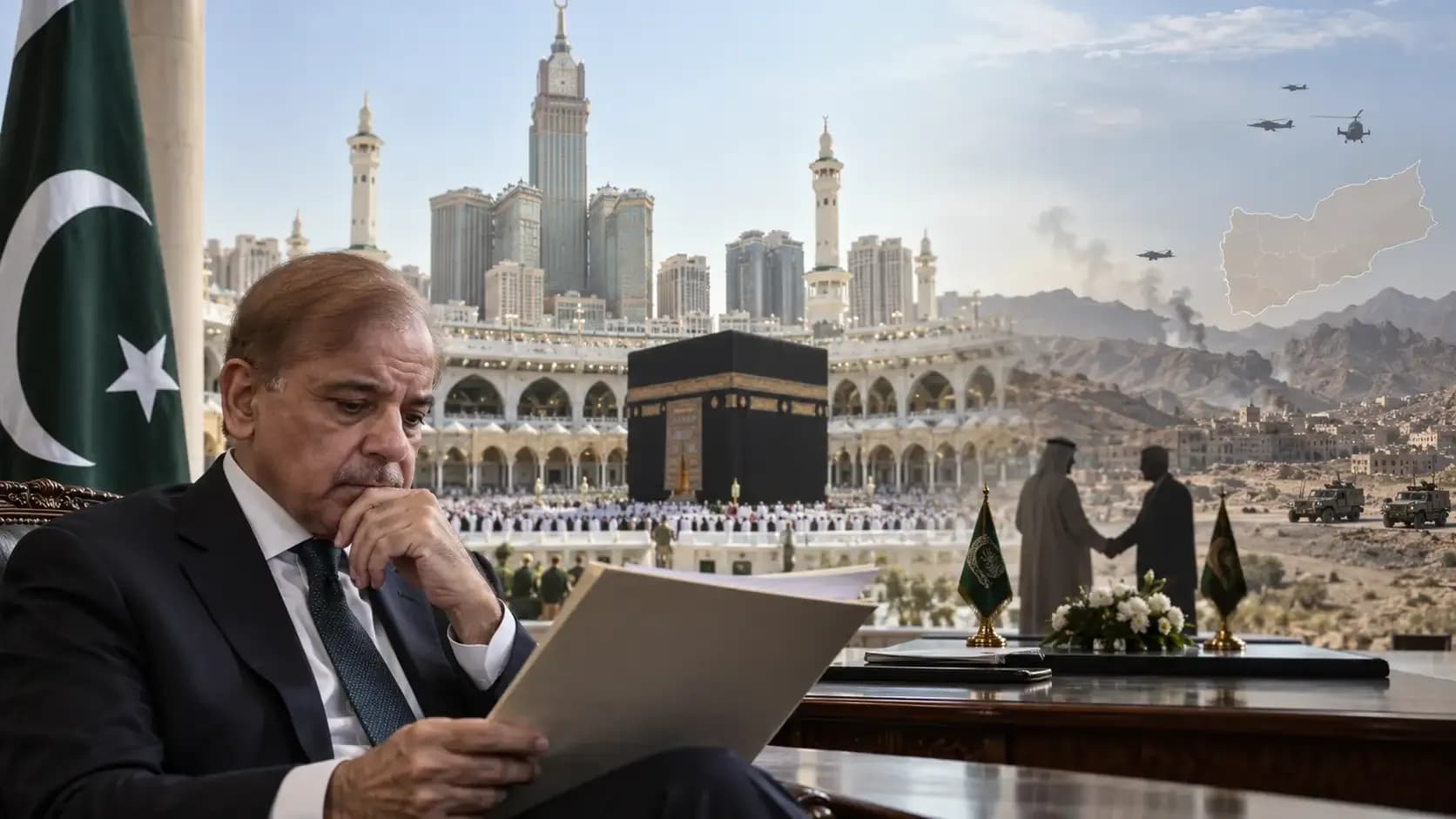
Quick answer: Based on the publicly available text, the Makkah Joint Defence Agreement does not spell out an automatic requirement for Pakistan to send troops into Yemen or conduct strikes there. It does create a collective-defence commitment: an armed attack on Pakistan, Saudi Arabia or Turkiye is to be treated as an attack on all three. How that commitment would be implemented in a specific crisis is not fully public.
That distinction has become important as Houthi attacks on Saudi territory have raised questions about whether Pakistan could be drawn into the Yemen conflict. Islamabad has repeatedly said it will honour its defence commitments to Saudi Arabia, but it has also described the trilateral pact as defensive and continued to call for dialogue and de-escalation in the region.
What Does the Makkah Joint Defence Agreement Actually Say?
Pakistan, Saudi Arabia and Turkiye signed the Makkah Joint Defence Agreement on August 7, 2026. The official joint statement says the pact is intended to strengthen collective deterrence and that an armed attack against any one of the three states will be regarded as an attack against all of them.
Pakistan’s Foreign Office has also stressed that the agreement is “purely defensive in nature”, is not directed against any country and is consistent with the right of individual and collective self-defence under Article 51 of the UN Charter. What the public documents do not provide is a detailed rule saying that every attack automatically requires Pakistani ground troops, air strikes or operations inside another country.
Does Collective Defence Automatically Mean War in Yemen?
Not necessarily. Collective defence describes an obligation to respond to an armed attack, but the form of that response can vary. Public statements from the three governments have not established that the only possible response is direct combat inside Yemen.
In practice, assistance under a defence pact can include different forms of support, depending on the agreement and the decision of the member states. These can range from air and missile defence, intelligence sharing, logistics and technical assistance to training, maritime security or, in a more escalatory scenario, direct military action. Pakistan has not publicly announced that it has chosen the last option in the current Yemen crisis.
Turkish Foreign Minister Hakan Fidan said on September 19 that Turkiye was prepared to meet Saudi military needs, particularly technical requirements, under the pact. His remarks showed that support under the agreement can be discussed in terms broader than sending forces into Yemen.
Pakistan’s Public Position as of September 23, 2026
Pakistan’s public position has combined a strong commitment to Saudi security with deliberate ambiguity over the exact military steps that could follow.
September 10:The Foreign Office said no military response under the Makkah pact was then under discussion and described possible strikes on Houthi targets as hypothetical.
September 17:The Foreign Office said Pakistan remained committed “in intent and spirit” to implementing both its bilateral Saudi defence agreement and the trilateral Makkah pact, while declining to disclose operational details.
September 23:Prime Minister Shehbaz Sharif again said Pakistan stood with Saudi Arabia in safeguarding its sovereignty, security and the sanctity of Islam’s holy sites. His statement did not announce a new deployment or specify that Riyadh had requested Pakistani combat operations.
September 23:Pakistan also announced retired Lt Gen Nauman Mahmood as the first secretary general of the Makkah Defence Alliance secretariat in Riyadh, showing that the alliance is continuing to build its institutional structure.
For wider diplomatic context, PehlePakistan has also covered Pakistan’s engagement on regional peace and stability.
The Bilateral Saudi Pact and the Makkah Pact Are Not the Same Thing
One source of confusion is that Pakistan has more than one defence framework with Saudi Arabia. Islamabad and Riyadh signed a bilateral Strategic Mutual Defence Agreement in September 2025, while the Makkah Joint Defence Agreement signed in August 2026 adds Turkiye to a trilateral arrangement.
On September 17, the Foreign Office confirmed that there had been “some deployments” in Saudi Arabia under the bilateral agreement, but it did not connect those deployments to Pakistani strikes in Yemen. That matters because existing military cooperation inside Saudi Arabia should not automatically be described as entry into the Yemen war.
What Would “Entering the Yemen Conflict” Actually Mean?
The phrase “entering the Yemen conflict” can describe several very different actions. It is useful to separate them instead of treating all military cooperation as the same thing.
Possible Action | Would It Equal Direct Entry Into Yemen War? | Current Public Status |
Air or missile defence inside Saudi Arabia | Not necessarily | Pakistan has not publicly detailed current Makkah-pact operations. |
Intelligence, logistics or technical support | Not necessarily | Possible forms of allied support, but specific current measures are not fully public. |
Training and capacity building | No, by itself | The Foreign Office lists training and capacity building as areas of defence cooperation. |
Strikes on Houthi targets inside Yemen | Yes, this would be direct combat involvement | Pakistan has not publicly announced such strikes. |
Ground deployment inside Yemen | Yes, this would be direct combat involvement | No such deployment has been publicly announced. |
Why the 2015 Yemen Decision Still Matters as Historical Context
Pakistan has faced a similar policy dilemma before, although the legal and strategic setting was different. In April 2015, Parliament adopted a unanimous resolution calling for Pakistan to maintain neutrality in the Yemen conflict while also expressing unequivocal support for Saudi Arabia’s territorial integrity and saying Pakistan would stand with the kingdom if its territory or the Haramain Sharifain were threatened.
That 2015 resolution does not by itself determine how the 2026 Makkah agreement must now be implemented. It does, however, show a long-standing distinction in Pakistani policy between supporting the defence of Saudi territory and joining military operations inside Yemen.
What Could Trigger a More Direct Pakistani Role?
The clearest publicly stated trigger in the Makkah agreement is an armed attack against a member state. Even then, the public record leaves major implementation questions unanswered. The full operational provisions are not available, and Pakistani officials have repeatedly declined to specify in advance what force, objective or mode of response would be used.
A more direct Pakistani role would therefore depend on decisions that have not been publicly announced: how the three members interpret a particular attack, what assistance Saudi Arabia requests, what the pact’s internal consultation mechanism decides and what Pakistan’s own authorities approve under domestic procedures.
What Is Still Unclear?
The complete operational text and rules of engagement of the Makkah Joint Defence Agreement have not been made public.
No public statement has confirmed that Saudi Arabia has formally requested Pakistani strikes or a Pakistani ground deployment inside Yemen.
Pakistan has not publicly announced direct combat operations against Houthi targets in Yemen under the Makkah pact.
The exact threshold between defensive assistance to Saudi Arabia and direct participation in the Yemen war remains a matter for the member states to define in practice.
So, Does the Mecca Pact Demand Pakistan Enter Yemen?
Based on the public record, the answer is more limited than a simple yes or no. The pact commits Pakistan to collective defence if a member state faces an armed attack, but the published text does not establish an automatic requirement to send Pakistani forces into Yemen. Pakistan could support Saudi defence in several ways without conducting combat operations inside Yemen, while direct strikes or a ground deployment would represent a much larger step that has not been publicly announced.
At the same time, it would be inaccurate to say the pact creates no obligation at all. Pakistani officials have repeatedly said the country will honour its commitments to Saudi Arabia. The unresolved question is not whether a collective-defence commitment exists, but what form Pakistan’s assistance would take if the alliance decides that a specific attack requires action.
Frequently Asked Questions
What is the Makkah Joint Defence Agreement?
It is a trilateral defence agreement signed by Pakistan, Saudi Arabia and Turkiye on August 7, 2026. Its public statement says an armed attack on one member will be regarded as an attack on all three.
Does the pact automatically require Pakistan to send troops to Yemen?
The public text does not state that every attack automatically requires Pakistani troops inside Yemen. The exact form of assistance and operational mechanisms are not fully public.
Has Pakistan announced strikes on Houthi targets in Yemen?
No public announcement reviewed for this article confirms Pakistani strikes on Houthi targets inside Yemen under the Makkah pact.
Can Pakistan help Saudi Arabia without entering Yemen?
Yes. In principle, defensive assistance can include air defence, intelligence, logistics, training or technical support. The exact support Pakistan may provide in the current crisis has not been fully disclosed.
What did Pakistan’s Parliament decide during the 2015 Yemen crisis?
Parliament called for neutrality in the Yemen conflict while also supporting Saudi Arabia’s territorial integrity and the protection of the Haramain Sharifain.
Is the Makkah pact fully operational?
The alliance is being institutionalised. Pakistan appointed the first secretary general of its Riyadh-based secretariat on September 23, 2026, while detailed operational procedures remain largely outside the public domain.
What should readers watch next?
The key developments would be any formal Saudi request for assistance, official statements on pact activation, new Pakistani deployments, or publicly announced decisions by the alliance’s joint institutions.
Follow the Latest Pakistan and Regional Security Updates
For continuing coverage of Pakistan’s foreign policy, regional security and major developments across the Middle East, visit PehlePakistan for the latest verified explainers and updates.
Source Note
This explainer was checked against public statements and reporting available through September 23, 2026, including Pakistan’s Ministry of Foreign Affairs, Pakistan’s National Assembly record, Reuters, Dawn and Arab News Pakistan. The full operational text of the Makkah Joint Defence Agreement is not publicly available, so undisclosed military arrangements are not presented as fact.
Article Details
Category: News
Published:
Updated:
Author: Kaif
More Stories