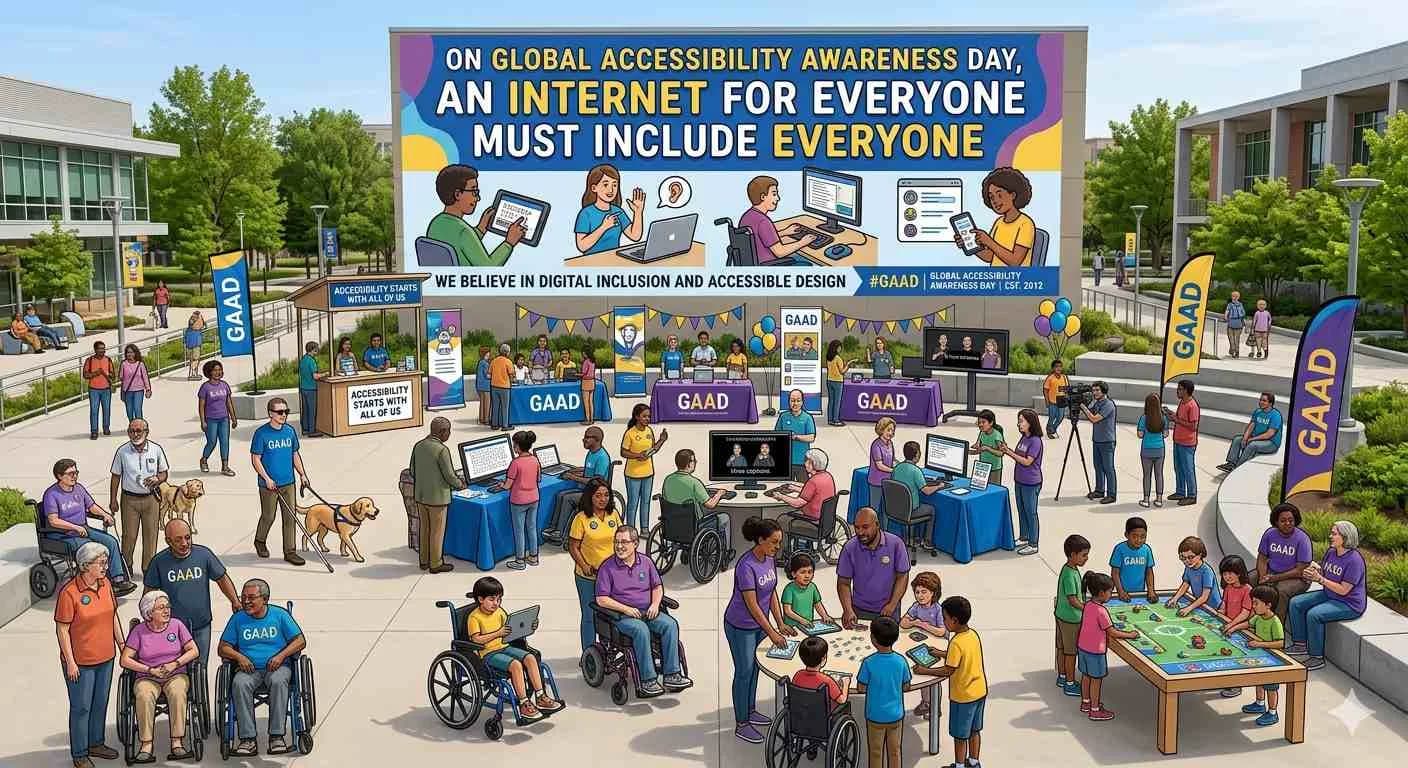
Beyond the Screen: Why True Accessibility Still Defines the Internet’s Future
What does it really mean when we say the internet is for everyone? On Global Accessibility Awareness Day, that question becomes harder to ignore. Because for millions of users, the digital world still comes with barriers that are invisible to most people.
The Digital Divide Is Not Just About Access
Access to the internet has expanded rapidly across the world, but accessibility remains uneven. For users with visual, hearing, cognitive, or mobility impairments, websites and apps often remain difficult to navigate.
In many cases, the issue is not connectivity but design. Poor contrast, missing captions, and unstructured layouts silently exclude users who rely on assistive technologies.
Why Global Accessibility Awareness Day Matters
This global observance highlights a simple but powerful idea: digital inclusion must be intentional. It is not something that happens automatically when technology improves.
From experience, one common mistake people make is assuming accessibility is a “feature” added later. In reality, it should be part of the foundation of every digital product from day one.
When Design Becomes a Barrier
Modern websites are visually rich, but that does not always mean they are usable. Complex animations, unlabelled buttons, and poorly structured content can make navigation frustrating or impossible for some users.
A simple analogy is a building with no ramps or elevators. It may look modern and well-designed from the outside, but it excludes anyone who cannot use stairs. Digital platforms often repeat the same mistake in invisible form.
Accessibility Standards in Practice
| Area | Common Issue | Accessibility Fix |
|---|---|---|
| Visual Design | Low contrast text | High contrast color schemes |
| Media Content | No captions or transcripts | Closed captions and alt text |
| Navigation | Keyboard inaccessible menus | Full keyboard navigation support |
Why Businesses Often Miss the Mark
One common mistake people make is treating accessibility as a compliance checklist instead of a user experience priority. This leads to partial implementation that fails under real-world use cases.
In practice, this gap also carries financial consequences. If a banking app or e-commerce platform is not accessible, users may need assistance from others just to complete basic tasks. That is similar to a family in Karachi depending on someone else to pay bills or shop for essentials because the system is not independently usable. It adds hidden dependency costs that are rarely measured.
Quick Facts Box
- Over 1 billion people globally live with some form of disability
- Most websites still fail basic accessibility standards
- Screen readers depend on proper HTML structure to function
- Accessible design improves usability for all users, not just disabled users
Building an Internet That Includes Everyone
True digital inclusion requires more than awareness campaigns. It demands consistent design practices, developer education, and stronger implementation of accessibility standards across platforms.
Small changes like better contrast, proper labels, and keyboard-friendly navigation can significantly improve usability. These are not complex upgrades, but they are often overlooked in fast-paced product development cycles.
On Global Accessibility Awareness Day, the message is clear. The internet continues to expand, but its real success will be measured by how many people can use it without barriers.
Article Details
Category: Global
Published:
Author: Muhammad Sheikh
More Stories