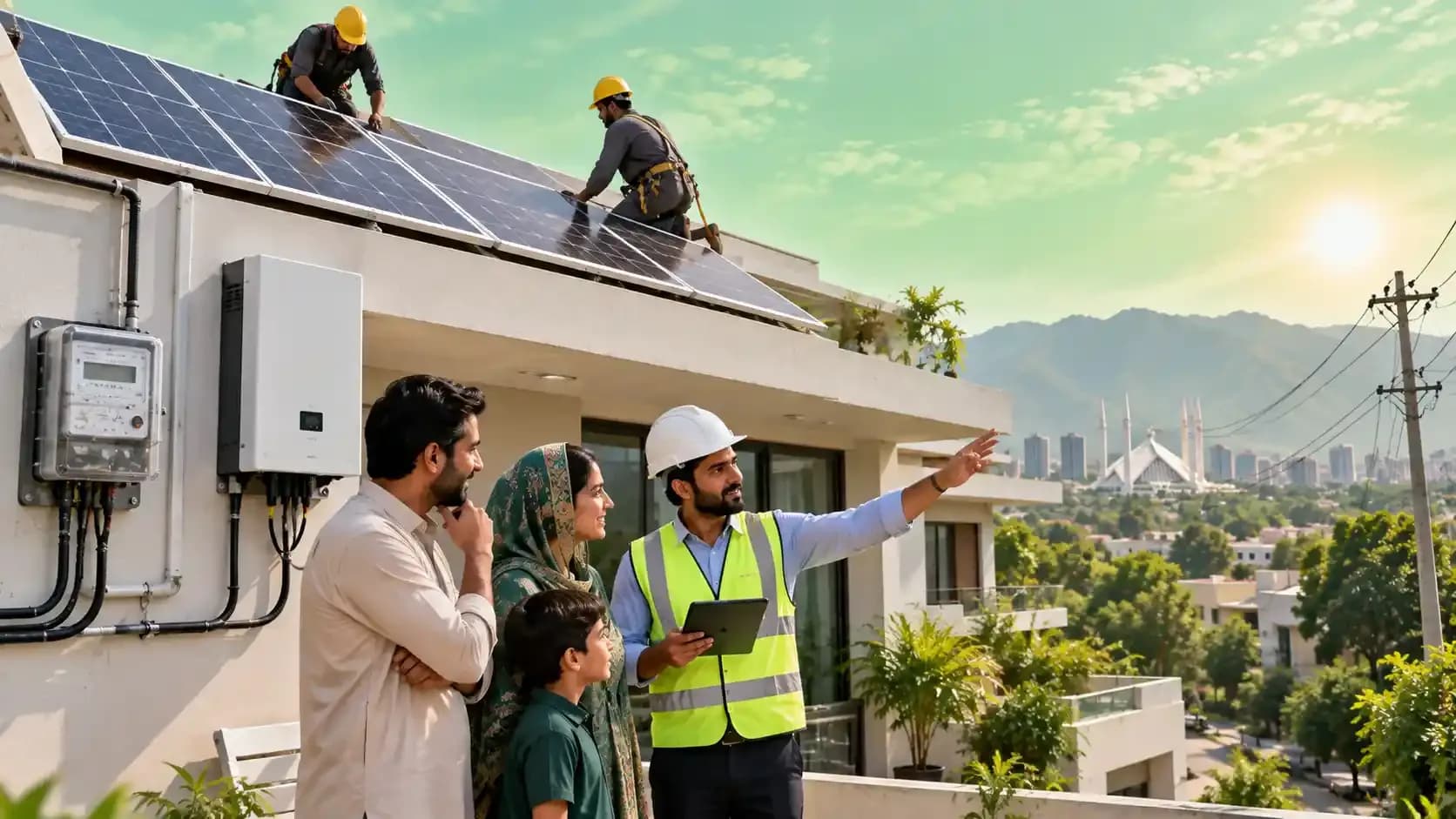
Planning rooftop solar to cut your electricity bill? In 2026, Pakistan changed the rules for new grid-connected solar users. Under NEPRA’s Prosumer Regulations 2026, new applicants use a net billing system rather than the old one-for-one net metering model.
You pay the normal tariff for electricity taken from the grid, while surplus solar sent back to the utility is credited at the applicable national average energy purchase price.
Existing valid agreements signed under the earlier rules can continue under their protected arrangement until expiry, provided there is no material modification. This guide covers eligibility, documents, application, meter installation, costs, savings, and common issues.
For complete information on all government energy and income-generation programs, see government schemes Pakistan Guide
What is Solar Net Metering?
Solar net metering traditionally lets a grid-connected solar consumer use a bi-directional meter to record electricity imported from and exported to the grid. For new applications from 9 February 2026, Pakistan now uses net billing under the NEPRA Prosumer Regulations 2026.
That means imported units and exported units are valued separately. The term “net metering” is still commonly used by consumers, but new applicants should understand that their billing follows the current net-billing framework.
Government Solar Schemes and Incentives
Solar support is not one single nationwide subsidy. Different programs target different provinces and consumer groups, and some are separate from the net-billing process.
Scheme Name | Subsidy/Support | Eligible Users | Details |
NEPRA Prosumer Framework 2026 | Grid-connected net billing and simplified approval for smaller systems | Eligible 3-phase domestic, commercial, industrial, agricultural, general-service and bulk consumers | DG systems can be 1 kW to 1 MW, subject to sanctioned load and technical feasibility. Systems up to 25 kW follow the licensee-approval route under the latest 2026 amendment. |
Punjab Free Solar Panel Scheme | Free solar systems under the recent provincial scheme | Low-use Punjab domestic consumers meeting the scheme criteria | The published round targeted up to 100,000 beneficiaries and had a completion timeline of September 2025. Check the Punjab Energy Department for any new round. |
Sindh Solar Home System Program | Free systems for low-income households; subsidized financing also announced for middle-income families | Eligible Sindh households under provincial criteria | Sindh announced distribution of 275,000 solar systems in 2026, with a separate subsidized rooftop-finance plan also announced. |
KP Household Solarization | Solarization support for poor households | Targeted households in merged districts | The KP Cabinet approved solarization of 120,000 poor households in the merged districts in March 2026. |
Balochistan Agricultural Tube-Well Solarization | Conversion of grid-powered agricultural tube wells to solar | Eligible agricultural tube-well users in Balochistan | The federal and Balochistan governments agreed on transitioning 28,000 electric agricultural tube wells to solar. |
For more government investment and support programs, visit our government investment schemes category.
Source note: NEPRA Prosumer Regulations 2026 · Punjab Energy Department · Sindh Government · KP DGIPR · Power Division
Who Is Eligible for Solar Net Metering?
For a new grid-connected prosumer application, the main 2026 requirements are:
Consumer type: A 3-phase 400V or 11kV domestic, commercial, industrial, agricultural, general-service, or single-point bulk-supply consumer can apply.
System size: The distributed-generation facility can use solar, wind, or biogas and can be from 1 kW up to 1 MW.
Sanctioned load: The proposed DG capacity cannot exceed the sanctioned load of the premises under the current regulations.
Network capacity: A new application may be restricted if connected DG on the local distribution transformer has reached 80% of its rated capacity, unless required network improvement is arranged under the applicable rules.
Approval still depends on the utility’s technical review, safety requirements, and complete documents.
Documents Required Before Applying for Solar Net Metering
Exact utility checklists can differ, but a typical application requires:
Applicant identification: CNIC for an individual or CUIN/company documents where applicable.
Electricity connection details: Consumer/reference number, latest bill, sanctioned load, tariff category, and premises address.
Contact details: Mailing address, phone number, email, and emergency contact information.
System design: Proposed DG size, single-line diagram, interconnection diagram, equipment specifications, and inverter details.
Installer/vendor details: Installer contact information and required technical certifications or registrations where the utility asks for them.
Energy estimates: Expected annual consumption, solar generation, and estimated export to the grid.
For systems above 25 kW, the current concurrence route can also require the prescribed NEPRA documents and applicable fee.
For systems up to 25 kW, the August 2026 amendment allows approval by the concerned distribution licensee without NEPRA concurrence.
How to Apply for Solar Net Metering in Pakistan
Use the electricity utility that serves the meter at your property. The exact portal or submission method can differ between DISCOs and K-Electric, but the core process is similar.
Step 1: Contact Your Electricity Distribution Company
Start with the DISCO or K-Electric serving your connection. Ask for the current prosumer/net-billing application form, technical requirements, and approved submission channel.
Before spending on a final system design, confirm your sanctioned load, supply type, and whether the local network can accept the proposed capacity.
Step 2: Submit Your Net Metering Application
Submit the completed application with identification, electricity-connection details, system design, inverter information, and other documents required by your utility.
Under the current rules, the utility should acknowledge a complete application and carry out its initial review within the prescribed stage-wise timelines. Systems up to 25 kW now follow the licensee-approval route, while larger systems may require NEPRA concurrence.
Step 3: Complete the Property and Solar System Inspection
The utility checks whether the proposed system can safely connect to its network. This can include the sanctioned load, inverter and protection equipment, single-line diagram, wiring, disconnect arrangement, and local transformer capacity.
If the design is incomplete or technically unsuitable, the utility can ask for corrections before approving interconnection.
Step 4: Get Approval and Install the Solar System
Once the design is accepted, complete the solar installation according to the approved technical requirements. Do not connect or export electricity to the grid without the required utility approval and commissioning process.
If your installed system differs materially from the approved design, the application may need to be updated before interconnection.
Step 5: Install the Bi-Directional Meter and Start Net Metering
After the required approvals, payment of applicable interconnection charges, testing, and commissioning, the utility installs or approves metering that records electricity in both directions.
For a new 2026 applicant, billing starts under the net-billing framework. Existing consumers with protected older agreements may continue under their legacy arrangement until the agreement expires, provided there is no material modification.
What Happens After Solar Net Metering Approval?
Approval is not the final step by itself. The system must still be connected, metered, commissioned, and placed under the applicable billing arrangement.
When Will Your Net Meter Be Installed?
There is no single guaranteed total number of days for every case because missing documents, technical work, network upgrades, or meter availability can add time.
The 2026 regulations set stage-wise timelines: the utility reviews the application, enters the interconnection agreement, issues the connection-charge estimate, and then installs and commissions the interconnection facility after the required payment. A clean application with no network issue normally moves faster than a case requiring corrections or upgrades.
When Does Net Metering Start?
For new applicants, net billing starts after the required approval, metering, interconnection, and commissioning are complete. You should not treat the date of solar-panel installation alone as the start date.
How Will Solar Units Appear on Your Electricity Bill?
The meter records grid imports and solar exports separately. Under the current net-billing arrangement:
Imported electricity: Units taken from the grid are billed at your applicable consumer tariff.
Exported electricity: Surplus units sent to the grid are credited at the applicable national average energy purchase price.
Extra export credit: If the export credit is higher than the billed amount for imported energy, the balance can be carried to the next billing cycle or paid according to the quarterly settlement rule.
The export rate can be revised through regulatory notification, so do not calculate long-term savings using an old fixed buyback figure.
Solar Net Metering After Approval: What You Get and Costs
Two-way metering: A bi-directional meter, or an approved equivalent metering arrangement, records import and export.
Agreement term: The current prosumer agreement runs for five years and may be renewed for further five-year terms by mutual consent.
Interconnection cost: The prosumer is responsible for the costs of interconnection and metering, including system improvements required solely for the connection where applicable.
Meter availability: If the utility does not have the required meter, the regulations allow the prosumer to procure one subject to utility testing before installation.
Current NEPRA fee: Systems up to 25 kW have no NEPRA concurrence fee under the 2026 fee amendment and now follow licensee approval. For larger systems, the notified concurrence fee is Rs 1,000 per kW, subject to any later regulatory change.
Your final cost can therefore include the solar equipment, installation, protection devices, meter/interconnection work, and any network upgrade specifically needed for your connection.
Solar System Size and Installation Cost
There is no government-fixed market price for a rooftop solar system. Panel brand, inverter type, mounting structure, city, warranty, wiring, and battery choice can change the final quotation.
System Size | Indicative Installed Cost (No Battery) | Typical Use |
3 kW | About Rs 300,000–450,000 | Small home with moderate daytime use |
5 kW | About Rs 450,000–650,000 | Medium home with regular daytime load |
10 kW | About Rs 850,000–1,250,000 | Large home or small commercial load |
These are broad September 2026 market-planning ranges, not official prices. Battery storage can add a large extra cost. Also remember that your proposed grid-connected DG capacity cannot exceed the sanctioned load under the current regulations.
Solar Net Metering Savings and Income
In the current net-billing system, the strongest savings usually come from using your solar electricity directly during the day instead of exporting most of it.
Self-consumed solar: Each unit you use directly reduces the amount you would otherwise buy from the grid at the applicable retail tariff.
Exported solar: Surplus electricity sent to the grid earns a separate credit at the applicable national average energy purchase price.
No guaranteed monthly income: Export earnings depend on generation, self-consumption, the applicable export rate, weather, and your electricity use.
For example, if your system generates 600 units in a month and you use 450 units directly, those 450 units reduce grid purchases. Only the remaining exported units are valued at the export-credit rate. This is why daytime self-consumption matters more under net billing than under the old one-for-one model.
Advantages of Solar Net Metering
Lower grid purchases: Daytime solar can reduce the number of units you buy from the utility.
Credit for surplus energy: Electricity you do not use can still be exported and credited under the current rules.
No battery required for grid export: A compliant on-grid system can participate in net billing without battery storage.
Useful for homes and businesses: Eligible domestic, commercial, industrial, agricultural, and other 3-phase consumers can apply.
Long-term energy planning: A well-sized system can reduce exposure to future increases in grid-energy costs, although tariffs and export rates can change.
Common Issues and Solutions
Problem | What to Do |
Single-phase connection | The current prosumer definition covers 3-phase 400V or 11kV consumers. Ask your utility whether your connection must first be upgraded. |
Solar size is above sanctioned load | Reduce the proposed DG capacity or complete the sanctioned-load enhancement process before approval. |
Transformer capacity is already high | If connected DG has reached the regulatory threshold, the utility may reject or require network improvement before allowing another connection. |
Documents or design do not match | Correct the CNIC/company details, consumer information, system capacity, inverter data, or single-line diagram requested by the utility. |
Existing legacy customer wants to expand | A material modification can move an older protected arrangement into the current prosumer framework. Get approval before increasing output or changing interconnection equipment. |
Meter or connection is delayed | Track the case with the utility and keep copies of the application, demand notice, payments, inspection reports, and correspondence. |
Frequently Asked Questions
Can I use solar panels during a power outage?
A normal on-grid solar inverter usually shuts down when the grid fails for safety. If you need backup during load shedding, use a properly designed hybrid or battery-backed system with the required isolation and protection.
Do I need batteries with a solar net metering system?
No. Batteries are not required for exporting surplus electricity to the grid. They are mainly useful if you want backup power during outages or want to store solar energy for use after sunset.
Can I add more solar panels after getting net metering?
Do not increase the approved output without informing the utility. A capacity increase or interconnection change can be treated as a material modification and may require a revised application and fresh approval or concurrence. For older protected agreements, a material modification can also change the billing framework that applies.
What happens to my solar system if I move to another house?
The interconnection approval is tied to the specific electricity connection and premises. You can physically move your equipment, but the new location needs its own utility review and approval before the system is connected to the grid.
Can a tenant install solar panels and apply for net metering?
A tenant should not assume automatic eligibility. Utility documentation can require the electricity connection to be properly recorded and may require the property owner’s CNIC, tenancy documents, or NOC. Confirm the exact checklist with your DISCO or K-Electric before installation.
What happens to excess solar electricity that I cannot use?
Surplus electricity is exported to the utility and credited under the current net-billing rules. If your export credit exceeds the billed value of imported electricity, the excess can be carried forward or settled according to the applicable quarterly-payment rule.
Can I use solar net metering for a commercial property?
Yes. Commercial consumers are included in the eligible consumer categories under the 2026 prosumer framework, provided the connection is 3-phase, the proposed system meets sanctioned-load and technical limits, and the utility approves the interconnection.
Other Government Schemes
Looking for more government support programs in Pakistan? Explore these useful guides:
Government Schemes in Pakistan - Explore major government financial assistance, subsidy, loan, and support programs.
CM Punjab Kissan Card 2026 - Check eligibility, registration, financing, card usage, and repayment details for Punjab farmers.
BISP Registration Process - Learn about registration, required documents, and the NSER survey.
Youth Business Loan Pakistan - Explore government-backed financing options for starting or expanding a business.
Article Details
Category: Goverments
Published:
Updated:
Author: Kaif
More Stories