Apple Reclaims Crown From Nvidia as World's Most Valuable Company
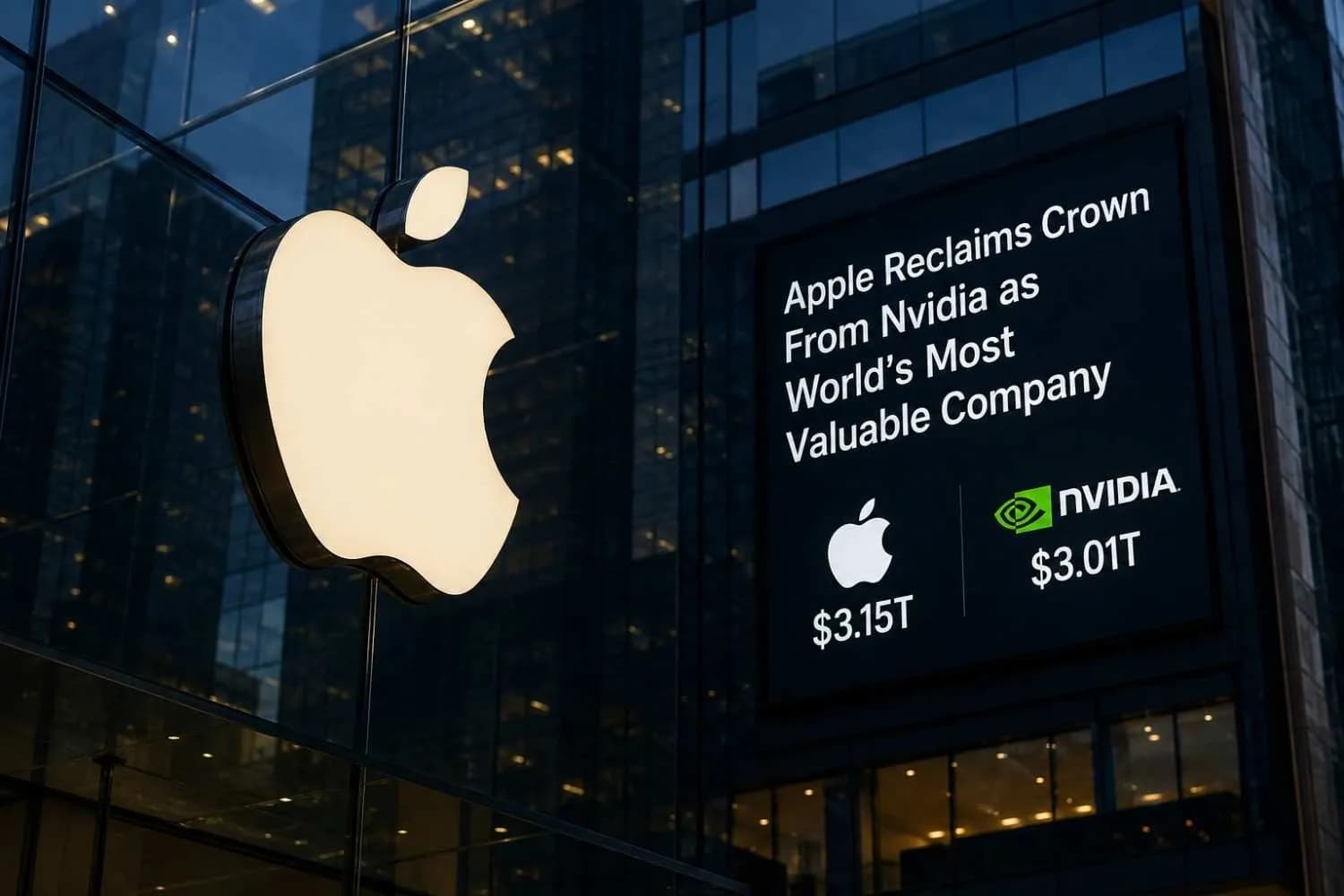
Apple Reclaims Crown From Nvidia as World's Most Valuable Company
Apple’s AI Strategy Changes the Technology Race
Apple has reclaimed its position as the world’s most valuable company after overtaking Nvidia, marking a major shift in how investors view the future of artificial intelligence. The change shows that the AI race is no longer focused only on companies building powerful chips but also on those that can turn AI into everyday consumer experiences.
On July 17, Apple’s market value reached around $4.88 trillion, slightly above Nvidia’s approximately $4.86 trillion valuation. Nvidia had dominated the AI investment story for nearly a year, becoming the first company to cross the $5 trillion market value milestone.
However, investor attention is now expanding beyond AI hardware. Apple’s strong ecosystem, millions of active devices, and focus on AI-powered services have changed the way markets evaluate its future growth.
From experience, technology trends often move in cycles. At first, investors reward companies building the infrastructure behind a major innovation. Later, attention shifts toward companies that can successfully bring that technology to everyday users.
Quick Overview: Why Apple Returned to the Top
Apple’s rise was supported by several factors:
Growing confidence in its AI strategy
Strong iPhone ecosystem advantage
Potential AI-driven service growth
Ability to monetize AI through hardware upgrades
Investor belief in long-term earnings stability
Apple vs Nvidia: Different AI Paths
Company | Main AI Focus | Key Advantage |
|---|---|---|
Apple | Consumer AI experiences | Global device ecosystem |
Nvidia | AI computing infrastructure | Leading AI chip technology |
The competition between Apple and Nvidia represents two different visions of AI. Nvidia powers the technology behind many AI systems, while Apple is focused on bringing AI features directly to consumers through devices and services.
One common mistake people make is judging AI success only by who builds the biggest models or fastest chips. The real challenge is creating technology that people use daily and that generates sustainable business value.
Apple’s comeback highlights a broader change in the technology industry: investors are beginning to look beyond AI infrastructure and toward companies that can successfully turn artificial intelligence into practical solutions.
Apple Overtakes Nvidia to Become the World’s Most Valuable Company
Apple’s return to the top of the global technology rankings represents a major change in investor sentiment. On July 17, Apple’s market valuation reached approximately $4.88 trillion, allowing it to move ahead of Nvidia, which stood near $4.86 trillion after its shares declined by around 3.5%.
This shift placed Apple back as the world’s most valuable company for the first time since April last year. While Nvidia had captured investor attention through its leadership in artificial intelligence infrastructure, Apple’s steady performance and renewed AI strategy helped rebuild confidence among shareholders.
The change does not mean Nvidia has lost its importance in the AI industry. Instead, it shows that investors are beginning to evaluate different ways companies can benefit from artificial intelligence.
How the Market Ranking Changed
For almost a year, Nvidia was considered the biggest winner of the AI boom. The company became the first in the world to surpass a $5 trillion market valuation, driven by massive demand for AI chips used by technology companies worldwide.
However, markets are now looking at a broader AI opportunity.
Company | Approximate Market Value | Primary AI Opportunity |
|---|---|---|
Apple | $4.88 trillion | AI-powered devices, services, and ecosystem |
Nvidia | $4.86 trillion | AI chips, computing infrastructure, and data centers |
Apple’s advantage comes from its ability to integrate AI into products already used by millions of customers. Instead of selling AI infrastructure to businesses, Apple’s strategy focuses on making AI part of daily consumer experiences.
Why Investors Shifted Their Focus
Investor expectations around AI are evolving. Initially, companies supplying AI infrastructure received the most attention because businesses needed powerful chips and computing systems to develop AI models.
Now, investors are asking a different question:
“How will companies actually make money from AI in the long term?”
Apple appears well positioned because it can potentially generate revenue through:
AI-powered iPhone upgrades
Improved digital services
Smarter personal assistants
Better user experiences across devices
Stronger ecosystem engagement
From experience, successful technology companies usually win when they combine innovation with an existing customer base. Apple already has millions of users who regularly upgrade devices and use its services.
Apple’s Return Reflects Confidence, Not Just AI Hype
One interesting aspect of Apple’s rise is that investors are not only betting on future AI possibilities. They are also valuing the company’s financial stability and ability to generate consistent earnings.
According to market observers, Apple was previously considered behind in AI because it did not spend at the same level as some competitors on AI model development. However, sentiment changed as investors recognized Apple’s ability to monetize AI through its ecosystem.
The company’s strategy is different from Nvidia’s. Nvidia provides the foundation that powers AI development, while Apple aims to make AI useful for everyday consumers.
Both approaches remain important, but Apple’s return to the top shows that the next phase of the AI competition may focus less on who builds the technology first and more on who delivers the most valuable user experience.
Why Investors Are Looking Beyond Nvidia’s AI Dominance
For nearly a year, Nvidia was considered the biggest winner of the artificial intelligence boom. The company’s advanced AI chips became essential for businesses building large AI models, cloud platforms, and data centers.
Nvidia’s success was driven by a simple reality: modern AI requires enormous computing power. Companies around the world invested heavily in Nvidia’s hardware to develop and operate advanced AI systems.
However, the market is now entering a new phase. Investors are no longer looking only at companies that provide the infrastructure behind AI. They are also focusing on businesses that can convert AI technology into practical products, services, and revenue.
This shift helped Apple regain the top position among the world’s most valuable companies.
The AI Market Is Expanding Beyond Hardware
In the early stages of the AI boom, chip manufacturers received most of the attention because companies needed powerful processors to train AI systems.
Now, investors are exploring opportunities across different parts of the AI ecosystem.
AI Segment | Example Companies | Main Opportunity |
|---|---|---|
AI Hardware | Nvidia | Building computing infrastructure |
AI Platforms | Technology companies | Developing AI models and tools |
AI Services | Apple and others | Delivering AI features to users |
The future value of AI may come from companies that successfully connect technology with everyday experiences.
For example, a smartphone user may not care which chip powers an AI feature. They care whether the assistant understands requests better, improves productivity, or makes daily tasks easier.
Why Nvidia Still Remains a Major AI Player
Apple’s rise does not reduce Nvidia’s importance. Nvidia remains one of the most influential companies in the AI industry because its chips support many of the world’s leading AI systems.
The company’s strengths include:
Advanced GPU technology
Strong position in AI computing
High demand from data centers
Partnerships with major technology companies
From experience, markets often move between different stages of a technology cycle. Infrastructure companies usually benefit first, while consumer-facing companies may gain later when adoption increases.
Apple and Nvidia Represent Two AI Strategies
The competition between Apple and Nvidia is not simply about which company is better. They represent two different approaches to AI growth.
Factor | Apple | Nvidia |
|---|---|---|
Core Business | Consumer technology | AI infrastructure |
AI Goal | Improve user experiences | Power AI development |
Main Customers | Everyday device users | Businesses and AI developers |
Growth Strategy | Ecosystem monetization | Computing demand |
Both models can succeed because artificial intelligence needs both powerful infrastructure and useful applications.
What Investors Are Watching Next
Investors are now paying closer attention to questions such as:
Can companies turn AI investments into real profits?
Which AI features will customers actually use?
How will businesses balance AI spending with returns?
One common mistake people make is assuming the AI race will have only one winner. In reality, different companies may dominate different parts of the AI ecosystem.
Nvidia built the foundation of the AI revolution, while Apple is attempting to bring AI into millions of personal devices. The next stage of competition will likely depend on how effectively companies transform AI technology into meaningful experiences for users.
Apple’s AI Strategy Changes Investor Sentiment
For much of the recent AI boom, Apple was often viewed as a company moving slower than its competitors. While companies like Nvidia focused on AI infrastructure and other technology firms invested heavily in AI models, Apple appeared more cautious with its approach.
However, investor sentiment has started to change. The market is increasingly recognizing that Apple may not need to compete only by building the largest AI models. Instead, the company’s strength lies in integrating artificial intelligence into products and services already used by millions of people worldwide.
The shift in perception helped Apple regain investor confidence and become the world’s most valuable company once again.
Why Investors Changed Their View of Apple
Apple’s AI opportunity is closely connected to its existing ecosystem. The company controls both hardware and software, allowing it to introduce AI features directly into devices such as iPhones, iPads, and Macs.
Key factors attracting investor attention include:
Massive global device user base
Strong customer loyalty
Ability to combine hardware and software
Revenue opportunities through services
Regular device upgrade cycles
From experience, companies with a strong ecosystem often have an advantage when introducing new technology. Customers are more likely to adopt new features when they are already connected to a trusted platform.
Apple’s Advantage: Monetizing AI Through Existing Products
Unlike companies that mainly sell AI infrastructure, Apple can introduce AI through products customers already own.
For example, an AI-powered iPhone feature could encourage users to upgrade devices, subscribe to services, or spend more time within Apple’s ecosystem.
Apple AI Opportunity | Possible Business Impact |
|---|---|
Smarter Siri | Better user engagement |
AI-powered iPhone features | Encourage upgrades |
AI services | Potential revenue growth |
Personalized experiences | Stronger customer loyalty |
The company’s strategy focuses on making AI useful rather than simply making AI powerful.
Apple vs Other AI-Focused Companies
Company | AI Strategy | Main Strength |
|---|---|---|
Apple | AI integrated into consumer devices | Ecosystem and customer base |
Nvidia | AI computing infrastructure | Powerful AI chips |
Microsoft | AI software and cloud services | Enterprise AI adoption |
AI models and digital services | Search and data expertise |
Each company is approaching AI from a different angle. Apple’s advantage is its direct relationship with consumers.
The Privacy Challenge
Apple’s biggest challenge is balancing AI improvements with its strong privacy commitments.
Analysts believe Apple has access to valuable user data generated through iPhones and other devices. This information could potentially make AI assistants more personalized and useful.
However, Apple has always emphasized privacy, meaning it must find ways to improve AI capabilities while protecting user information.
This creates a unique challenge: Apple has valuable data, but it cannot use that data in the same way some competitors might.
Investor Confidence Is Based on Long-Term Potential
The market’s renewed confidence in Apple is not only about artificial intelligence. Investors are also considering the company’s financial strength, brand value, and ability to create new revenue opportunities.
One common mistake people make is measuring AI success only by research spending or computing power. In the consumer technology market, adoption matters just as much.
If Apple successfully integrates AI into everyday experiences, it could become one of the companies that defines the next stage of artificial intelligence growth.Apple Intelligence and Siri Upgrade: Closing the AI Gap
Apple’s long-awaited AI improvements represent a major attempt to strengthen its position in the artificial intelligence race. For years, Siri was considered one of the weaker points of Apple’s ecosystem compared with newer AI assistants and advanced tools developed by competitors.
The company’s upgraded AI strategy focuses on making Siri more intelligent, helpful, and connected with everyday user needs. Instead of competing only on AI research, Apple is aiming to bring practical AI features directly to millions of device users.
This approach could become one of Apple’s biggest opportunities because the company already has a large customer base that regularly interacts with its products.
Why Siri’s AI Upgrade Matters
Voice assistants have existed for years, but customer expectations have changed significantly. Users now expect AI assistants to understand context, provide useful answers, and complete more complex tasks.
Apple’s improved Siri could help users with:
More natural conversations
Better understanding of personal requests
Improved device control
Smarter recommendations
More useful daily assistance
For example, a user could expect Siri to help organize schedules, find information across devices, or manage daily tasks more efficiently.
Customer Experience: How AI Could Change iPhone Usage
The success of Apple’s AI strategy will depend on real-world user experiences.
A typical iPhone user may not think about AI models or technical systems. They simply want technology that saves time and works smoothly.
User Need | Possible AI Improvement |
|---|---|
Managing daily tasks | Smarter reminders and planning |
Finding information | More accurate responses |
Device control | Easier commands |
Personalization | Better recommendations |
In markets like the United States, many smartphone users are already familiar with AI tools through search engines, productivity apps, and smart devices. Apple’s challenge is convincing users that its AI features offer something more valuable within the iPhone ecosystem.
Apple Siri vs AI Competitors
AI Assistant | Company | Main Strength |
|---|---|---|
Siri | Apple | Deep device integration |
Gemini | AI search and information access | |
ChatGPT | OpenAI | Conversational intelligence |
Copilot | Microsoft | Productivity and workplace tools |
Apple’s advantage is that Siri is built into devices people already use daily. However, competitors have gained attention through advanced AI conversations and broader AI capabilities.
Pros and Cons of Apple’s AI Approach
Pros
Strong integration with iPhone hardware and software
Large existing user base
Better control over user experience
Potential for AI-driven upgrades
Strong privacy-focused approach
Cons
Slower AI development compared with some competitors
High expectations from users
Privacy limits how data can be used
Siri must catch up with advanced AI assistants
From experience, customers do not adopt technology simply because it is advanced. They adopt it when it solves real problems.
Apple’s success will depend on whether its AI features feel useful in everyday situations rather than just being impressive demonstrations.
The Bigger Picture
The Siri upgrade represents more than an improvement to one feature. It shows Apple’s broader plan to become a stronger player in AI by combining intelligence with its existing ecosystem.
If Apple can deliver reliable, personalized, and practical AI experiences, it may close the gap with competitors and create a new reason for users to stay within its ecosystem.Apple’s Hidden AI Advantage: The iPhone Ecosystem and Personal Data
One of Apple’s biggest advantages in the artificial intelligence race may not be its AI models or computing power. Instead, it could come from something the company already has: a massive ecosystem of devices and user interactions.
Millions of people around the world use iPhones every day for communication, payments, photography, work, entertainment, and personal organization. This creates a huge opportunity for Apple to develop AI experiences that understand how people use technology in their daily lives.
Some analysts believe this ecosystem gives Apple a valuable position in AI. However, the company faces a major challenge: using this opportunity while maintaining its strong privacy standards.
Why the iPhone Ecosystem Gives Apple an Advantage
Apple controls both the hardware and software experience, which allows it to create AI features that work closely with its devices.
The company’s potential AI advantage comes from:
Millions of active iPhone users
Integration between devices and services
Long-term customer relationships
Direct connection with consumers
Ability to deliver AI through software updates
From experience, companies with direct customer relationships often have an advantage when introducing new technology. They already understand user behavior and can improve products based on real needs.
Data and AI: Apple’s Opportunity and Challenge
Artificial intelligence becomes more useful when it understands context. Personal information can help AI assistants provide more relevant responses and recommendations.
For example, an AI assistant could become more helpful by understanding:
User schedules
Preferred apps
Daily routines
Communication patterns
Personal preferences
However, Apple has always positioned privacy as a key part of its brand identity.
The challenge is finding a balance between making AI smarter and protecting user information.
Privacy vs Personalization: A Major AI Debate
Factor | Apple Approach | Competitor Approach |
|---|---|---|
User data | Strong privacy focus | Different levels of data usage |
AI personalization | Controlled experience | Often broader data integration |
Customer trust | Major brand advantage | Depends on platform policies |
Apple’s privacy approach can be a competitive advantage because many users are becoming more concerned about how companies handle personal information.
At the same time, privacy restrictions may make it more challenging to develop highly personalized AI features.
How This Could Affect iPhone Users
If Apple successfully combines AI with its ecosystem, customers could experience:
More intelligent personal assistance
Better recommendations
Faster daily tasks
Improved device automation
More personalized services
For example, instead of searching through multiple apps, users could rely on AI features that understand their needs and provide information more efficiently.
Apple vs Nvidia: Different Sources of AI Power
Apple and Nvidia are competing in different areas of artificial intelligence.
Company | AI Advantage |
|---|---|
Apple | Consumer ecosystem and device integration |
Nvidia | AI chips and computing infrastructure |
Nvidia provides the technology foundation that powers AI development, while Apple focuses on bringing AI into everyday consumer experiences.
The future AI market will likely need both sides. Powerful infrastructure enables AI development, while consumer platforms determine how widely people actually use these technologies.
The Long-Term AI Opportunity
Apple’s ecosystem could become one of its strongest advantages if the company successfully turns everyday user interactions into better AI experiences.
The key challenge is execution. Having access to a large ecosystem is valuable, but customers will only respond positively if AI features are useful, reliable, and respectful of privacy.
Apple’s future in AI may depend less on creating the biggest AI system and more on creating the most trusted AI experience.Nvidia vs Apple: Two Different Paths to AI Leadership
The competition between Apple and Nvidia represents two completely different approaches to winning the artificial intelligence race. While Nvidia has built its reputation by providing the powerful hardware needed to develop AI systems, Apple is focusing on bringing AI directly into the hands of everyday consumers.
Both companies are benefiting from the AI revolution, but their strategies, customers, and growth opportunities are very different.
Nvidia became the symbol of AI infrastructure growth because its chips power many advanced AI systems worldwide. Apple, meanwhile, is betting on its massive ecosystem and the ability to turn AI into useful features for millions of users.
From experience, technology markets often reward different companies at different stages of innovation. Infrastructure leaders usually grow first, while consumer-focused companies can benefit when adoption becomes mainstream.
Apple vs Nvidia: AI Strategy Comparison
Category | Apple | Nvidia |
|---|---|---|
Main AI Focus | Consumer AI experiences | AI computing infrastructure |
Core Products | iPhone, Mac, services | GPUs and AI chips |
Main Customers | Individual users | Technology companies and data centers |
AI Advantage | Ecosystem integration | Powerful computing technology |
Revenue Opportunity | Services and hardware upgrades | AI chip demand |
Main Challenge | Catching up in AI capabilities | Maintaining growth expectations |
This comparison shows that Apple and Nvidia are not direct competitors in every area. Instead, they represent two important parts of the AI ecosystem.
Nvidia’s Strength: Powering the AI Revolution
Nvidia’s success comes from solving one of the biggest challenges in AI development: computing power.
Companies building advanced AI systems need specialized chips to process large amounts of information. Nvidia became a key supplier because its technology supports many AI applications.
Nvidia’s major strengths include:
Industry-leading AI processors
Strong relationships with technology companies
High demand from AI infrastructure projects
Deep expertise in accelerated computing
The company’s growth demonstrates how valuable the foundation of AI has become.
Apple’s Strength: Bringing AI to Consumers
Apple’s strategy is different. Instead of selling AI tools to developers, the company wants to make AI part of everyday digital experiences.
Apple’s potential advantages include:
Hundreds of millions of device users
Control over hardware and software
Strong customer loyalty
Ability to introduce AI through existing products
For many consumers, the success of AI will not depend on technical specifications. It will depend on whether AI makes their daily tasks easier.
Competitor Landscape: Where Other Companies Stand
Company | AI Strategy | Competitive Advantage |
|---|---|---|
Apple | Consumer AI integration | Device ecosystem |
Nvidia | AI hardware | Computing power |
AI models and services | Search and data expertise | |
Microsoft | Enterprise AI tools | Cloud and workplace solutions |
OpenAI | AI assistants and models | Conversational intelligence |
The AI industry is becoming more competitive because companies are focusing on different opportunities.
Pros and Cons of Apple’s AI Strategy
Pros
Strong relationship with customers
Massive hardware ecosystem
Ability to combine software and devices
Potential for AI-driven product upgrades
Strong privacy reputation
Cons
Slower AI progress compared with some rivals
Limited public AI model presence
Pressure to improve Siri quickly
High customer expectations
Pros and Cons of Nvidia’s AI Strategy
Pros
Dominant position in AI chips
Strong demand from AI companies
Critical role in AI infrastructure
Early advantage in the AI boom
Cons
Heavy dependence on AI spending growth
Increasing competition in AI chips
High market expectations
Vulnerability to changes in AI investment cycles
The Future AI Battle Will Be About Value Creation
The next stage of artificial intelligence competition will likely focus on who can create the most practical value.
Nvidia may continue powering the technology behind AI, while Apple may focus on making AI part of everyday life.
The biggest winners may not be companies that simply build AI technology, but those that successfully connect AI with real user needs.Apple’s Leadership Transition and Tim Cook’s AI Legacy
Apple’s rise back to the top of the global technology market comes at an important moment for the company’s leadership. CEO Tim Cook is preparing to step away from his role in September, with hardware executive John Ternus expected to take over the leadership position.
The timing makes Apple’s artificial intelligence strategy even more significant. How Apple handles AI growth could become one of the defining factors of Cook’s final years and shape the direction of the company under new leadership.
Since becoming CEO, Tim Cook has transformed Apple into one of the world’s most valuable companies by expanding services, strengthening the product ecosystem, and maintaining strong customer loyalty.
However, artificial intelligence represents one of the biggest technology shifts Apple has faced in recent years.
Tim Cook’s Impact on Apple’s Growth
Under Cook’s leadership, Apple expanded beyond traditional hardware sales and built a stronger services business.
Key achievements during his leadership include:
Growth of Apple’s global ecosystem
Expansion of subscription-based services
Strong focus on privacy and security
Continued iPhone innovation
Increased company valuation
From experience, leadership transitions at major technology companies are closely watched because investors want to know whether the next leader can continue the company’s growth strategy.
Why AI Will Define Apple’s Next Era
The next phase of Apple’s growth will likely depend heavily on artificial intelligence.
The company needs to answer important questions:
Can Apple make AI features valuable for everyday users?
Can Siri compete with advanced AI assistants?
Can Apple maintain privacy while improving personalization?
Can AI encourage future device upgrades?
The answers to these questions may influence how investors view Apple’s future.
John Ternus and Apple’s Future Direction
John Ternus, known for his hardware leadership, represents continuity in Apple’s product-focused culture.
A leadership transition could bring new opportunities, but maintaining Apple’s balance between innovation, quality, and customer trust will be important.
Leadership Focus | Potential Impact |
|---|---|
Hardware expertise | Continued product innovation |
AI investment | Stronger technology position |
Ecosystem strategy | Customer retention |
Privacy approach | Brand trust |
Apple’s AI Challenge After Tim Cook
Apple’s biggest challenge is not simply entering the AI race. It is proving that its approach can compete with companies already leading in AI models and infrastructure.
Competitors have moved quickly in areas such as:
Generative AI tools
AI assistants
Enterprise solutions
Advanced language models
Apple’s advantage is its ecosystem, but the company must ensure AI features are useful enough that customers notice a real difference.
What Investors Will Watch Next
The technology industry will closely monitor Apple’s next steps, including:
AI product launches
Siri improvements
New device features
Services growth
Leadership decisions
One common mistake people make is assuming a new CEO must completely change a company’s direction. At Apple, maintaining the strengths of the existing ecosystem while improving AI capabilities may be the bigger challenge.
Apple’s return as the world’s most valuable company shows strong investor confidence. The next leadership era will determine whether that confidence grows further or faces new challenges.Customer Experience: How Apple’s AI Push Could Change iPhone Usage
The success of Apple’s artificial intelligence strategy will ultimately depend on one important factor: how much value users actually feel in their daily lives.
For most iPhone users, AI is not about technical specifications or complex algorithms. They are not concerned about how many parameters an AI model has or which technology powers it. They want features that save time, improve convenience, and make their devices smarter.
Apple understands this consumer-focused approach. Instead of promoting AI only as a technology breakthrough, the company aims to integrate intelligence into products people already use every day.
How AI Could Improve Everyday iPhone Experiences
A successful AI upgrade could change how users interact with their devices.
Potential improvements include:
More accurate voice assistance through Siri
Better photo organization and editing
Smarter message suggestions
Improved search capabilities
More personalized recommendations
Faster access to information
For example, a busy professional in the US might use AI features to summarize emails, organize meetings, or quickly find important information without manually searching through multiple apps.
Similarly, students could benefit from smarter tools that help manage schedules, research topics, and improve productivity.
Real-World User Expectations From AI
Many consumers have already experienced AI through platforms like search engines, chat assistants, and productivity tools. This has raised expectations for smartphone companies.
Users increasingly expect AI to:
User Need | Expected AI Benefit |
|---|---|
Saving time | Faster completion of tasks |
Better organization | Smarter reminders and planning |
Communication | Improved writing assistance |
Information access | More relevant answers |
Personalization | Features that understand preferences |
From experience, the best technology is not always the most advanced one. It is the technology that solves common problems without making users think about the complexity behind it.
Apple vs Competitors: Customer Experience Comparison
Company | AI Experience Focus |
|---|---|
Apple | AI integrated into personal devices |
Search, information, and AI services | |
Microsoft | Workplace productivity and business tools |
OpenAI | Conversational AI assistance |
Apple’s advantage is the connection between hardware, software, and services. A feature introduced on the iPhone can quickly reach millions of users because the company controls the complete experience.
Customer Trust and Privacy Expectations
Privacy remains a major part of Apple’s customer relationship. Many users choose Apple products because they believe the company takes personal data protection seriously.
However, AI creates a new challenge. More personalized AI often requires more understanding of user behavior.
Apple must find the right balance:
Benefits
More personalized experiences
Better AI recommendations
Smarter device interactions
Improved productivity
Challenges
Maintaining privacy standards
Managing customer expectations
Competing with faster AI innovators
Ensuring AI features provide real value
What Could Make Apple’s AI Successful?
The biggest opportunity for Apple is making AI feel natural. Customers do not want technology that feels complicated. They want features that quietly improve their daily routines.
If Apple successfully combines AI with its existing ecosystem, it could strengthen customer loyalty and create new reasons for users to upgrade their devices.
The future of Apple’s AI journey will not be decided only by technology leadership. It will be decided by whether millions of users find these features genuinely useful.
What Apple Becoming the World’s Most Valuable Company Means for the Future of Technology
Apple overtaking Nvidia as the world’s most valuable company represents more than a change in market rankings. It reflects a broader shift in how investors and businesses view the future of artificial intelligence.
At the beginning of the AI boom, the biggest opportunities were concentrated around companies building the infrastructure needed to power AI systems. Nvidia became the leading example of this trend by supplying advanced chips that support AI development worldwide.
Now, attention is moving toward companies that can transform AI technology into products and services used by everyday people.
Apple’s comeback shows that the next stage of AI competition may focus on practical applications, customer experience, and long-term business value.
The AI Industry Is Entering a New Phase
The technology market is moving from AI development toward AI adoption.
The next winners may be companies that successfully answer questions like:
How will people use AI every day?
Which AI features will customers actually value?
How can companies turn AI into sustainable revenue?
AI Stage | Main Focus | Leading Examples |
|---|---|---|
Early AI Boom | Computing power and infrastructure | Nvidia |
Current Shift | Consumer and business applications | Apple, Microsoft, Google |
Future Growth | Everyday AI experiences | Technology ecosystem companies |
From experience, major technology shifts usually create opportunities for different types of companies at different times. The companies that build the foundation and the companies that make technology useful can both succeed.
Apple’s Opportunity in the Global AI Race
Apple’s strength comes from its ability to connect AI with products already used by millions of customers.
The company’s future AI growth could come from:
Smarter iPhones and personal devices
Improved digital services
More advanced AI assistants
Better customer personalization
New software opportunities
The challenge will be maintaining innovation speed while protecting user privacy and customer trust.
What This Means for Competitors
Apple’s rise increases pressure on other technology companies to prove how they will generate value from AI investments.
Competitors will need to focus on:
Better AI experiences
Stronger consumer adoption
More practical applications
Sustainable business models
The AI race is becoming less about who spends the most money and more about who creates the most useful technology.
Final Thoughts.
Apple reclaiming the title of the world’s most valuable company highlights a changing technology landscape. Nvidia remains a critical force in AI infrastructure, but Apple’s success shows that consumer-focused AI could become equally important.
The future of artificial intelligence will likely depend on both powerful technology foundations and user-friendly applications.
Companies that can combine innovation, trust, and real customer value will have the strongest position in the years ahead.
Stay Updated With the Latest Technology Trends
The AI industry is evolving rapidly, and companies like Apple and Nvidia are shaping how people will interact with technology in the future.
Follow PehlePakistan for the latest updates on artificial intelligence, global technology developments, business trends, and major market movements that impact the digital world.FAQs
1. Why did Apple overtake Nvidia as the world’s most valuable company?
Apple overtook Nvidia after investors gained more confidence in Apple’s AI strategy, ecosystem strength, and ability to generate future revenue through AI-powered products and services.
2. What is Apple’s current market value compared with Nvidia?
Apple reached an estimated market value of around $4.88 trillion, while Nvidia was valued at approximately $4.86 trillion after a decline in its share price.
3. Is Apple ahead of Nvidia in artificial intelligence?
Apple and Nvidia lead different areas of AI. Nvidia dominates AI hardware and computing infrastructure, while Apple focuses on AI features integrated into consumer devices.
4. How will AI improve future iPhones?
AI could improve iPhones through smarter assistants, better personalization, improved photography, faster searches, and more efficient daily tasks.
5. Why is Siri’s AI upgrade important for Apple?
Siri’s improvement is important because Apple needs a stronger AI assistant to compete with advanced AI tools from companies like Google, Microsoft, and OpenAI.
6. What is Nvidia’s role in the AI industry?
Nvidia provides advanced AI chips that power many artificial intelligence systems, data centers, and AI development projects worldwide.
7. Can Apple maintain its position as the world’s most valuable company?
Apple’s future position will depend on how successfully it integrates AI into its products, grows services revenue, and continues delivering valuable experiences to customers.
Topics in this story
Article Details
Category: Tech
Published: 23 July 2026
Time: 1:05 pm
Updated: 23 July 2026 at 3:20 pm
Author: Rabia
More Stories