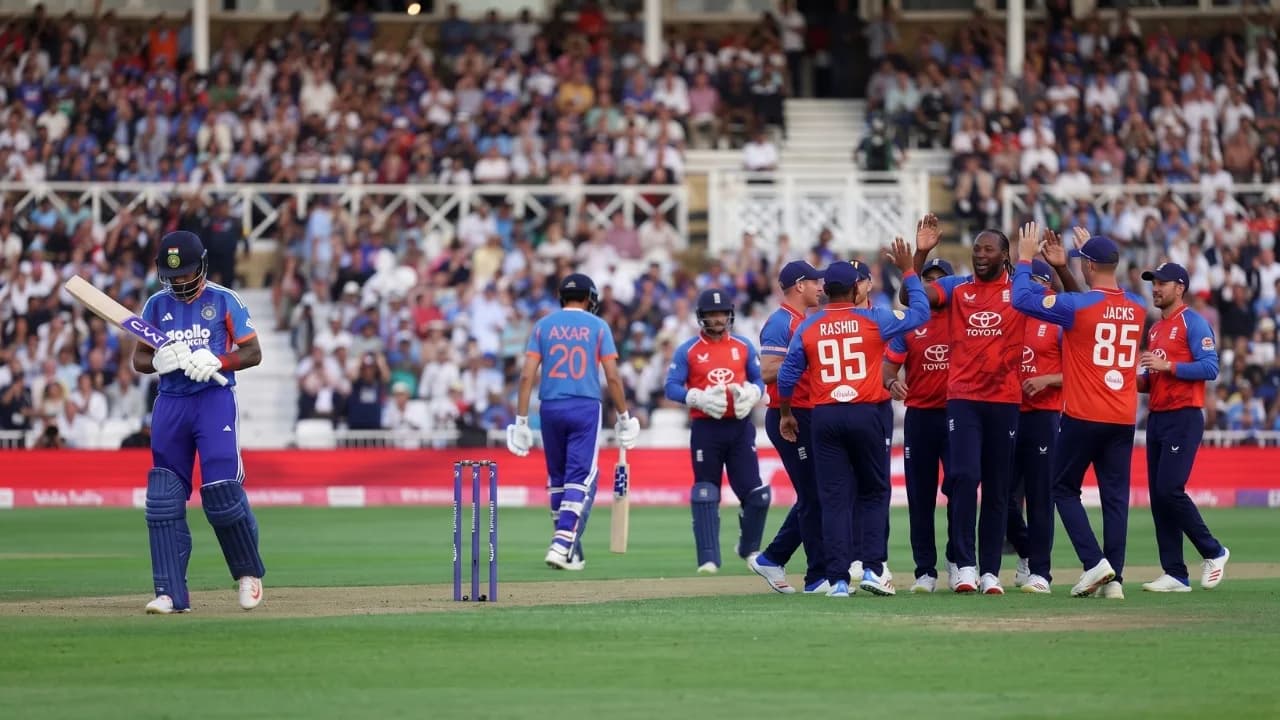
The England vs India, fifth T20 international became one of the most talked-about matches of the series as England delivered a dominant performance at The Ageas Bowl, Southampton. The hosts defeated India by 56 runs, completed a 4-0 series victory, and secured the No.1 position in the ICC Men's T20I rankings.
India entered the match hoping to avoid a disappointing series finish, but England’s aggressive batting approach created a challenge from the first over. Jos Buttler and Harry Brook produced a remarkable batting display, putting India’s bowling attack under constant pressure.
The match was not only about a single win. It reflected the changing balance of power in international T20 cricket. England showed why their attacking style remains one of the toughest challenges for any team, while India found themselves searching for answers after a difficult run of results.0Findia
England vs India Fifth T20I
The contest started with India winning the toss and choosing to bowl first. That decision looked reasonable considering the conditions, but England quickly turned the game around with fearless batting.
England posted a huge total of 257/3 in 20 overs, their highest-ever T20I score against India. The foundation of this massive total was built through an incredible partnership between Jos Buttler and Harry Brook.
Key match details:
Category | Details |
|---|---|
Match | England vs India, 5th T20 International |
Venue | The Ageas Bowl, Southampton |
Toss Winner | India chose to bowl |
England Score | 257/3 (20 overs) |
India Score | 201/8 (20 overs) |
Result | England won by 56 runs |
Series Result | England won 4-0 |
India showed some resistance during the chase, especially through Ishan Kishan and Tilak Varma, but the required run rate kept increasing. England’s bowlers maintained control and prevented India from creating a late comeback.
Why This Match Matters for Global Cricket Fans
For fans watching from countries like the USA, Canada, Pakistan, Australia, and other cricket-growing regions, this match represented more than just a bilateral series result.
It highlighted three important trends:
England’s continued evolution as an aggressive T20 side.
India’s challenge of rebuilding after a major tournament victory.
The increasing importance of power hitting and fearless cricket.
One common mistake people make is looking only at the final score. From experience watching T20 cricket trends, the bigger story is often how teams respond under pressure. England’s ability to dominate key moments separated them from India in this contest.
The fifth T20 international will be remembered as a match where individual brilliance, strategic decisions, and team confidence combined to create a major shift in the T20 rankings.
Jos Buttler’s Record-Breaking Knock: A Player of the Match Performance to Remember
The biggest highlight of the England vs India, fifth T20 international was Jos Buttler’s breathtaking batting performance. The England captain produced a career-defining innings, scoring 131 runs from just 64 balls and completely changing the direction of the match.
Buttler’s innings was a perfect example of modern T20 batting. Instead of waiting for mistakes from the bowlers, he controlled the game from the start by attacking the right deliveries and rotating the strike when boundaries were not available.
For many cricket followers, especially fans watching from emerging cricket markets like the USA, this was a reminder of why T20 cricket has become one of the fastest-growing sports formats worldwide. A single player can completely transform a match within a few overs.
Buttler’s Masterclass: Numbers Behind the Incredible Innings
Buttler’s performance was not just about the final score. The way he built the innings showed experience, patience, and excellent shot selection.
Performance Area | Jos Buttler’s Numbers |
|---|---|
Runs Scored | 131 |
Balls Faced | 64 |
Fours | 12 |
Sixes | 7 |
Strike Rate | 204.69 |
Match Award | Player of the Match |
His innings helped England reach a record-breaking 257/3, putting India under enormous pressure before their chase even started.
Key moments from Buttler’s innings:
Took advantage of India’s inconsistent bowling attack.
Maintained a strike rate above 200 throughout the innings.
Built confidence after a difficult period in T20 internationals.
Delivered when England needed leadership from their captain.
Why Buttler’s Innings Was Different From a Normal T20 Century
Many T20 centuries come from aggressive starts, but Buttler’s approach was more calculated. He understood when to attack and when to rebuild.
One common mistake people make when analyzing T20 batting is focusing only on boundaries. In reality, elite players create pressure by keeping the scoreboard moving every ball.
Buttler demonstrated:
Excellent game awareness.
Strong control against spin and pace.
Ability to handle pressure situations.
Leadership through performance.
From experience following modern cricket, players like Buttler are valuable because they do not just score runs; they influence how the opposition plans their entire innings.
Buttler Compared With Other Top T20 Batters
The modern T20 era has produced several explosive batters, but Buttler’s ability to combine consistency with power separates him from many competitors.
Player | Strength | T20 Impact |
|---|---|---|
Jos Buttler | Power hitting with match control | Can win games single-handedly |
Virat Kohli | Timing and consistency | Excellent run chaser |
Glenn Maxwell | Innovation and creativity | Changes games quickly |
Babar Azam | Classical batting technique | Builds long innings |
Unlike some power hitters who rely mainly on boundaries, Buttler creates pressure through smart cricketing decisions. This makes him dangerous in both high-scoring matches and pressure situations.
Pros and Cons of Buttler’s Batting Approach
Pros
Can completely dominate world-class bowling attacks.
Provides confidence to the players around him.
Handles pressure situations effectively.
Brings leadership value along with batting ability.
Cons
His aggressive approach carries a higher risk of early dismissal.
Teams can target him with specific bowling plans.
Maintaining such a high strike rate consistently is physically demanding.
Why Performances Like This Grow Cricket Globally
Many cricket fans discover T20 cricket through memorable individual performances. Buttler’s innings is the type of display that attracts new viewers because it offers excitement from the first over.
For example, fans discussing major T20 matches online often highlight moments where one player changes the entire atmosphere of the game. Similar reactions have been seen among international cricket communities, where viewers appreciate fearless batting and high-pressure performances.
A match like this helps explain why leagues and international T20 tournaments continue gaining popularity among audiences outside traditional cricket nations.
Buttler’s 131 was not only a personal achievement. It was a statement that England’s senior players remain capable of producing match-winning performances on the biggest stages.
Harry Brook and Jos Buttler’s Historic 233-Run Partnership
One of the biggest reasons behind England’s incredible total in the England vs India, fifth T20 international was the unforgettable 233-run partnership between Jos Buttler and Harry Brook. The second-wicket stand completely changed the momentum of the match and created a new benchmark in men’s T20 cricket.
After losing Phil Salt early, England could have slowed down and focused on rebuilding. Instead, Buttler and Brook responded with fearless batting and turned the match into a one-sided contest.
Their partnership showed the difference between attacking cricket and reckless cricket. Both batters understood when to take risks and when to rotate the strike. This balance allowed England to maintain pressure on India throughout the innings.
A Record-Breaking Partnership That Entered T20 History
The 233-run partnership between Buttler and Brook became one of the greatest partnerships ever recorded in men's T20 cricket.
Partnership Record | Details |
|---|---|
Total Runs | 233 |
Batting Pair | Jos Buttler and Harry Brook |
Wicket | Second wicket |
Match | England vs India, 5th T20I |
Venue | The Ageas Bowl, Southampton |
Ranking Achievement | Fourth-highest partnership for any wicket in men's T20Is |
This partnership also surpassed the previous record for the highest second-wicket partnership in all men's T20 cricket, replacing the famous 229-run stand between Virat Kohli and AB de Villiers during the IPL 2016 season.
Harry Brook’s Leadership Statement With the Bat
While Buttler received the Player of the Match award, Harry Brook played an equally important role in England’s dominance. The England captain remained unbeaten on 95 runs from only 45 balls and showed why he is considered one of the most exciting young leaders in world cricket.
Brook’s innings included:
Powerful stroke play against pace and spin.
Excellent strike rotation.
Confidence under pressure.
Strong partnership management with Buttler.
Leadership in cricket is often judged by results, but performances like this show another side of captaincy. Brook did not simply make tactical decisions; he led from the front with his batting.
Why This Partnership Worked So Well
Many high-scoring partnerships fail because both batters try to play the same role. Buttler and Brook succeeded because they complemented each other.
Their partnership worked because:
Buttler provided experience and controlled aggression.
Brook played fearless attacking cricket.
Both players kept the scoreboard moving.
India struggled to find a bowling strategy that worked against both styles.
From experience analyzing T20 matches, successful partnerships usually involve two players who understand game situations. It is not always about hitting sixes; it is about creating constant pressure.
Comparison With Other Famous T20 Partnerships
Batters | Runs | Competition | Importance |
|---|---|---|---|
Buttler & Brook | 233 | England vs India T20I | Record second-wicket stand |
Kohli & de Villiers | 229 | IPL 2016 | Previous second-wicket record |
Quinton de Kock & David Miller | 174* | South Africa vs India | Highest partnership against India before this match |
This comparison shows how rare England’s achievement was. Partnerships above 200 runs are uncommon because T20 cricket gives bowlers fewer opportunities to recover once momentum shifts.
What Other Teams Can Learn From England’s Approach
The biggest lesson from England’s batting display is the importance of positive intent.
Modern T20 cricket rewards teams that:
Attack weak bowling options quickly.
Avoid allowing pressure to build.
Trust their strongest batters.
Maintain aggression throughout 20 overs.
For teams like India, Australia, Pakistan, and other international sides, this match provides a clear example of how quickly a game can move away when partnerships are not controlled.
A Partnership That Changed the Match Experience
For cricket fans watching globally, especially in regions where T20 cricket is attracting new audiences, partnerships like this create unforgettable moments.
A viewer does not need to follow every technical detail to understand the excitement of two batters dominating an international attack. This is one reason T20 cricket continues growing among younger audiences.
The Buttler-Brook partnership was not just a statistical achievement. It was a complete batting performance that helped England secure a historic series victory and reclaim the No.1 position in T20 rankings.
England’s Record Total 257/3: How They Dominated India’s Bowling Attack
England’s batting performance in the England vs India, fifth T20 international was a clear example of modern T20 cricket at its most aggressive. The hosts posted a massive 257/3 in 20 overs, creating the highest-ever T20I total against India.
The score was not achieved through random attacking shots. England built their innings with planning, excellent shot selection, and constant pressure on India’s bowlers. Every phase of the innings had a clear purpose, from building a strong foundation to accelerating during the middle overs.
For teams competing at the international level, this type of batting display shows how important momentum has become in T20 cricket. Once England gained control, India struggled to find a way back into the contest.
England’s Record-Breaking Batting Display
England’s total of 257/3 became one of the most significant batting achievements in their T20 history.
Record Category | Achievement |
|---|---|
England Total | 257/3 |
Overs Played | 20 |
Highest Against India | New T20I record |
Previous England 250+ Scores | 267/3 vs West Indies, 304/2 vs South Africa |
Series Result Impact | Helped England win 4-0 |
England became only the second team after India to register three or more 250-plus totals in men's T20 internationals. This highlights their reputation as one of the most attacking batting sides in the format.
How England Built Their Huge Score
A successful T20 innings requires balance. England avoided the common mistake of trying to hit every ball from the beginning.
Their approach included:
Protecting key wickets while maintaining a high scoring rate.
Targeting weaker bowling options.
Using partnerships to control the match.
Increasing aggression during the middle overs.
The 14th, 15th, and 16th overs were particularly damaging for India, as England scored more than 20 runs in each over. This period effectively ended India’s hopes of restricting England below a manageable target.
India’s Bowling Struggles Under Pressure
India entered the match with experienced bowlers, but England’s aggressive approach exposed weaknesses in the attack.
Indian Bowler | Overs | Runs Conceded | Wickets |
|---|---|---|---|
Axar Patel | 4 | 63 | 0 |
Prince Yadav | 4 | 60 | 0 |
Shivam Dube | 1 | 22 | 0 |
Prasidh Krishna | 4 | 38 | 1 |
Arshdeep Singh | 4 | 33 | 0 |
The biggest challenge for India was not only the number of runs conceded but the lack of control during crucial moments. In T20 cricket, one expensive over can change the entire match, and England capitalized whenever opportunities appeared.
England vs Other Top T20 Teams: Batting Comparison
Team | T20 Batting Style | Main Strength |
|---|---|---|
England | Aggressive attacking cricket | Power hitting throughout innings |
India | Balanced approach | Strong top-order batting |
Australia | Fearless stroke play | Explosive middle order |
Pakistan | Timing-based batting | Quality top-order anchors |
England’s advantage is their willingness to maintain pressure even after losing wickets. Their players are encouraged to continue attacking rather than shifting into a defensive mindset.
Pros and Cons of England’s Aggressive T20 Strategy
Pros
Creates pressure on opposition bowlers immediately.
Allows teams to achieve match-winning totals.
Gives players confidence to play natural cricket.
Works especially well on batting-friendly surfaces.
Cons
Higher risk of losing early wickets.
Requires players with exceptional skills and confidence.
Can fail if conditions support bowlers.
Heavy reliance on maintaining momentum.
One common mistake teams make is copying aggressive strategies without having the right players. England’s approach works because their batters understand their roles and have the experience to manage pressure situations.
Why High-Scoring Matches Attract New Audiences
For cricket audiences in countries like the USA, where T20 leagues are helping introduce new fans to the sport, matches with explosive batting often create the biggest impact.
A casual viewer may not know every bowling tactic, but seeing a team score 250-plus runs creates immediate excitement. These moments help explain why T20 cricket continues expanding internationally.
England’s 257/3 was more than just a high score. It was a statement of intent and a reminder that modern T20 cricket is increasingly about controlling the game through fearless batting.
India’s Batting Fightback: Key Performances During a Challenging Chase
Chasing 258 runs in the England vs India, fifth T20 international was always going to be a difficult task, but India showed determination with an aggressive response. Although they eventually finished at 201/8 and lost by 56 runs, their batting effort provided some positive signs for the team’s future.
India’s challenge was clear from the beginning. Against a target above 250, the required run rate was extremely high, meaning batters had to attack from the first over while also protecting wickets. This balance is one of the hardest challenges in T20 cricket.
Despite the pressure, India produced moments of quality batting, especially through Ishan Kishan and Tilak Varma, who gave fans hope during the middle phase of the chase.
India’s Top Batting Performances in the Fifth T20I
India’s chase was built around aggressive contributions from their younger batters. They understood that a traditional approach would not be enough against England’s huge total.
Indian Batter | Runs | Balls | Strike Rate |
|---|---|---|---|
Ishan Kishan | 56 | 35 | 160.00+ |
Tilak Varma | 53 | 25 | 200+ |
Shreyas Iyer | 28 | 16 | 175.00 |
These performances showed India still had the ability to compete with aggressive batting teams, even when facing an almost impossible target.
Ishan Kishan Provides Stability and Aggression
Ishan Kishan played one of India’s most important innings of the match. His 56-run knock gave India a strong start and prevented England from completely controlling the chase in the early overs.
His approach included:
Attacking England’s opening bowlers.
Finding boundaries regularly.
Maintaining a healthy strike rate.
Building confidence among the middle-order batters.
In high-pressure chases, the first few overs often decide the mindset of the entire team. Kishan’s positive intent helped India avoid an early collapse.
Tilak Varma’s Explosive Middle-Order Impact
Tilak Varma continued to show why he is considered one of India’s promising T20 talents. His 53 runs from only 25 balls gave India a brief chance of making the chase competitive.
His innings showed:
Excellent timing against pace bowling.
Confidence in attacking senior bowlers.
Ability to score quickly under pressure.
Strong understanding of T20 situations.
From experience watching T20 cricket, young players often struggle when asked to attack from the beginning against a massive target. Varma showed maturity beyond his age.
Why India Could Not Complete the Record Chase
Although India’s batting showed quality, chasing 258 requires almost a perfect performance. England’s bowlers maintained pressure whenever India started building momentum.
Main reasons India fell short:
Early wickets increased the required run rate.
England’s total created constant pressure.
Indian batters had to take high-risk shots.
England’s bowling changes were effective.
A common mistake people make is judging a chase only by the final score. In reality, chasing a target above 250 is a different challenge because even good batting performances can still result in defeat.
India’s Batting vs England’s Batting Approach
Factor | England | India |
|---|---|---|
Batting Philosophy | Attack from the start | Build and accelerate |
Main Strength | Power hitting depth | Technical batting ability |
Middle Overs | Extremely aggressive | Strong but inconsistent |
Pressure Handling | Maintained momentum | Lost momentum after wickets |
The difference between the two teams was not talent. Both sides had skilled players. The key difference was how effectively England maintained attacking pressure throughout 20 overs.
A Positive Sign Despite Defeat
For global cricket fans, especially supporters following India’s transition under new leadership, the chase offered some encouraging moments.
Many fans value seeing young players take responsibility in difficult situations. Even though India lost, performances from Kishan and Varma showed that the team has attacking options for future tournaments.
The bigger question for India will be consistency. A few strong individual innings are not enough against teams producing record totals. The next step will be creating a complete batting strategy that works under extreme pressure.
England’s Bowling Performance: How They Controlled India’s Record Chase Attempt
England’s batting performance created the foundation for victory, but their bowling attack completed the job in the England vs India, fifth T20 international. Defending 257 runs is never easy because even a few explosive overs from the opposition can create pressure. However, England’s bowlers stayed disciplined and managed crucial moments effectively.
India’s chase required an almost perfect batting performance, but England did not allow partnerships to continue for long periods. Whenever India looked ready to accelerate, England responded with a wicket or a well-controlled over.
This balance between aggressive batting and smart bowling is one of the main reasons England became the new No.1 ranked T20I team.
England’s Bowling Figures That Made the Difference
England used a combination of pace and spin to slow India’s scoring rate. Instead of only focusing on taking wickets, their bowlers concentrated on creating difficult situations for Indian batters.
England Bowler | Overs | Runs Conceded | Wickets |
|---|---|---|---|
Sam Curran | 4 | 36 | 3 |
Adil Rashid | 4 | 24 | 2 |
Liam Dawson | 4 | 14 | 1 |
Other Bowlers | 8 | Controlled pressure | Key support |
Sam Curran was the standout performer with three important wickets, while Adil Rashid used his experience to control the middle overs.
Sam Curran’s Impact Under Pressure
Defending a huge total can sometimes make bowlers relax too much. England avoided that mistake. Sam Curran maintained intensity and attacked India’s batting lineup with confidence.
His success came from:
Mixing pace variations effectively.
Bowling smart lines under pressure.
Taking wickets when India needed momentum.
Supporting England’s aggressive game plan.
In many cases, T20 matches are decided by one or two critical overs. Curran’s ability to deliver during important phases prevented India from building a realistic chase.
Adil Rashid and Liam Dawson Control the Middle Overs
Spin bowling often becomes important in T20 cricket because the middle overs can decide whether a team stays competitive.
Adil Rashid played a key role by limiting India’s scoring opportunities. His experience against top international batters helped England maintain control.
Liam Dawson also contributed with economical bowling, giving India fewer chances to attack.
Their approach showed an important T20 strategy:
Do not always chase wickets.
Reduce boundary opportunities.
Force batters into risky shots.
One common mistake teams make is attacking too aggressively with every delivery. England showed that control can be just as valuable as aggression.
England vs Other Top T20 Bowling Attacks
Team | Bowling Strength | Main Advantage |
|---|---|---|
England | Variety and experience | Flexible options |
India | Pace and spin talent | Individual brilliance |
Australia | Fast bowling depth | Extra bounce and pace |
Pakistan | Quality pace attack | Swing and variations |
England’s biggest advantage is having multiple bowlers who can perform different roles. They do not depend on one player to win matches.
Pros and Cons of England’s Bowling Strategy
Pros
Strong combination of pace and spin.
Experienced players in pressure situations.
Ability to adapt during matches.
Effective against aggressive batting teams.
Cons
Can be challenged on extremely flat batting pitches.
Some bowlers rely heavily on variations rather than pure pace.
Expensive overs can quickly change T20 matches.
A balanced bowling attack does not guarantee victory every time, but it gives teams more ways to recover when situations become difficult.
Why England’s Bowling Completed the Story
For cricket fans watching globally, especially those following T20 cricket in growing markets like the USA, the excitement often comes from seeing whether a huge target can be chased.
England’s bowling performance answered that question clearly. They did not simply rely on their 257-run total. They backed it up with intelligent bowling and strong field awareness.
The combination of Buttler and Brook’s batting brilliance with a disciplined bowling effort showed why England dominated the series. Their performance was not based on one department alone; it was a complete team victory.
India’s Bowling Struggles: Problems Exposed in the Series Finale
The biggest concern for India in the England vs India, fifth T20 international was not only the defeat but the way their bowling attack struggled against an aggressive England batting lineup.
India came into the match with talented bowlers, but England’s fearless approach created problems from the middle overs. The hosts did not allow Indian bowlers to settle, constantly changing the pace of the game with powerful hitting and smart strike rotation.
In T20 cricket, bowling mistakes are often punished immediately. A single loose delivery can disappear for six, and one expensive over can completely change the match situation. India experienced exactly this problem as England built a record-breaking total of 257/3.
India’s Bowling Performance: Key Numbers From the Match
India’s bowlers found it difficult to control England’s scoring rate, especially during the partnership between Jos Buttler and Harry Brook.
Indian Bowler | Overs | Runs Conceded | Wickets |
|---|---|---|---|
Axar Patel | 4 | 63 | 0 |
Prince Yadav | 4 | 60 | 0 |
Shivam Dube | 1 | 22 | 0 |
Prasidh Krishna | 4 | 38 | 1 |
Arshdeep Singh | 4 | 33 | 0 |
The figures show the challenge India faced. Two bowlers conceded more than 60 runs, allowing England to maintain complete control of the innings.
Middle Overs Became India’s Biggest Weakness
The middle overs are usually where teams try to regain control in T20 cricket. Unfortunately for India, this phase became England’s strongest period.
England scored more than 20 runs in three consecutive overs:
14th over
15th over
16th over
This was a major turning point because England moved from a strong position to an almost unbeatable total within a few minutes.
One common mistake people make is focusing only on the final score. The real damage often happens during small periods of the match. For India, those three overs completely changed the outcome.
Why England Managed India’s Bowling Better
England’s batters had a clear strategy. They identified scoring opportunities and did not allow bowlers to build confidence.
Their approach included:
Attacking predictable lengths.
Using the pace of the bowlers against them.
Targeting boundary options consistently.
Rotating the strike between big shots.
India’s bowlers needed more variation and better control during pressure situations.
Comparison: India vs Other Leading T20 Bowling Units
Team | Bowling Style | Current Challenge |
|---|---|---|
India | Mix of pace and spin | Maintaining consistency |
England | Flexible attack | Managing high-pressure games |
Australia | Fast bowling focused | Handling spin-friendly pitches |
Pakistan | Pace-heavy approach | Improving batting support |
India still has several quality bowling options, but international T20 cricket demands consistency. Talent alone is not enough when opponents are scoring at such a rapid pace.
Pros and Cons of India’s Current Bowling Setup
Pros
Good variety with both pace and spin options.
Several young bowlers with international experience.
Ability to perform strongly on different pitches.
Strong depth compared to many teams.
Cons
Lack of control during high-pressure overs.
Expensive spells can decide matches quickly.
Bowling plans need better adaptation against aggressive batters.
Death bowling remains an area requiring attention.
Lessons India Can Take Before Future T20 Challenges
India’s bowling performance in this match provides useful lessons rather than only criticism. Modern T20 cricket requires bowlers who can adjust quickly when batters attack.
Important improvements include:
Developing stronger plans against power hitters.
Improving execution during middle overs.
Using matchups more effectively.
Building confidence among younger bowlers.
From experience following international T20 cricket, even the strongest teams experience difficult phases during transitions. The key difference is how quickly they identify problems and make improvements.
Why Bowling Balance Matters More Than Ever
For cricket fans worldwide, including new audiences watching T20 cricket in countries like the USA, high-scoring games are exciting, but competitive balance makes matches memorable.
India’s batting showed fighting spirit, but their bowling struggles made the contest difficult before the chase even began. To challenge teams like England in future tournaments, India will need a bowling unit capable of handling aggressive batting approaches.
The fifth T20I highlighted an important reality of modern cricket: winning teams need both explosive batting and reliable bowling under pressure.
England Become the New No.1 T20I Team After Historic Series Victory
The result of the England vs India, fifth T20 international was not only important for the series scoreline. It also created a major shift in international cricket rankings. After completing a dominant 4-0 series win, England moved to the top position in the ICC Men's T20I Team Rankings, replacing India as the world’s No.1 ranked team.
For more than 1,600 days, India held the top position in the T20I rankings. England’s performance in this series ended that long period of dominance and showed that the competition at the highest level of T20 cricket continues to grow.
The achievement was especially significant because England reached the No.1 spot by defeating the current T20 World Champions. Instead of simply benefiting from ranking changes, they earned the position through a complete team performance.
England’s Rise to the Top of T20 Cricket
England’s journey to the No.1 ranking has been built around an aggressive style of cricket. Their approach focuses on attacking opposition teams rather than waiting for mistakes.
The series against India highlighted several strengths:
Powerful batting depth throughout the lineup.
Confidence under pressure situations.
Flexible bowling options.
Strong leadership from Harry Brook and senior players.
The fifth T20I became the perfect example of this philosophy. England did not depend on one department. They dominated with both bat and ball.
Ranking Impact | Details |
|---|---|
Previous No.1 Team | India |
New No.1 Team | England |
Series Result | England won 4-0 |
Ranking Change | England moved to first place |
India’s Position | Dropped to second |
Why England’s No.1 Ranking Matters
A ranking position is more than just a number. It reflects consistency, adaptability, and performance against strong opponents.
England’s achievement shows that their T20 strategy continues to work in different situations. Their players are comfortable playing aggressive cricket, which has become increasingly important in modern T20 competitions.
One common mistake people make is judging a team only by tournament wins. Rankings often provide a wider picture because they measure performance over a longer period.
England’s rise has been supported by:
Experienced players like Jos Buttler.
Emerging leaders like Harry Brook.
Strong domestic T20 development.
A clear attacking mindset.
England vs India: A Changing T20 Rivalry
The rivalry between England and India has become one of the biggest attractions in world cricket. Both teams have large fan bases, strong talent pools, and successful T20 systems.
Category | England | India |
|---|---|---|
Current Ranking | No.1 | No.2 |
Batting Style | Aggressive from the start | Balanced with acceleration |
Leadership Focus | New era under Harry Brook | Transition under Shreyas Iyer |
Major Strength | Power hitting depth | Individual batting talent |
The latest series showed that small differences in execution can create a major gap between two elite teams.
Comparison With Other Top T20 Teams
Team | Biggest Strength | Current Challenge |
|---|---|---|
England | Fearless batting and flexible squad | Maintaining consistency |
India | Huge talent pool and experience | Building a stable new combination |
Australia | Match-winning all-rounders | Finding balance |
Pakistan | Quality fast bowlers | Improving consistency |
England’s biggest advantage is their ability to maintain an attacking mindset regardless of the opponent.
Why Rankings Create More Interest
For cricket supporters around the world, rankings add another layer of excitement to every series. Fans are not only watching individual matches but also following how results affect global positions.
In growing cricket markets like the USA, rankings help new fans understand team performance and rivalries. A No.1 ranking battle creates a simple storyline that attracts casual viewers as well as long-time supporters.
Many fans enjoy seeing traditional powerhouses challenged because it creates fresh competition. England replacing India at the top represents exactly that type of change.
What This Means for Future T20 Cricket
England’s rise to No.1 sends a clear message to other teams. Modern T20 success requires more than talented players; it requires a complete strategy.
Teams competing for the top ranking will need:
Aggressive batting plans.
Reliable bowling under pressure.
Strong bench strength.
Players comfortable with changing match situations.
England’s series victory over India was not just a short-term success. It showed a team that currently understands the demands of modern T20 cricket better than most opponents.
India’s Winless Streak After World Cup Success: A New Challenge for the Team
The England vs India, fifth T20 international ended a difficult period for India’s new leadership group. After achieving World Cup success earlier in the year, India entered this series with high expectations, but the team was unable to secure a single victory during the UK tour.
The 4-0 series defeat against England extended India’s winless run in men's T20 internationals to seven matches. It was a surprising turnaround for a team that had recently reached the highest level of success in the format.
However, this phase also represents a transition period. New leadership, changing player combinations, and the pressure of maintaining World Cup standards have created challenges that India must address before future tournaments.
India’s Longest Winless Run in T20 Internationals
The series loss created an unwanted record for India in the shortest format.
Record Category | Details |
|---|---|
Consecutive T20Is Without Win | 7 matches |
Series Result vs England | Lost 4-0 |
Previous Long Struggles | Six consecutive defeats |
Captain During Run | Shreyas Iyer |
This was the first time India suffered four defeats in a single men's T20I series. The result highlighted how quickly momentum can change in international cricket.
Leadership Transition Under Shreyas Iyer
One of the biggest talking points from the series was India’s new leadership direction under Shreyas Iyer.
Leading an international team is challenging, especially during a period when expectations are extremely high. Iyer has faced immediate pressure because India’s previous success created a difficult standard to maintain.
His captaincy record during the early phase:
Six defeats across his first seven matches as India captain.
First Indian men's T20I captain to experience more than two defeats before securing a win.
Tasked with developing a new team combination.
Leadership changes often require patience because captains need time to understand player roles and create a settled strategy.
Why India Struggled After Their World Cup Triumph
Winning a major tournament can create confidence, but it can also increase expectations. India’s recent struggles came from several areas working together.
Key challenges included:
Inconsistent bowling performances.
Difficulty controlling aggressive batting teams.
Changing combinations.
Pressure on new leadership.
Lack of momentum during important moments.
One common mistake people make is assuming a successful team should continue winning automatically. In reality, international cricket moves quickly, and opponents constantly develop new strategies.
India’s Performance Compared With Previous Champions
Team | Post-Tournament Challenge |
|---|---|
India | Managing transition and new leadership |
England | Maintaining aggressive identity after success |
Australia | Balancing experienced and young players |
Pakistan | Creating consistency after major changes |
Every successful cricket team eventually faces a rebuilding phase. The important factor is how effectively they identify weaknesses and improve.
Pros and Cons of India’s Current Transition Phase
Pros
Strong pool of talented young players.
Experienced international performers available.
Ability to compete in different conditions.
Plenty of options across batting and bowling departments.
Cons
Team combinations are still developing.
Bowling consistency remains a concern.
Leadership pressure is high.
Players need more experience in difficult situations.
Why Indian Supporters Should Watch the Bigger Picture
For millions of fans globally, including growing cricket audiences in countries like the USA, India’s recent results may feel disappointing after World Cup success. However, rebuilding periods are common even among the strongest teams.
Many experienced cricket followers understand that one difficult series does not define a team’s future. The focus should be on whether young players improve, whether strategies become clearer, and whether the team learns from challenging conditions.
The England series exposed areas that India must improve, but it also revealed promising talent. The next stage of India’s journey will depend on how quickly they adapt to modern T20 demands.
Harry Brook’s Leadership Era Begins With a Statement Performance
The England vs India, fifth T20 international was a major moment for Harry Brook, not only because of England’s victory but also because of his growing influence as a leader. The England captain delivered a performance that showed why the team trusted him with responsibility in the new era of T20 cricket.
Brook finished the match unbeaten on 95 runs from just 45 balls, guiding England toward a record total alongside Jos Buttler. His innings was a combination of confidence, power, and smart decision-making.
For a young captain, leading against a team like India comes with enormous pressure. However, Brook handled the situation calmly and showed that leadership is not only about tactical decisions but also about setting an example on the field.
Harry Brook’s Match-Winning Contribution
While Buttler’s century received much of the attention, Brook’s contribution was equally important. His ability to maintain England’s scoring speed allowed the team to continue attacking throughout the innings.
Performance Area | Harry Brook’s Contribution |
|---|---|
Runs | 95* |
Balls Faced | 45 |
Partnership | 233 runs with Buttler |
Role | England Captain |
Series Achievement | Player of the Series |
Brook’s innings helped England cross the 250-run mark and created a target that India could not overcome.
Why Brook’s Captaincy Performance Stood Out
Captaincy in T20 cricket is challenging because decisions must often be made within seconds. A captain needs to manage bowlers, adjust field placements, and understand changing match situations.
Brook showed several positive leadership qualities:
Maintained an aggressive team mindset.
Trusted experienced players like Buttler.
Encouraged attacking cricket.
Stayed focused during pressure moments.
From experience following international cricket, young captains often face criticism when results do not go their way. However, performances like this can build credibility quickly because players respond strongly to leaders who deliver themselves.
Brook Compared With Other Young T20 Leaders
Modern cricket has seen several young players take leadership roles. Each captain brings a different style and philosophy.
Captain | Leadership Style | Main Strength |
|---|---|---|
Harry Brook | Attacking and confident | Fearless decision-making |
Shubman Gill | Calm and structured | Long-term planning |
Babar Azam | Technical and composed | Batting leadership |
Pat Cummins | Tactical and balanced | Managing pressure |
Brook’s style fits naturally with England’s aggressive T20 identity. Instead of changing the team’s approach, he appears focused on strengthening it.
Pros and Cons of Brook Leading England
Pros
Understands modern attacking T20 cricket.
Leads through personal performance.
Connects well with younger players.
Brings confidence to the squad.
Cons
Limited long-term captaincy experience.
Will face pressure during difficult series.
Needs to manage workload between batting and leadership.
Must continue developing tactical decision-making.
Leadership success is measured over time. One great series does not define a captain, but strong starts can create confidence within the team.
England’s Future Under Harry Brook
England’s decision to build around Brook represents a move toward the next generation. While players like Jos Buttler remain extremely valuable, Brook’s rise suggests England are preparing for the future.
His leadership could become an important part of England’s plans in upcoming T20 tournaments.
Key areas to watch:
How he handles close matches.
His bowling changes under pressure.
His ability to manage senior players.
His consistency with the bat.
Why New Leaders Create Fresh Excitement
Cricket fans around the world enjoy watching new leadership eras because they bring different ideas and strategies. For audiences in developing cricket markets, including the USA, young captains often create new stories and attract new followers.
Brook’s performance against India was more than a personal milestone. It was a message that England’s future remains strong, with a leader capable of carrying forward their aggressive style.
The fifth T20I may be remembered as the match where Harry Brook moved from being a talented batter to a recognised leader on the international stage.
England vs India Fifth T20I Analysis: Team Comparison, Performance Review, and Key Takeaways
The England vs India, fifth T20 international was not just a single match result. It was a clear comparison between two different approaches to modern T20 cricket.
England focused on aggressive intent, fearless batting, and maintaining pressure throughout the innings. India showed moments of individual brilliance but struggled to match England’s consistency in both batting and bowling departments.
For cricket fans and analysts, this match provided valuable lessons about what separates top T20 teams. Talent was present on both sides, but execution under pressure created the difference.
England vs India Fifth T20I: Complete Match Comparison
Category | England | India |
|---|---|---|
Final Score | 257/3 | 201/8 |
Result | Won by 56 runs | Lost |
Batting Approach | Aggressive from start | Attack with recovery phases |
Top Performer | Jos Buttler and Harry Brook | Ishan Kishan and Tilak Varma |
Partnership Highlight | 233-run stand | Individual fighting innings |
Bowling Control | Strong during chase | Struggled against pressure |
Series Outcome | Won 4-0 | Lost 4-0 |
The biggest difference was England’s ability to control every phase of the match. They dominated the powerplay, middle overs, and finishing stages with confidence.
England vs India: Strength Comparison Before Future T20 Battles
Both teams remain among the strongest sides in world cricket, but their current strengths are different.
Area | England Advantage | India Advantage |
|---|---|---|
Batting Depth | Multiple power hitters | Strong technical batters |
Leadership | Harry Brook’s attacking mindset | Experienced cricket system |
Bowling Options | Flexible combinations | Variety of pace and spin |
Player Pool | Strong domestic T20 structure | Huge talent base |
England currently have an advantage in aggressive T20 execution, while India’s biggest strength remains their ability to produce world-class players consistently.
Competitor Comparison: How Other T20 Teams Compare
The global T20 landscape is becoming more competitive. England and India are not the only teams capable of dominating this format.
Team | Biggest Strength | Area To Improve |
|---|---|---|
England | Fearless batting approach | Maintaining consistency |
India | Talent and experience | Finding balance |
Australia | Match-winning all-rounders | Building combinations |
Pakistan | Quality fast bowling | Middle-order stability |
South Africa | Explosive batting options | Pressure management |
One important trend is that successful T20 teams now need players who can adapt quickly. Traditional cricket skills are still valuable, but decision-making speed has become equally important.
What England Did Better Than India
England’s victory came from several small advantages working together:
Created pressure through partnerships.
Attacked weaker bowling options.
Maintained a high scoring rate.
Used bowlers according to match situations.
Stayed calm despite India’s batting response.
This is where many teams struggle. A strong start is common in T20 cricket, but maintaining control for 20 overs separates elite teams from average performances.
What India Needs To Improve
India does not need a complete rebuild. The team has quality players and strong cricket infrastructure. However, certain areas require attention.
Important improvements include:
Developing clearer bowling plans against aggressive batters.
Creating a settled playing combination.
Supporting young players during transitions.
Improving performance in high-pressure moments.
From experience following international cricket, successful teams are not built only through winning streaks. They are built by identifying weaknesses early and making adjustments.
Overall Pros and Cons of Both Teams
England
Pros:
Explosive batting lineup.
Strong leadership transition.
Flexible bowling attack.
Excellent confidence in pressure situations.
Cons:
Aggressive style can sometimes create risks.
Heavy reliance on momentum.
Requires consistent execution.
India
Pros:
Huge pool of talented players.
Strong batting options.
Experienced cricket system.
Ability to compete globally.
Cons:
Bowling inconsistency exposed.
New leadership needs time.
Team combination still developing.
Struggled against England’s attacking approach.
Why This Rivalry Continues Growing
The England-India rivalry attracts millions of viewers because both teams represent different cricket cultures. England’s fearless approach and India’s technical depth create exciting contests.
For new cricket audiences in countries like the USA, matches like this provide an easy introduction to the sport. High scores, international stars, and ranking battles create stories that attract both casual viewers and dedicated fans.
The fifth T20I showed that T20 cricket is constantly evolving. England’s victory was a statement, but India’s response in future matches will be one of the most interesting storylines to follow.
Customer Experience and Global Fan Reaction: Why England vs India Fifth T20I Became a Memorable Contest
The England vs India, fifth T20 international was not only a battle between two elite cricket teams; it was also an unforgettable experience for fans watching around the world. From record-breaking batting performances to a major ICC ranking change, the match provided multiple storylines that kept supporters engaged from the first ball to the final wicket.
Modern cricket audiences expect more than just a result. Fans want entertainment, individual brilliance, emotional moments, and competitive storylines. This match delivered all of those elements.
For viewers in traditional cricket nations like England and India, the rivalry carried historical importance. For newer cricket audiences in countries like the USA, Canada, and parts of Europe, matches like this help explain why T20 cricket has become one of the fastest-growing sports formats.
What Made the Match Special for Cricket Fans
Several moments created a memorable viewing experience:
Jos Buttler’s explosive 131-run innings.
Harry Brook’s leadership performance and unbeaten 95.
The record-breaking 233-run partnership.
England reaching a historic 257/3 total.
The change in ICC T20I rankings.
These moments gave fans something to discuss beyond the final result.
Many supporters follow cricket through highlights, social media clips, and short video content. A match featuring record partnerships and huge sixes naturally attracts attention because it creates instant memorable moments.
From Stadium Atmosphere to Global Viewers
The atmosphere at the Southampton venue reflected the importance of the contest. England supporters celebrated a dominant home performance, while Indian fans continued supporting their team despite the difficult result.
Different types of fans experienced the match in different ways:
Fan Group | Match Experience |
|---|---|
England Supporters | Celebrated a historic series victory |
Indian Supporters | Looked for positives from young players |
New Cricket Fans | Experienced the excitement of T20 cricket |
Analysts | Studied tactics and team strategies |
One common mistake people make is judging fan reactions only by the winner. Cricket supporters often appreciate individual performances even when their team loses. India’s fighting innings from Ishan Kishan and Tilak Varma received positive attention despite the defeat.
Real Cricket Community Discussions and Viewer Opinions
Across online cricket communities, fans often highlight a few important themes after matches like this:
The excitement created by aggressive batting.
The importance of strong leadership.
The need for balanced teams.
The changing nature of T20 strategies.
Many discussions focus on how teams can adapt to the modern format. Fans often compare current performances with previous eras, especially when records are broken.
For example, viewers frequently debate whether attacking batting or traditional consistency creates better T20 success. The England-India match provided a strong example of how aggressive intent can dominate when executed correctly.
How This Match Helps Grow Cricket in New Markets
T20 cricket has played a major role in introducing the sport to new audiences. In the USA, where sports fans are already familiar with fast-paced competitions, T20 cricket offers a shorter and more accessible format.
Matches like England vs India attract attention because they include:
Famous international players.
Clear match situations.
High-scoring action.
Shorter viewing time compared with traditional formats.
For new fans learning cricket, watching a team chase 250-plus runs creates immediate excitement. It removes some of the complexity of longer formats and highlights the entertainment value of the game.
Why Fans Will Remember This Match
The fifth T20I delivered the complete T20 package:
Pros:
Record-breaking performances.
World-class players competing.
High entertainment value.
Major ranking consequences.
Cons:
The contest became one-sided after England’s huge total.
India’s bowling struggles reduced competitiveness.
The series lacked a close finish.
Despite the one-sided result, the match created memorable cricket moments. England’s dominance, Buttler and Brook’s partnership, and the ICC ranking change ensured that this game would remain an important chapter in the England-India T20 rivalry.
England vs India Fifth T20I Shows the Future Direction of T20 Cricket
The England vs India, fifth T20 international will be remembered as a match where England displayed the perfect combination of aggressive batting, smart leadership, and disciplined bowling. Their 56-run victory completed a historic 4-0 series win and helped them become the new No.1 team in the ICC Men's T20I rankings.
The match was decided by England’s incredible batting performance, especially the record-breaking partnership between Jos Buttler and Harry Brook. Their 233-run stand created a target that placed India under immediate pressure.
However, the match also provided valuable lessons for both teams. England proved that fearless cricket can succeed when backed by planning and execution. India, meanwhile, discovered areas that need improvement as they continue building a new leadership era.
Key Lessons From England’s Dominant Victory
The fifth T20I highlighted several important factors that define success in modern cricket.
England’s Biggest Strengths
Aggressive batting approach throughout the innings.
Strong partnership building under pressure.
Effective use of experienced players.
Confidence in attacking situations.
Balanced bowling options.
India’s Main Areas for Improvement
Better control during middle overs.
More consistent bowling plans.
Stronger adaptation against power-hitting teams.
Finding the right balance between young talent and experience.
T20 cricket changes quickly, and teams must constantly evolve. A successful strategy today may become predictable tomorrow. The best teams are those that continue learning and adapting.
Final Comparison: England vs India After the Series
Category | England | India |
|---|---|---|
Series Result | 4-0 Winners | 4-0 Defeat |
ICC Ranking | No.1 T20I Team | No.2 T20I Team |
Batting Highlight | Buttler-Brook partnership | Kishan and Varma fightback |
Biggest Advantage | Aggressive mindset | Talent depth |
Main Challenge | Maintaining consistency | Building a settled combination |
Why Cricket Fans Should Continue Following This Rivalry
The England-India rivalry remains one of the biggest attractions in world cricket. Both teams have exceptional talent, passionate supporters, and the ability to produce unforgettable moments.
For global audiences, especially new cricket followers in countries like the USA, these matches provide a perfect introduction to the sport. The combination of international stars, high-pressure situations, and exciting performances makes T20 cricket increasingly accessible.
The fifth T20I was not just another series match. It represented a shift in the rankings, a new leadership chapter for England, and a rebuilding challenge for India.
Frequently Asked Questions (FAQs):
1. Who won the England vs India fifth T20 international?
England won the fifth T20 international against India by 56 runs at The Ageas Bowl in Southampton. England posted a massive total of 257/3 in 20 overs before restricting India to 201/8.
The victory helped England complete a dominant 4-0 series win and secure the top position in the ICC Men's T20I Team Rankings.
2. How many runs did Jos Buttler score against India in the fifth T20I?
Jos Buttler scored 131 runs from 64 balls in the fifth T20 international against India.
His innings included 12 fours and 7 sixes, making it one of the most destructive T20I performances by an England batter. It was also his highest individual score against India in men's T20 internationals.
3. Why was England vs India T20 delayed?
India’s arrival at Southampton was delayed due to a traffic jam before the fifth T20I, adding another challenge to their UK tour.
4. Where can I watch England vs India T20?
In India, the match was available on Sony Sports Network on TV and streamed live on Jio Hotstar.
5. Where was the first T20 international match played?
The first men’s international T20 match was played at Eden Park, Auckland, on 17 February 2005, where Australia defeated New Zealand.
6. Who won the toss in IND vs ENG 5th T20I?
India won the toss and chose to bowl first in the fifth T20I against England.
7. Which England cricketer is banned from IPL?
Ben Duckett withdrew from the IPL to focus on his England Test career and reportedly faces a three-year IPL ban.
8. How did Harry Brook perform as England captain in the fifth T20I?
Harry Brook delivered an outstanding performance as England captain. He scored an unbeaten 95 runs from 45 balls and played a major role in England’s record-breaking total.
His leadership was also praised because he maintained England’s aggressive style while successfully managing pressure against a strong Indian side.
The series strengthened his reputation as one of the emerging leaders in international cricket.
9. Why did India lose the fifth T20I against England?
India lost because England dominated both batting and bowling departments. The biggest difference came during England’s innings when Buttler and Brook created a record partnership.
India’s bowling struggled to control England’s scoring rate, with Axar Patel and Prince Yadav both conceding more than 60 runs.
Although India’s batters showed fighting spirit through Ishan Kishan and Tilak Varma, chasing 258 runs was always a difficult challenge.
[Source: Sky Sports]
Article Details
Category: Cricket
Published:
Updated:
Author: Urooj
More Stories
Continue Reading