Is Crypto Halal or Haram in Pakistan? Inside the PVARA-Ulama Standoff
Is Crypto Halal or Haram in Pakistan? Inside the PVARA-Ulama Standoff
Is Crypto Halal or Haram in Pakistan? Inside the PVARA Ulama Standoff
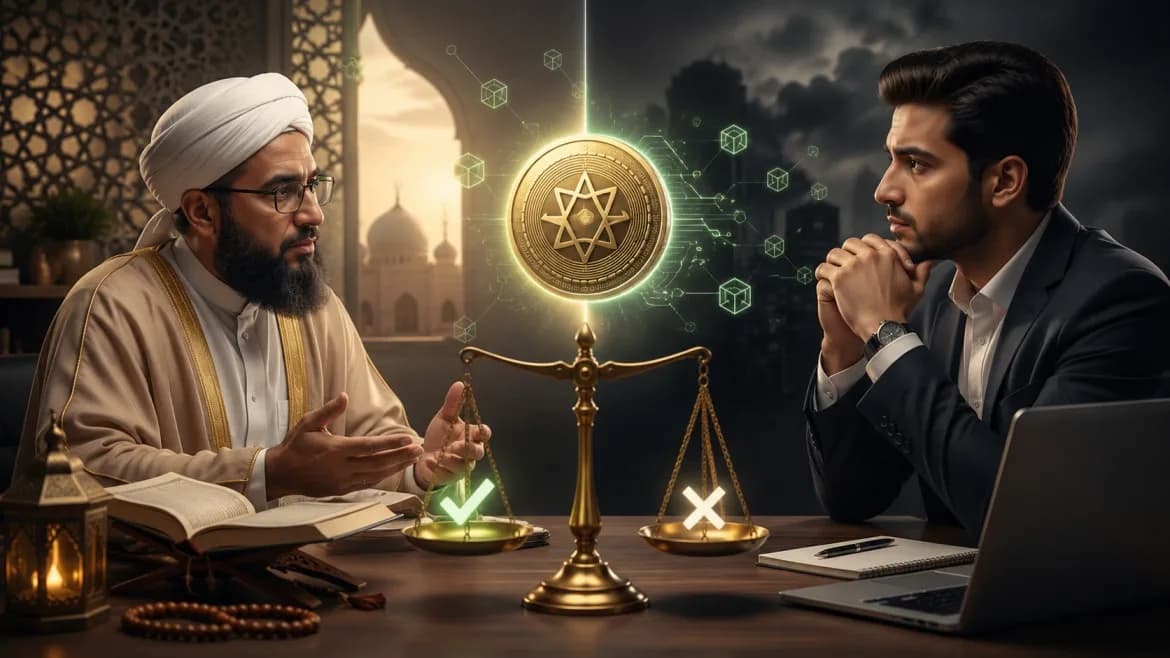
Pakistan's digital assets landscape now sits at an uneasy intersection of finance and faith. The question is no longer simply whether cryptocurrency is halal or haram. It has evolved into something more nuanced: can every digital token really be judged by the same yardstick? Bilal bin Saqib, Chairman of the Pakistan Virtual Assets Regulatory Authority (PVARA), has put that very question to the country's most influential religious institution, Jamia Darul Uloom Karachi, and the answer remains pending.
The Fatwa: What Was Decided on June 10
The controversy traces back to June 10, 2026 (24 Zilhaj 1447 AH), when the Darul Ifta at Jamia Darul Uloom Karachi issued a religious ruling. The fatwa was signed by Mufti Muhammad Taqi Usmani, a former judge of the Federal Shariat Court, along with five other prominent scholars. It was issued in response to a query about whether crypto tokens, including USDT, could be used to purchase books and online courses.
The verdict was unambiguous: buying goods or services with cryptocurrency is not permissible. The ruling was grounded in the finding that, based on available research and expert opinion, cryptocurrency does not meet the Shariah definition of "maal" (wealth). It was characterized as nothing more than the recording of fictitious numbers in an account, an entity with no tangible, real world existence.
The ruling landed at a moment when Pakistan ranks among the world's largest retail crypto markets, and the government has been moving rapidly to build out a formal regulatory framework for digital assets.
PVARA's Response: Not All Tokens Are Created Equal
Rather than treating the fatwa as a collision course, Bilal bin Saqib reached out to Mufti Taqi Usmani directly, describing the resulting meeting as a "constructive discussion." Both sides, he said, agreed on one central objective: protecting Pakistanis from fraud, exploitation, and financial harm.
But Saqib was equally clear that digital assets "should not be judged through a single lens." According to him, the fatwa raises exactly the right question, whether a digital asset qualifies as recognised wealth under Shariah, but the answer, he argues, depends on the nature of each individual instrument, not the category as a whole.
Sukuk, Gold Backed Tokens, and Stablecoins: Where the Line Is Drawn
Blockchain recorded sukuk: These represent ownership of a real, income generating asset, functioning the same way traditional Islamic bonds do.
Gold backed tokens: These carry an enforceable claim on something tangible and redeemable.
Fully reserved stablecoins: Similarly tied to real reserves, placing them in a different Shariah category from purely speculative assets.
At the same time, Saqib acknowledged that cryptocurrencies with no underlying real asset, those driven purely by speculation, deserve to have the scholars' concerns taken seriously, not dismissed.
He also stressed a distinction that's often blurred in public debate: blockchain itself is not a financial asset. It is simply a record keeping and transaction verification technology. The technology and the asset that may sit on top of it, he noted, are two entirely different things.
The Regulatory Backdrop: The Virtual Assets Act and PVARA's Role
This isn't just an academic dispute. It has direct implications for the regulatory framework Pakistan is building. Parliament passed the Virtual Assets Act in March this year, giving PVARA status as a permanent federal regulator with the authority to license exchanges, custodians, and token issuers. Any firm seeking a license must ensure Shariah compliance under the oversight of a committee of Islamic finance scholars.
That's the context behind Saqib's statement that PVARA will continue working with religious scholars on Pakistan's crypto licensing framework, stablecoins, and real world asset tokenisation. In his view, Pakistan has a genuine opportunity to lead the world in Shariah compliant digital finance, but only through sustained cooperation between regulators and religious authorities.
What Does This Mean for the Market?
Waqas Ghani, head of research at JS Global Capital, believes the fatwa's biggest impact could be on bank led crypto adoption, particularly among people outside Pakistan's established urban trading community. In his assessment, the ruling could become a genuine hurdle to bringing crypto into the mainstream financial system.
That said, he was equally clear that crypto trading volumes have shown no noticeable change so far. In other words, retail activity, at least in the short term, doesn't appear to be reacting to the fatwa. The longer term picture for institutional adoption and regulatory momentum, however, remains far less certain.
The Diplomatic Dimension
Pakistan's crypto policy isn't purely a domestic matter anymore. It has taken on a diplomatic dimension too. The country has struck a deal with an affiliate of World Liberty Financial, the crypto venture tied to US President Donald Trump's family, to explore using its USD1 stablecoin for cross border payments, part of what Islamabad calls its "crypto diplomacy." Against that backdrop, getting the domestic Shariah question right carries added weight: any framework Pakistan builds needs to be ideologically sound at home, not just regulatory friendly abroad.
What Happens Next?
As of now, Jamia Darul Uloom Karachi has not issued a formal response to PVARA's request. The real question is whether the coming months will produce a new, category based Shariah framework that separates asset backed tokens from speculative crypto, or whether the existing fatwa will stand as is, potentially affecting the timeline for licensing Pakistan's crypto exchanges.
Whichever direction it takes, one thing is clear: the future of digital assets in Pakistan is no longer just a matter of technology or regulation. It has become a debate where jurisprudence, finance, and public policy all converge.
FAQs: Everything You Need to Know About Crypto and Shariah in Pakistan
1. Is using cryptocurrency illegal in Pakistan?
No. The fatwa is a religious ruling, not a legal ban. Under the Virtual Assets Act, PVARA is actively regulating and licensing crypto exchanges, meaning crypto activity is becoming legally recognised, even as its Shariah status remains under debate.
2. What exactly does Mufti Taqi Usmani's fatwa say?
The fatwa states that cryptocurrency does not meet the Shariah definition of "maal" (wealth), and therefore purchasing goods with crypto is not permissible. It describes crypto as merely a record of numbers in an account rather than a real asset.
3. Is all cryptocurrency considered haram?
According to both the fatwa and PVARA, the answer depends on the category. Purely speculative tokens with no underlying asset are where the scholars' concerns are most serious. But instruments like gold backed tokens, fully reserved stablecoins, and blockchain recorded sukuk may carry a different Shariah status because they're tied to real, redeemable assets.
4. What has PVARA done in response to the fatwa?
PVARA Chairman Bilal bin Saqib has formally asked Jamia Darul Uloom Karachi to draw a clear distinction between speculative cryptocurrencies and asset backed digital tokens, so the regulatory framework can be shaped accordingly.
5. Has the fatwa affected crypto trading in Pakistan?
According to financial analysts, trading volumes have shown no significant change so far. However, it could pose a challenge to broader, bank led crypto adoption, especially outside Pakistan's urban trading community.
6. What's the difference between asset backed digital tokens and speculative crypto?
Asset backed tokens, such as gold backed tokens or sukuk, are tied to a real, tangible asset against which a legal claim can be enforced. Speculative crypto, like most actively traded coins, is driven purely by market price movements, with no underlying asset backing it.
Article Details
Category: Business
Published: 20 July 2026
Time: 6:03 pm
Updated: 20 July 2026 at 10:22 pm
Author: Abdullah
More Stories