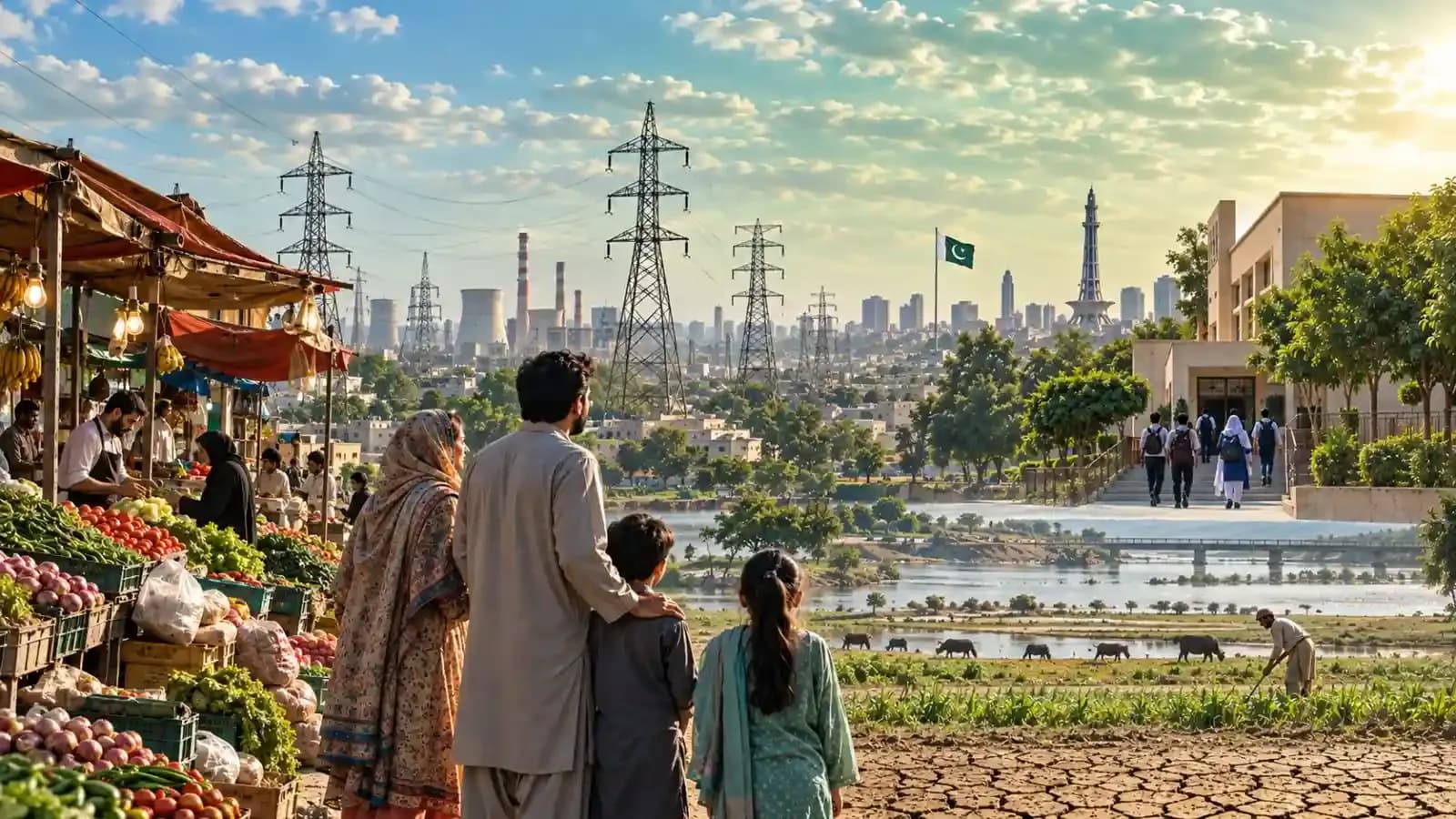
Pakistan’s biggest challenges in 2026 are not moving on separate tracks. Cost of living, energy, education, and water security influence each other and together they shape household budgets, business costs, skills, food security, and long-term growth.
For broader verified updates across the country, follow our Pakistan news today
Pakistan’s Four Challenges at a Glance
The four issues below are different, but pressure in one area can quickly spill into the others.
Challenge | Why It Matters | What It Can Affect |
Cost of living | Prices reduce purchasing power | Food, transport, savings, household choices |
Electricity & energy | Power costs feed into homes and businesses | Bills, production costs, competitiveness |
Education & human capital | Skills determine future productivity | Jobs, incomes, innovation, social mobility |
Water & climate security | Weather and water shocks hit essential systems | Agriculture, food, cities, infrastructure |
1. Cost of Living and Economic Pressure
Pakistan Bureau of Statistics reported national CPI inflation of 11.15% year-on-year in August 2026, compared with 3.06% in August 2025. Inflation does not mean every price rises at the same rate, but it does show that the overall cost of a typical basket of goods and services is increasing.
For households, the effect is practical: food, transport, utilities, rent and other recurring expenses compete for the same income. For businesses, higher input and transport costs can also influence the final price of goods and services.
Fuel is one visible part of that pressure. See our petrol price and tax breakdown for a closer look at the components behind retail petrol prices.
Why Economic Pressure Spreads Beyond Household Budgets
When families spend more on essentials, they may have less room for savings, education, healthcare or discretionary purchases. At the same time, firms facing higher energy, fuel or financing costs can delay investment or pass part of those costs through to consumers. That is why the cost-of-living problem is closely linked with the energy challenge.
2. Electricity and Energy
Electricity affects almost every part of economic life. A high or unpredictable power bill matters to a household, but it also matters to a shop, factory, school, hospital and digital business. In 2026, NEPRA continued issuing fuel-charge and periodic tariff adjustments, showing how consumer electricity costs remain connected to generation costs and sector-wide financial decisions.
Pakistan is also trying to reduce exposure to imported energy risks by increasing the role of domestic energy resources.
The Challenge Is Bigger Than Generating More Power
Energy affordability and sector sustainability have to be viewed together. Generation costs, grid losses, fuel prices, capacity payments, transmission investment, efficiency and bill recovery can all influence the final burden on consumers. Demand-side efficiency can matter too.
One example is the government’s energy-efficient fan scheme, which focuses on reducing household electricity use through more efficient appliances.
3. Education and Human Capital
Education is not only an enrollment issue. UNICEF currently estimates that 25.1 million children aged 5–16 are out of school, representing about 35% of children in that age group. For students who are in the system, learning quality, teacher development, digital access and career-relevant skills remain equally important.
Students planning higher education can use our university admissions in Pakistan guide to understand tests, merit and deadlines.
Career choice matters as well; our guide to the best degrees after FSc, ICS and I.Com compares major study paths and job directions.
Human Capital Is Ultimately a Jobs Question
A young population becomes an economic advantage when people leave school or university with usable literacy, numeracy, technical, digital and communication skills. The challenge is therefore both access and outcomes: getting children into education, keeping them there, and helping them build capabilities that match a changing labour market.
For students whose finances are a barrier, explore scholarships for Pakistani students.
4. Water and Climate Security
Pakistan’s water challenge sits at the intersection of population growth, agriculture, urban demand, rainfall variability, floods, heat and long-term climate risk. Water shortages can reduce agricultural output, while extreme rainfall can damage crops, homes, roads and public infrastructure. Both outcomes can feed back into food prices and fiscal pressure.
The scale of the resilience challenge is also financial. Read our report on Pakistan’s climate finance needs.
Recent weather alerts also show how quickly climate risk can become a public-safety issue; see our coverage of Pakistan rain and flood risks.
The Indus Waters Treaty Adds a Cross-Border Dimension
Water security also has a legal and diplomatic dimension. On 31 August 2026, the Permanent Court of Arbitration said the Indus Waters Treaty remained in force and set interim limits related to the Ratle hydropower project.
India rejected the tribunal’s jurisdiction and said the ruling would not affect its actions. Pakistan’s Foreign Office welcomed the award on 2 September. The disagreement means treaty implementation remains an active issue alongside Pakistan’s domestic water-management and climate challenges.
How the Four Challenges Connect
These issues are best understood as a system rather than four separate headlines:
Economy and Energy: higher power and fuel costs can raise business and household expenses.
Economy and Education: financial pressure can make education costs harder to absorb, while weak skills can hold back productivity and incomes.
Water & Climate and Economy: floods, droughts and heat can damage crops, infrastructure and livelihoods, creating new price and budget pressures.
Energy and Water: power generation, irrigation, pumping and urban water systems all depend on infrastructure and resource planning.
How Progress Can Be Tracked
No single statistic can show whether Pakistan is improving across all four areas. A more useful picture comes from watching several indicators together:
Cost of living: inflation, real household incomes and the cost of essential goods and services.
Energy: consumer tariffs, system losses, reliability, fuel mix and sector financial performance.
Education: enrollment, out-of-school children, learning outcomes, completion rates and employable skills.
Water & climate: water availability, irrigation efficiency, disaster losses, urban resilience and adaptation investment.
Frequently Asked Questions
Q: What are Pakistan’s four biggest challenges in this article?
This explainer focuses on cost of living and economic pressure, electricity and energy, education and human capital, and water and climate security.
Q: Was Pakistan’s inflation really 11.15% in August 2026?
Yes. Pakistan Bureau of Statistics reported national CPI inflation at 11.15% year-on-year for August 2026.
Q: Why is electricity treated as an economic issue?
Electricity is an input for homes, shops, services and industry. Changes in energy costs can therefore affect household bills, production costs and prices across the economy.
Q: How large is Pakistan’s out-of-school challenge?
UNICEF estimates that 25.1 million children aged 5–16 are out of school, about 35% of the population in that age group.
Q: What is the current position on the Indus Waters Treaty?
The Permanent Court of Arbitration said in August 2026 that the treaty remains in force. India rejected the tribunal’s jurisdiction, while Pakistan welcomed the award. The dispute therefore remains active.
Q: Are these four problems separate from each other?
No. They interact through household budgets, business costs, skills, agriculture, infrastructure and public finances, so pressure in one area can create pressure in another.
Keep Following the Issues That Shape Pakistan
Pakistan’s economic, energy, education and climate picture changes as new data and policy decisions emerge. Follow PehlePakistan for fact-based explainers and use our latest Pakistan news hub for ongoing updates.
Article Details
Category: Pakistan
Published:
Author: Usama Haider
More Stories