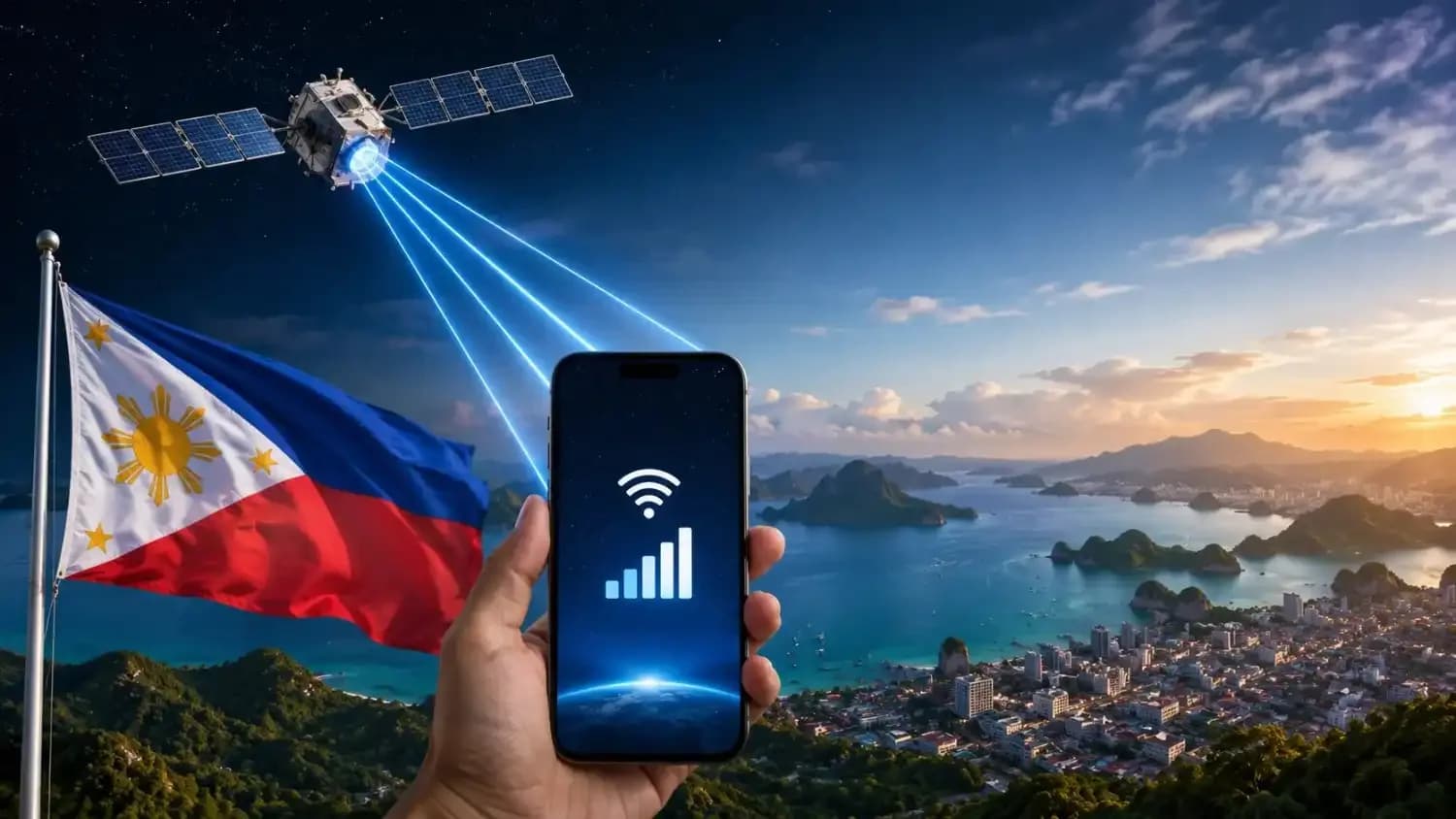
The Philippines has become the first country in Southeast Asia to launch a commercial satellite-to-phone service. Globe Telecom started the Starlink Direct-to-Cell service after getting nationwide approval from the National Telecommunications Commission (NTC). It allows ordinary smartphones to connect directly to satellites in areas with no mobile tower coverage.
The service works without a dish, special phone, or separate satellite subscription. Compatible Android LTE phones with an active Globe SIM connect automatically to Starlink’s network of over 650 low-Earth orbit satellites, giving access to SMS, calls, messaging apps, navigation and mobile data.
It runs on satellite roaming, so users are not charged extra roaming fees. The Philippines has more than 7,000 islands, and around 4% of Filipinos still have no mobile network access, which this service aims to cover.
The technology was already used during a real emergency. After a magnitude 7.8 earthquake struck South Cotabato, Sultan Kudarat and Sarangani in June, it supported communication for more than 150,000 subscribers in the affected areas.
Globe President and CEO Carl Cruz said the launch allows the company to extend coverage beyond regular towers and keep people connected in remote and disaster-hit areas.
The partnership between Globe and Starlink was signed in February. Starlink has named the Philippines and Indonesia as key markets for expanding its 4G/LTE coverage.
Separately, China’s Spacesail recently completed the country’s first direct-to-cell voice calls using regular smartphones, with no hardware changes needed. The company said voice quality matched terrestrial 5G networks.
This differs from earlier satellite calling on Huawei and Xiaomi phones since 2024, which used Tiantong-1, a satellite operated by China Telecom. Spacesail had 162 satellites in orbit by mid-May, compared to Starlink’s roughly 9,600 satellites as of March 2026, which served 10.3 million subscribers across 164 countries.
In the region, Japan’s NTT Docomo plans to launch its own direct-to-cell service in early fiscal year 2026, while Rakuten is targeting late 2026 with AST SpaceMobile.
Juniper Research analyst Alex Webb said subscription-based direct-to-cell services will likely remain a niche market over the next five years, though operators may use it to make regular plans more attractive.
Indonesia is already on Starlink’s shortlist for expansion, while Malaysia has not yet announced a similar move.
Source: [telecomstechnews]
Article Details
Category: Telecom
Published:
Updated:
Author: Usama Haider
More Stories